
Interview with Kseniia Oliinyk
Hello Kseniia Oliinyk! We're so
pleased to have you. To start, please tell us about your journey and
background. We're particularly interested to know if your passion
for art began in childhood, and if there were any individuals who
particularly inspired you along the way. Hello! Yes, my passion for art really began in my early
childhood. The walls in my room were always covered with my
drawings. I attended art school even before I started regular
school. Then, at the age of 14, when I saw the show “Miami Ink”
especially Kat Von D, I realized that tattooing combined two things
I was passionate about: art and medicine. At that time, I had just
enrolled in a medical academy to study nursing. That’s when I
decided that tattooing would become my life’s work.
Q: How long did your initial learning phase last, and what
kind of guidance did you receive, was it through formal education, a
mentor, or perhaps a combination?
A: My initial learning phase was with a tattoo artist from a nearby
town. I went to his lessons only two or three times. He showed me
the basic fundamentals, after which I continued learning on my own.
I also took a short course in a local studio where I was living at
the time. However, I didn’t gain much practical skill from it, it
was mostly focused on tattoo design. My second teacher didn’t
believe in me. He said I would never become a real tattoo artist
because, in his eyes, I was still a kid. So I kept learning
independently. Later, when I began earning from tattooing, I started
attending various masterclasses and conferences. And to this day, I
continue learning.
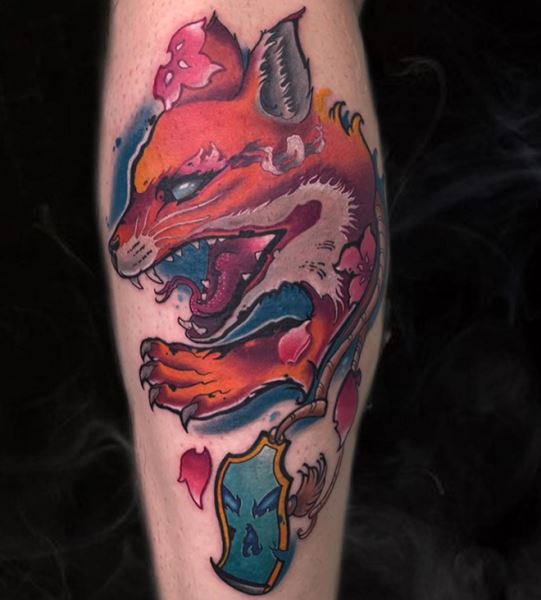
Q: When tattooing came into the picture?
A: I began tattooing clients at fourteen. My first tattoo was a
blackwork sleeve for my first teacher. During the first lesson, he
gave me a machine, ink, and paper towels, and told me to start
tattooing. I was a bit shocked, but I managed. After that, I
immediately fell in love with color tattoos and began focusing on
them. Initially, I explored the New School style, and later I grew
fond of Neo-Traditional. I continued developing within it. Now I
create illustrative tattoos, mixing different styles, watercolor,
abstraction, thick black lines. I combine whip shading, realism,
cartoon elements. I’m still searching for my own style. It took me
about 5–6 years to feel truly confident, because learning from
online videos and tattooing once a month is quite challenging. I
tattooed real skin from the start, because at that time there
weren’t many options for synthetic skin. My friends volunteered and
I practiced on them. We later improved those tattoos, and I’m very
glad I could fix my early work.
Q: Could you tell us about the point you transitioned into a
professional tattoo studio? What was that initial experience like,
and what stands out from that time?
A: In 2016, I joined a real professional tattoo studio for the first
time. It wasn’t completely new to me, because I had already set up a
home studio, couch, lights, tables, everything. So I didn’t feel a
major difference. Even in my home studio, I approached it
professionally, like a medical professional. I already had good
communication skills with clients, so the transition was smooth.
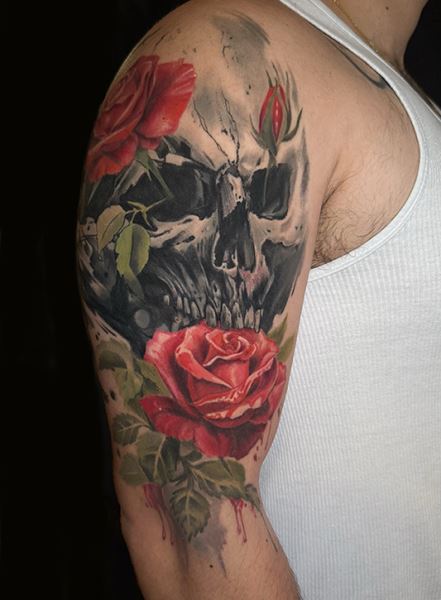
Q: It's great that you're so versatile with different tattoo
styles, catering to both color and black and grey preferences. Are
there certain designs or styles that you find yourself most drawn
to, or enjoy working on more than others?
A: I really enjoy working with realistic and surrealistic images and
combining them with black abstraction, elements that resemble waves
or ink blurs.
Q: Tell us about your custom design process. Do you
typically prepare sketches in advance, or is the design a
collaborative effort finalized during the appointment?
A: My process usually begins with a consultation meeting, where we
discuss the placement, ideas, and references to clarify the vision.
Then I create a quick but informative design on a tablet in front of
the client and place it on a 3D model. After that, I finish the
sketch on my own and agree on it with the client. We can fine-tune
the sketch for as long as needed to reach the best result.
Sometimes, for abstract designs, I can’t prepare a sketch in
advance, so I work freehand directly on the skin. That’s probably my
favorite part, drawing on the client’s skin with a brush,
integrating the design into the body’s anatomy, so it looks amazing.
Q: Given the demands of consistently delivering
high-quality, custom work, are there occasions when you experience
creative blocks or encounter challenges in meeting client
expectations?
A: Yes, creative blocks happen. Inspiration doesn’t always come when
you need it. That’s why sketching isn’t just about inspiration, it’s
about discipline and work. I’m always willing to find the best
solution for a client and do what they want. But I never sacrifice
important aspects like size, placement, or detail for the sake of
their desires. These factors affect how a tattoo will age in 5–10
years. I also understand that a client’s expectations don’t always
match what is possible, skin isn’t paper, after all. But I always
aim to find a compromise and create something that looks great and
interesting.
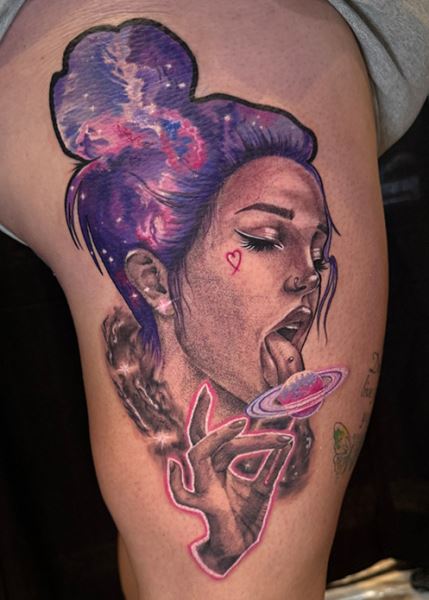
Q: Witnessing such personal moments during the tattooing
process must be incredibly meaningful. Could you share a
particularly impactful or memorable experience you've had with a
client?
A: Recently, a client came to me with a very difficult life story. I
even cried reading it because I felt so sorry that such a wonderful
person might soon lose loved ones. But it was a story of love, and
we created a tattoo that reflected all their wishes. This tattoo now
carries immense power, pain, joy, and happiness, the freedom they
had longed for and the love they dreamed of. It was very touching
and meaningful to help someone share such personal and beautiful
history. Especially when a client says, “This is my story, depict it
as you see it,” and then we look at each other, both feeling happy,
hugging, celebrating together. Being able to see the happiness in my
clients’ eyes after a session is simply priceless.
Q: With so many resources available today, from online
tutorials and workshops to conventions and guest spots, it seems
like there are more avenues than ever for aspiring tattoo artists.
Do you feel this increased accessibility has made it easier to break
into the field?
A: Nowadays, aspiring tattoo artists have many resources: quality
equipment, many artists willing to teach beginners, workshops,
festivals, conferences, video lessons, etc. But because there are so
many artists now, the industry feels somewhat oversaturated, and
finding a place to stand out is harder. For an entry-level artist,
though, it’s definitely much easier than 15 years ago.
Q: Setting aside artistic skill, what other attributes do
you consider most important in an artist?
A: I believe the most important attribute for a tattoo artist is
precision. Yes, precision. Because careful work and adherence to
safety protocols are crucial for the health and well-being of both
the artist and the client.
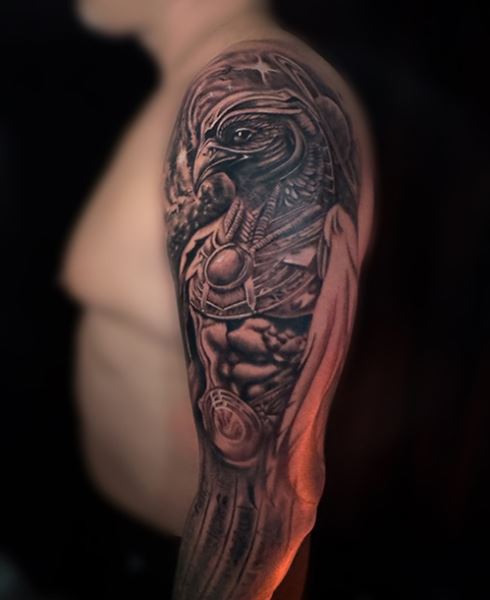
Q: Having experienced both, what notable distinctions do you
observe between the Ukrainian and American tattoo industries?
A: The main difference between the Ukrainian and American tattoo
scenes, in my view, is the dedication to certain styles. Here, I see
a lot of people loving old-school tattoos, while in Ukraine it tends
to be more graphic-oriented. For black-and-white work, design themes
differ across cultures, although color tattoos are quite similar
overall.
Q: Could you tell us about your time in the U.S. and what
your impressions of living here have been?
A: I currently love working in the U.S. because people here seem
more open to my ideas. I love being able to travel to tattoo
festivals across the country, it’s amazing. Life in the U.S. is
completely different. It’s complicated and full of nuances due to a
different system. It’s difficult at times, but I know I’ll figure it
out, this isn’t my first move in recent years, so if I'm confident
it will be ok.
Q: Do you envision yourself staying in the U.S. long-term
for your career?
A: Yes, I would love to open a tattoo studio, maybe several, here in
the U.S., and work as a guest piercing artist. I want to bring my
tutoring system here, because I haven’t seen such a system locally.
I really want aspiring artists to enter the industry as quickly as
possible, according to their abilities.
Q: How often do you attend tattoo conventions? In your
experience, how valuable are tattoo conventions for artistic growth
and building client relationships?
A: Conventions are extremely important for growth, you see other
artists, successful work, top professionals, and you can talk to
everyone, ask for advice, and learn about new products and
suppliers. It’s a great way to exchange information and enter the
community. If you stay locked in your studio working 24/7, you won’t
grow beyond your comfort zone. I attend conventions about every 2–3
months. I was invited as a judge at a tattoo convention in Chicago,
it was incredible, I had never seen so many tattoos in just a couple
hours. Conventions are also very important for building client
relationships because you show people that you’re growing, you can
bring something new in style, workflow, and conveniently ease
client’s discomfort during sessions. I recommend them strongly to
everyone.
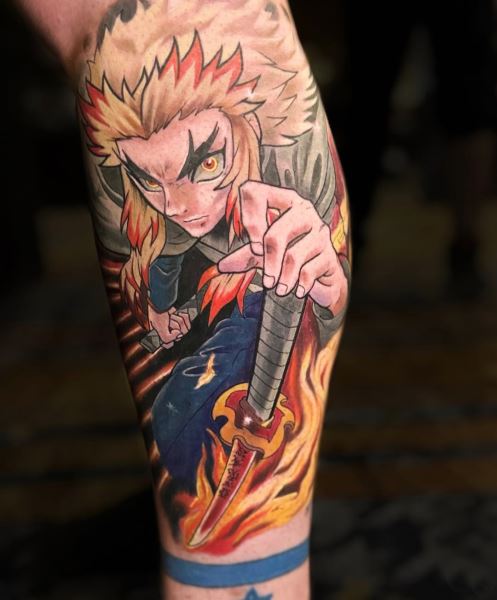
Q: Could you tell us which tattoo studio you're currently
with, and what your experience has been like?
A: I’m currently working in San Francisco at Black Serum. I love
that we have guest artists from all around the world sharing their
experience, it’s priceless.
Q: Please write down your studio location and website/social
media links.
A: Black Serum Tattoo Studio
310 Valencia St, San Francisco, CA, US
instagram.com/blkserum
instagram.com/storm_tattooart
Q: The American tattoo scene is undoubtedly vast and
dynamic, with constant innovation and high standards. In such a
competitive environment, what truly motivates you to stay on this
path and continue growing as an artist?
A: What motivates me most is that no one stands still, everybody
develops, learns something new, and reaches new heights. There are
many conventions and exhibitions where you can share your art with
the world.
Q: As you've experienced the American tattoo scene, have any
specific styles or cultural elements particularly resonated with
your artistic vision? If so, how might we see those influences
reflected in your future designs?
A: I can’t say that American culture has significantly influenced my
artistic vision, but I appreciate how open clients are here to new
styles and combinations 100%.
Q: Do you have any favorite American tattoo artists you
would like to work with in the future?
A: Unfortunately, I don’t know many American artists yet, but I’d
love to work with the Petunia Twins from Los Angeles, their bright
style and positive energy really attract me.

Q: Favorite career highlight?
A: The most significant moment, sadly, wasn’t a pleasant one, I had
to leave my home due to war, but it became a huge boost for my
development. I had to move around a lot and find new places. On the
bright side, I took part in my first tattoo festival in Kharkiv,
Ukraine, and instantly placed second in the Neotraditional category,
I’m very proud of that.
Q: What impact do you aspire to have on the tattoo
community?
A: I want to promote tattoo culture, create interesting and
accessible events for beginners so they can discover themselves
faster, and develop tattoo therapy for people with scars, maybe a
charitable project.
Q: Beyond your tattooing work, do you engage in any other
hobbies or creative pursuits that you find particularly fulfilling
or interesting?
A: I absolutely love riding motorcycles, doing Tarot readings,
painting in oil, and I used to play electric guitar. I wish I had
more time for my hobbies and family. Beyond tattooing, I’m a wife,
daughter, corgi mom, and friend. If I hadn’t become a tattoo artist,
I probably would have become a cardiac surgeon, I truly love
medicine.
Q: If you could go back and give your younger self advice
about pursuing tattooing, what would it be?
A: I would definitely say: “Honey, you’re doing great, you’re doing
everything right! Don’t be afraid to network, to approach studios
and offer your services as an artist. If someone told you you’re not
worthy, that’s not true!”
This interview was done by Magnus Karlsson on 12/07/2025


