
Interview with Andy Noir
Welcome, Andy Noir! We're thrilled to have you here. Thank you for joining us for this interview. To kick things off, we'd love to learn more about you and your background. Hello my name is Andrei. I’m 28 years old. I was born and raised in Russia. I've been drawing since I was a kid, but my parents sent me to hockey because I showed prospects in sports. When I grew up and it was time to choose to go to college, I didn't understand what profession I wanted to choose. One question helped me make the right choice: "what would I do in a world where there is no money?" after a couple of days of thinking about this question, I realized that I would draw. With this realization in mind, I tried to enroll in college as a subject designer, but I didn't have enough points for admission. After not joining the faculty, I did not stop drawing and studied with undergraduates, it helped me and practiced at home. By that time, I was already collecting tattoos on my body, and one day I thought about the fact that I wanted to try to make tattoos myself. I ordered a tattoo box for beginners with cheap supplies and machines. Of course, my first tattoos on people were terrible, but it only increased my interest and I started practicing more and buying new expensive equipment. At the moment, I have been doing tattoos for nine years and for me this time has passed like an instant, and the longer I do this, the more interested I’m in doing new bold projects.

Q: What art forms, apart from tattooing, fuel your creative
inspiration? And which artists do you find particularly influential?
A: I'm very inspired by music, especially the phonk genre. Music
helps me create the image and mood of the tattoo I want to create.
For me personally, artists who create new forms and compositions in
tattoos are more influential and authoritative. Something bold and
new always impresses me and can also inspire me.
Q: What marked the beginning of your tattooing career? And
how did your style evolve from your early days as a beginner?
A: I started studying on my own in my apartment when I was 18 years
old. I'm from a small town in Siberia, and at that time there were
two studios in the city that didn't take students or share
information about tattoos, so I experimented and practiced a lot. At
the beginning of my journey, I was inspired by color tattoos and it
captured all my attention. For the first two years I did all the
styles and studied techniques, after the next two years I did color
tattoos, after that I decided to change my style to black graphics,
then back to color tattooing... and again I changed my style to gray
wash realism (I was engaged in this style exclusively for commercial
purposes). A year and a half ago, I realized that tattooing had
become a routine for me and I stopped enjoying the process, so I
decided to remember my beginning and what attracted me to tattooing.
With this understanding, I decided that I had enough skills and the
time had come when I could do exactly what I liked, and I returned
to color tattooing and realized that this was my style.

Q: Your work displays a compelling fusion
of realism and surrealism. Could you elaborate on the creative
process and inspirations that drive this unique aesthetic?
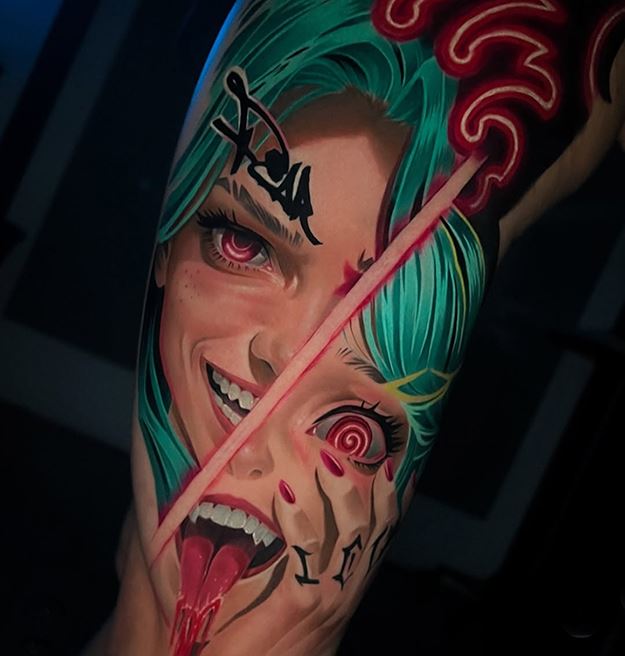
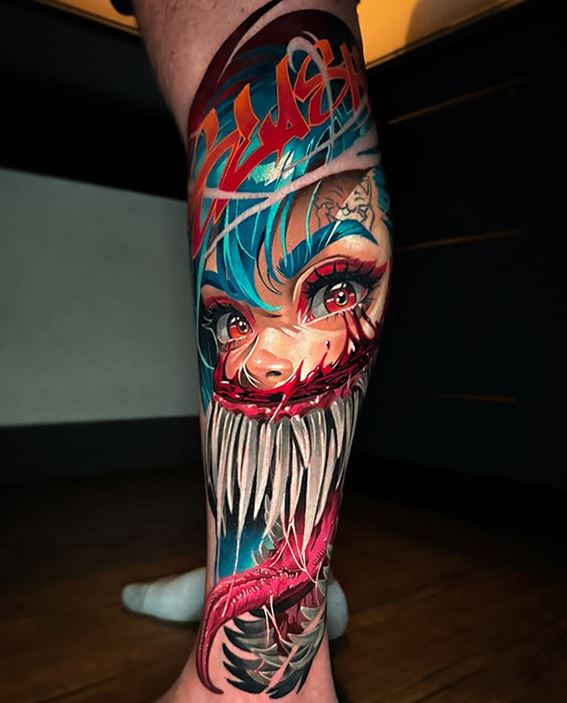
A: My basic style is color new school. I like this style, but I
didn't have enough details in the objects. I also like realism, you
can depict a lot of details in this style, but I have never liked
the boring composition of this style, which often does not harmonize
with the body of the person. One day, I was looking for references
in Pinterest in order to preserve the positions of faces and bodies
in space for future sketches, and realized that I had started saving
a lot of AI illustrations. One day, while redrawing another AI
reference, I realized that I spend an insanely long time on this
when someone creates these images in a couple of minutes. Losing my
temper, I immediately bought myself a powerful laptop and an AI
course and started creating my own designs using AI. As a result,
when I create the perfect reference for myself, I recycle it, change
its shape and add shadows and elements to the composition, and in
the end I get a cool illustration. (AI is a way to create the
perfect reference, the perfect design is only in your head. Without
basic knowledge of academic drawing, AI will not help.
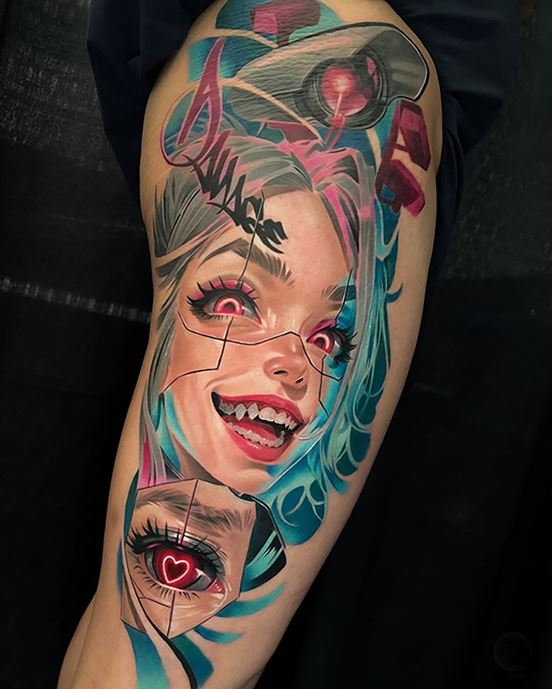
Q: The recurring motif of powerful, elegant, and darkly
romantic characters in your work is quite distinctive. Could you
speak to the interplay between your own artistic inspiration and the
preferences of your clientele in shaping these designs?
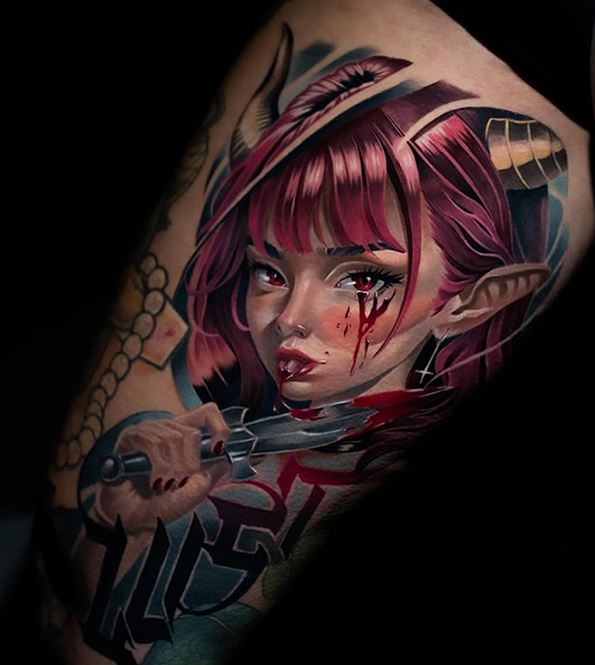
A: I like to depict vivid emotions in my portraits, as it helps to
convey the mood of the composition. I used to create free designs
and offer them to clients at a discount to create a portfolio. Now
my clients understand what they are coming for and ask me to create
something similar or even give me full creative freedom. I really
like portraits, and even if the tattoo is done perfectly with a cool
composition, an emotionless face makes it boring. That's why I
prefer to make them as emotional as possible.
Q: In addition to your personalized
designs, do you keep a library of preliminary sketches or design
ideas that clients might find helpful in visualizing their tattoo
concepts?
A: I usually make free designs with relatively popular characters
from games, movies, and comics. In this way, I try to reach out to
more clients and continue to create more interesting projects on a
particular topic.
Q: Your designs are truly captivating. Have you ever
considered expanding your creative work into other mediums, such as
a clothing line, skateboard designs, or perhaps an illustrated book?
A: I've really thought about it and I'm already in the process of
creating prints for T-shirts. There are prospects for new projects
and expansion into new areas, but tattooing remains a primary
importance.

Q: What recent project stands out as
particularly creatively fulfilling, perhaps one that presented
unique challenges but yielded a truly rewarding result?
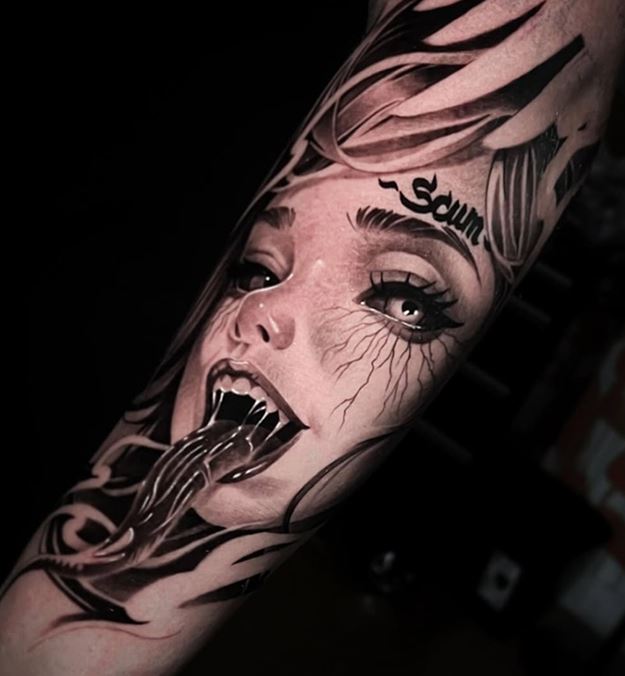
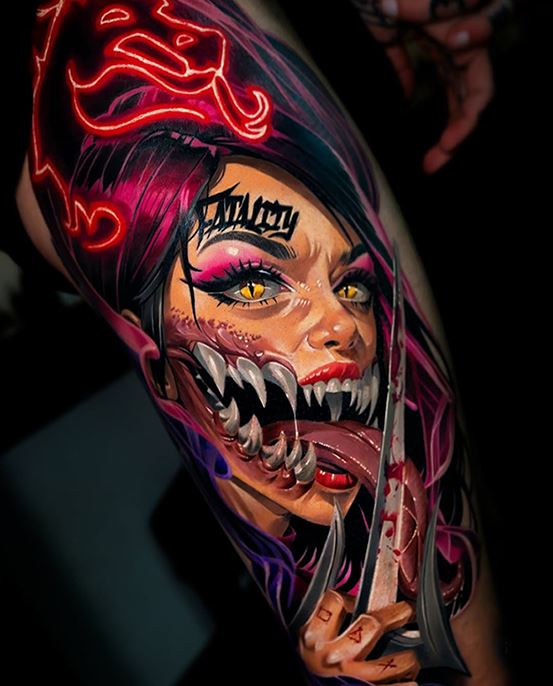
A: This is a project with Milena from Mortal Kombat. Working with
this project, I revealed the potential of my palette even more when
I needed to work with her tongue and gums. This experience helped me
understand the right combination of certain shades in order to get
as close as possible to the real shade of gums and tongue, which
used to be difficult for me.
Q: Reflecting on your journey thus far, could you pinpoint
the moment when you felt a significant increase in your confidence
as a tattoo artist? Furthermore, how do you perceive your ongoing
artistic growth and development?
A: I started growing up as a tattoo artist a year and a half ago
when I started combining my illustrations with AI and using more
daring solutions for my compositions. At the moment, I'm still
continuing my growth, looking for new combinations of shades and new
compositional solutions, as I don't like to repeat what I've done
before. I see it as a game and I try to enjoy the process.
Q: If granted complete creative freedom by
a client, what would be your ideal, most artistically fulfilling
tattoo project?
A: My latest tattoos are the result of complete creative freedom. I
always have a lot of interesting ideas and unusual solutions in
creating a design. Unfortunately, I can't use all the combinations
in one project, but I try to show something new in each work.
Q: Your color work is outstanding. How essential is a
comprehensive knowledge of ink usage and skin response in creating
such vibrant and well-executed color tattoos?
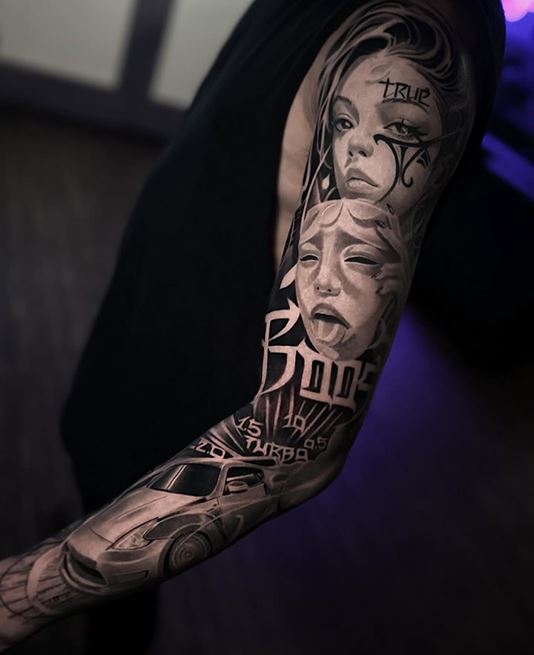
A: Of course, knowledge from the academic drawing and colorology
database is important. There is also an understanding of the harmony
of shades among themselves and which shades will help each other
create contrast. Practicing with skin and choosing the best ink
brands certainly plays an important role. I've had a lot of practice
and even now I don't stop trying new combinations and mixing shades
with each other.
Q: How fundamental do you believe strong
drawing skills are to the artistry of tattooing, considering its
unique technical demands?
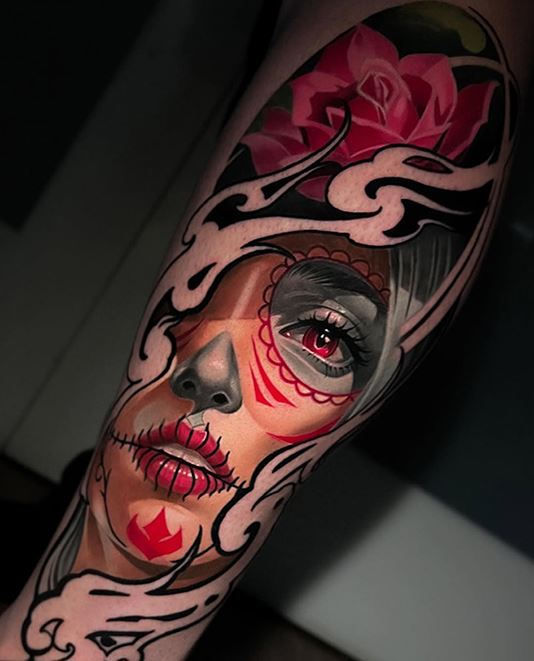
A: The beauty in tattooing is created by three basics, body design,
tattoo composition, and effects. Without drawing knowledge, it will
be very difficult to understand which size and shape of the design
will look better for certain parts of the body, which shapes will
interact better with each other in the composition and which effects
will be appropriate and which ones will be better suited for a
particular design. You can get tattoos without drawing knowledge,
but it will be impossible to create something unique, just repeat
finished images and make a lot of mistakes.
Q: Given your proven artistic ability,
have you ever explored the possibility of experimenting with
different tattoo styles, or blending them into your unique style?
A: Of course, there are such plans and I will integrate them. Now
it's difficult to surprise the audience by working in only one
direction, since in recent years a lot of talented guys have come to
the industry who are already creating a buzz and forcing famous
tattoo artists with long experience to rise up and do something new.
Q: Earning client trust requires both exceptional tattoo
skills and unwavering ethical behavior. A good reputation solidifies
this trust, guaranteeing clients a quality tattoo. What, in your
opinion, is the most effective way to maintain this crucial
reputation?
A: First of all, you need to be honest with the client, and if there
is a suspicion that the design and the idea will end up looking bad,
you should talk about it and show clients possible solutions on how
to make it better. It was a very pleasant experience when my client
came and told me that he wants to give me full creative freedom so I
could do anything. This inspired me a lot and made me believe in
myself and the preciousness of my style when I was just starting
out.
Q: As collaborative tattooing gains
popularity, are there any artists whose distinct style or approach
you find particularly compelling, and with whom you'd be interested
in exploring a shared creative venture?
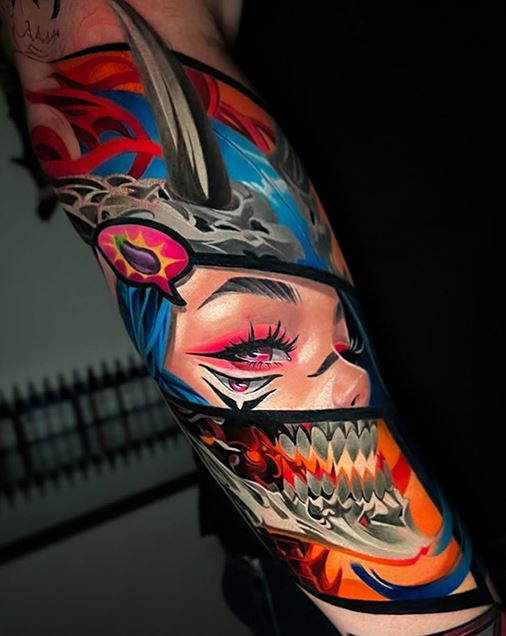
A: I like collaborations between artists with completely opposite
styles and when a composition is created that everything harmonizes
with each other. Of course, there are many artists with whom I would
like to collaborate, but I don't think it will be soon.
Q: What are your observations regarding the local tattoo
community? Are you witnessing any significant developments, such as
the rise of new artists, evolving styles, or innovative events?
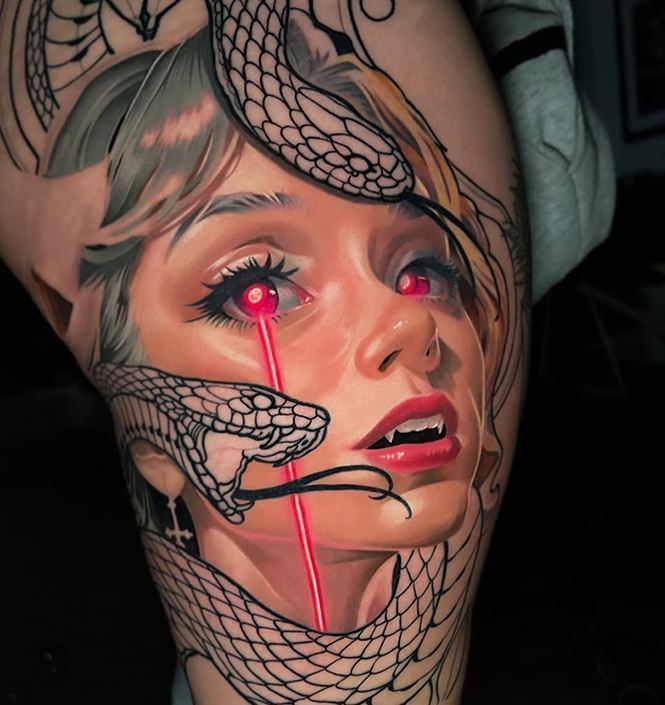
A: Of course, this is already happening! New and strong guys come to
the industry and create hustle and bustle in the industry. There are
many bold and interesting new solutions, and AI has made a special
contribution. This is definitely a cool new tool that has brought
new shapes and bold solutions to tattooing. At the moment, it is not
enough just to make good quality tattoos, now there is a competition
of designs and compositions, we need to work more with imagination,
combinations of styles and effects.
Q: To allow our audience to connect with
you, please provide your studio location, website, and social media
links. Finally, kindly let us know if you are currently accepting
new bookings.
A: My main messenger is instagram www.instagram.com/andynoirtattoo I
work in Canada in Kelowna, Don’t Look Down tattoo shop. I'm moving
to America in 2026 and will be working in San Francisco, NORTH
tattoo shop. My booking is open and all info about booking is at my
instagram main page.
Q: How has your passion for tattooing been sustained and
developed throughout your professional journey? Have you noticed a
consistent enthusiasm, or has it deepened and transformed with
experience?
A: I wanted to leave the industry many times because I didn't
understand exactly what I wanted and where I saw myself in the
industry, until I started asking myself the right questions and
setting clear goals for myself. I would like to share one of the
questions that made me progress. I asked myself, would I like to get
a tattoo from myself? At that time, I didn't want it, not because my
tattoos were bad, but because they didn't stand out and weren't as
attractive to people. Now I would be happy to get a tattoo on
myself, but it's unlikely to happen, anyway, it was an indicator
that I found the style that changed my attitude to the industry and
my work.
Q: Favorite career highlights? What are
your aspirations for the future of your artistic journey?
A: This is definitely a tattoo conventions. I love competing and
showing something new at tattoo shows. I like being in a competitive
state and forcing my brain to work faster and find new unusual
solutions. My plans are to continue traveling the world and
participate in any tattoo-related events and activities. Absolutely
the most enjoyable part of our profession is the opportunity to
travel and earn money that covers the cost of travel.
Q: If you could offer guidance to your younger self at the
start of your tattooing path, what essential advice would you
provide?
A: Move to a large city to reach more clients and communicate with
more tattoo artists, as well as draw more and spend more time
studying the drawing.


