
Interview with Armando Nasufi
Hello Armando Nasufi! First off, thank you for taking the time to speak with me. To start, can you tell us a little about your background before tattooing? What was the first thing that drew your eye to the world of art and led you to pick up a tattoo machine? As far back as I can remember, drawing has always been a part of my life. I was constantly sketching and experimenting, going through many different phases and styles, even before I knew where this path would eventually lead me. My first real connection with tattooing happened by chance, when I saw a stranger on the street with a full tattoo sleeve. I remember staring at it, wondering how someone could create something so powerful and alive on the human body. That moment marked my first real exposure to the world of tattooing. A few years later, while I was still in school, a classmate saw my drawings and asked me why I wasn’t pursuing tattooing. That question stayed with me and pushed me to take my art more seriously. From that point on, I started building a portfolio and, at the age of 15, I began visiting tattoo studios, asking for an apprenticeship. Even though no one accepted me due to my age, it never discouraged me. When I was 17, my brother gifted me a simple Chinese tattoo machine, just so I could start practicing. Not long after, I found my first person willing to trust me with a tattoo, and that was the moment I knew for sure this was what I wanted to do for the rest of my life.
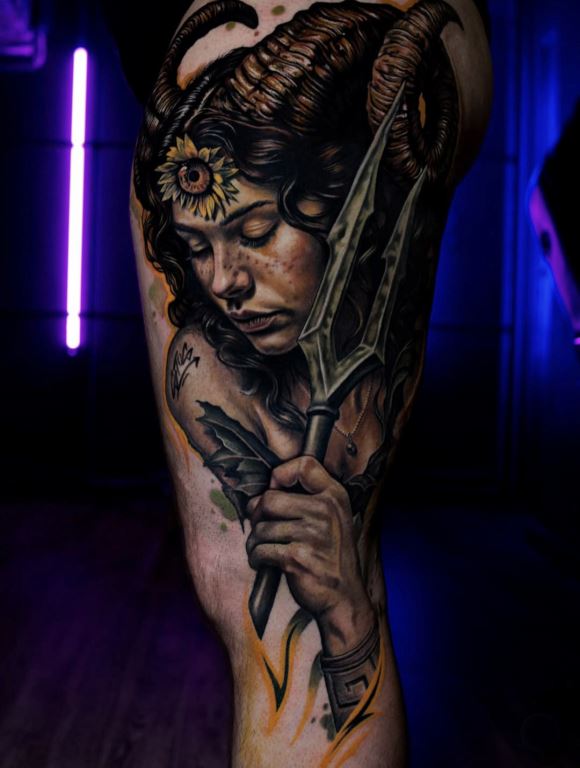
Q: Your portfolio shows incredible artistic skill,
especially with realism. Were you always an artist, even as a child?
What were your main mediums (drawing, painting, digital) before you
transitioned those skills into tattooing?
A: I’ve been drawing for as long as I can remember, and when I
decided to take tattooing seriously, I focused on developing my
skills across various artistic disciplines such as freehand drawing,
pencil realism, pen realism, color realism with colored pencils and
pen, oil painting, graffiti, dotwork, and more. I believe this broad
experience made the transition to tattooing much easier, as the
tattoo machine ultimately became just another tool I was already
trained to use.
Q: Tattooing is a challenging field to enter. What was your
ex perience like securing an apprenticeship or learning the ropes?
What was the most difficult skill you had to master in those early
days?
A: In the beginning, the journey was incredibly challenging. I
struggled to balance financial survival with my personal and
artistic growth, dedicating all of my time to improving my skills
while often working for free, without any stable income. At the same
time, I had to learn how to communicate professionally with clients,
constantly explore new techniques, and fight to discover my own
artistic identity. There were many moments of deep self-doubt,
questioning whether this was truly the path I was meant to follow.
The financial pressure pushed me to the edge of giving up more than
once, but in the end, my passion, perseverance, and love for this
craft were stronger than any obstacle. Because of this experience, I
truly believe that the most important skill to develop during this
stage is patience. I know it may sound like a general answer, but in
the beginning, what really matters is simply taking action,
creating, trying, and moving forward. Through doing, you gradually
learn what is worth continuing and what needs to be left behind.
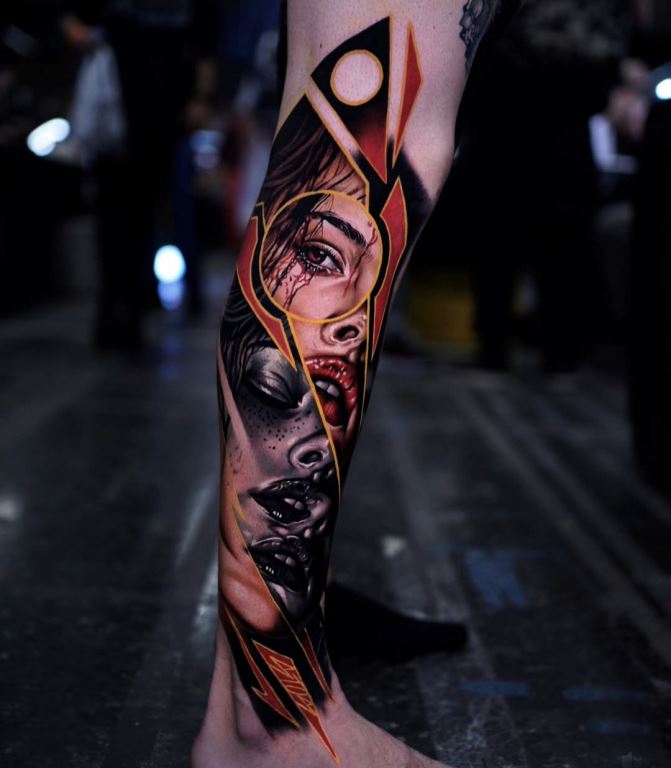
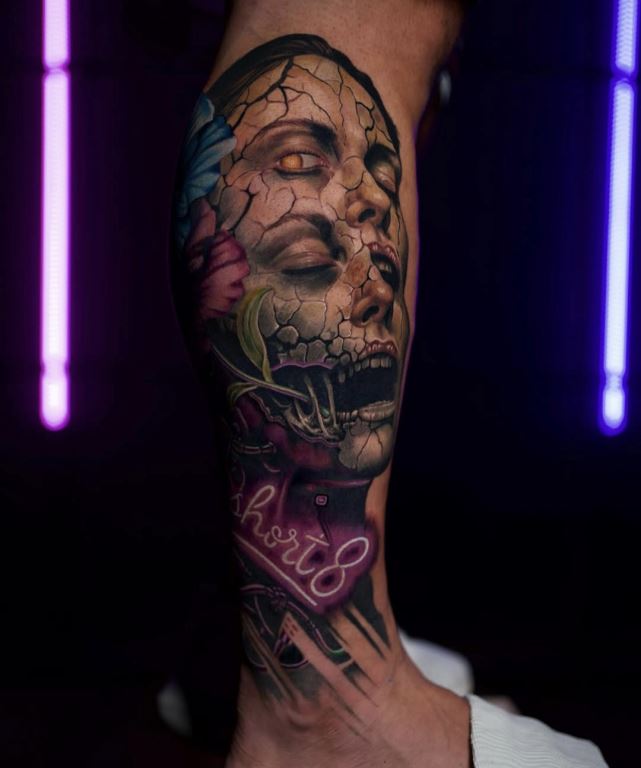
Q: Your realism work is phenomenal. What do you consider the
biggest secret to achieving that hyper-realistic depth and texture,
especially in large-scale portraits like the ones you've done of
famous figures?
A: As I mentioned before, trying to depict the same subject in many
different ways helped me develop my perception and find solutions
using whatever tools I had, and when it comes to portraits of
recognizable people, I believe the “secret” lies in preparation: if
you properly study and prepare your reference beforehand, all that’s
left is to copy it as accurately as possible.
Q: I notice you excel in both rich color realism and stark
B&G. How do you decide whether a design is better suited for color
or B&G?
A: I don’t make strict distinctions in terms of design. I try to
maintain a consistent aesthetic in both color and black and grey
work. Technically, however, my approach can vary significantly.
Overall, I aim to adapt each project to the client’s needs while
preserving my own aesthetic, whether the outcome is in color or
black and grey.
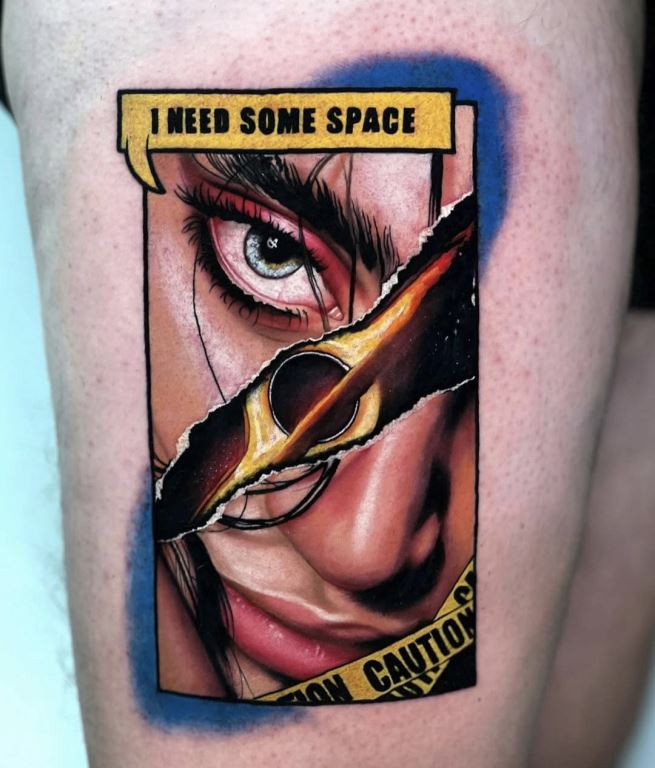
Q: Many of your pieces incorporate striking surreal or
abstract elements. What inspires you to blend traditional realism
with these more contemporary, graphic elements?
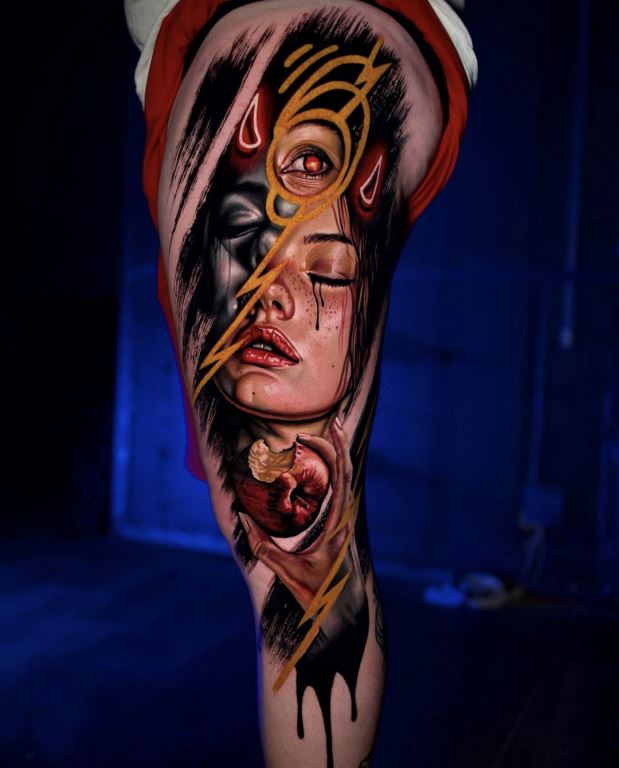
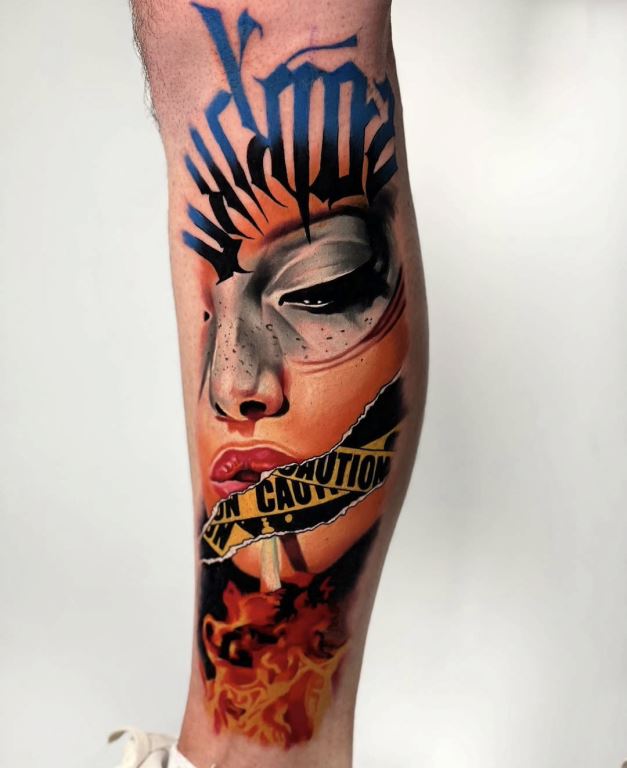
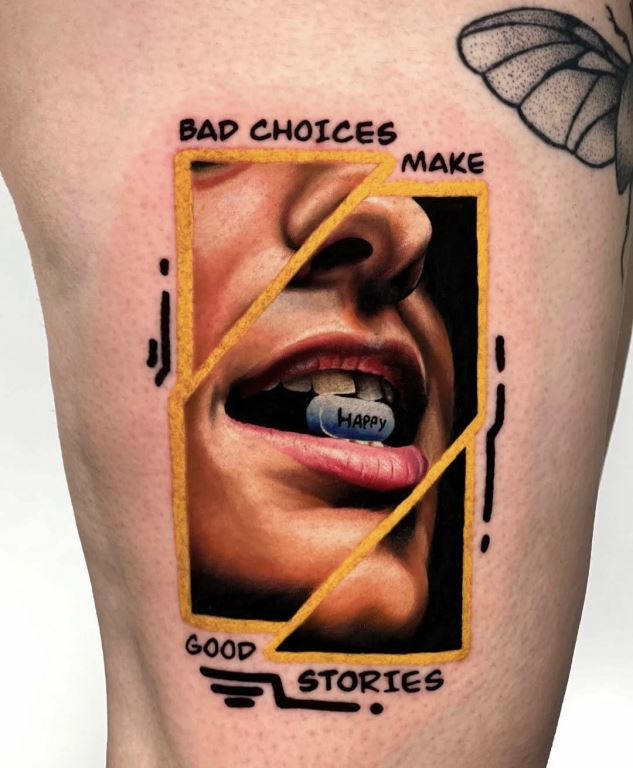
A: The way I create a design is shaped by my influences. This may
change in the future as I gain new influences, but for now I
maintain this aesthetic. My background in graphic design has played
an important role, as well as my experience with drawing since
childhood, which has influenced the way I think about design.
Additionally, yellow is one of my favorite colors, and I try to
incorporate it into my work whenever possible.
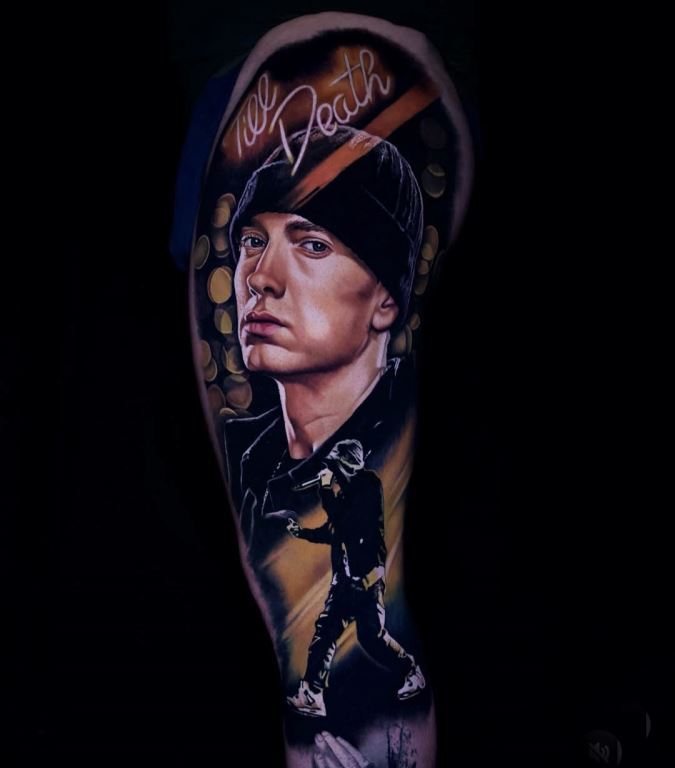
Q: Realism tattoos often require great patience from the
client and the artist. What does your creative process look like
when a client comes to you with an idea? How do you translate a
complex, photographic reference into a design that flows beautifully
with the muscle and movement of the body?
A: I usually prefer to create the design together with the client,
so we can review and adjust elements in real time, deciding what
should be added or removed in order to achieve the best possible
result. I also pay attention to whether the client is open to
suggestions, which allows me to incorporate my own aesthetic into
the design. This way, I can truly enjoy the creative process, while
the client receives something unique, something that reflects both
their vision and my personal style, leaving fully satisfied with the
final outcome.
Q: What is the most difficult color, texture, or element to
render accurately and make sure it heals well?
A: One of the most complex aspects of tattooing is accurately
rendering different textures, such as wood, metal, or water.
When it comes to the healing process, it is primarily determined by
the tattoo artist’s technical skill. If the technique is correct,
the choice of color is not a decisive factor. In many cases, the
placement on the body also plays an important role in how well a
tattoo heals. For example, the sole of the foot is a very poor area
for tattooing, as the skin there makes proper healing difficult.
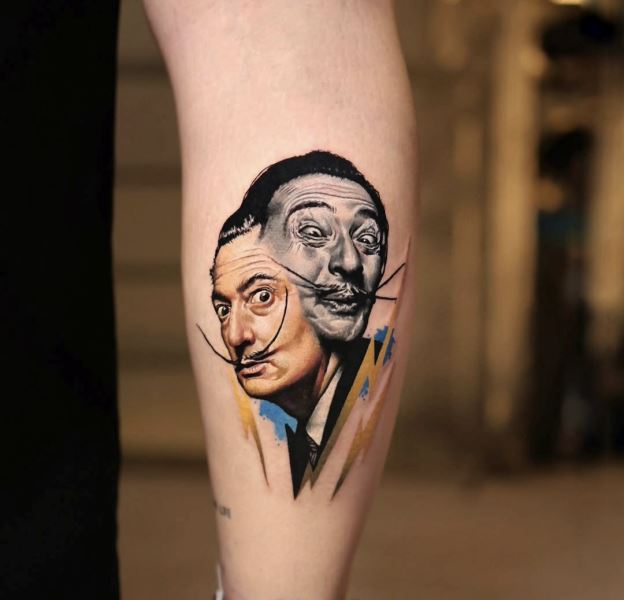
Q: What do you like the most about this beautiful blend of
realism and surrealism?
A: I’m drawn to the fusion of realism and surrealism because it
creates something unique and gives a true identity to my work. It’s
not just about copying a photograph, it’s about transforming it and
imprinting it onto the skin as art.
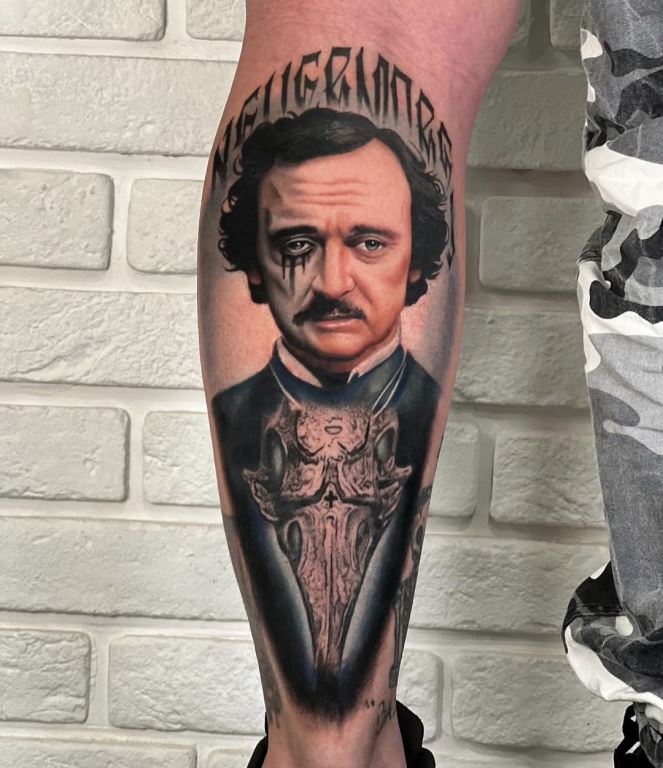
Q: Would you change something about your style?
A: I’ve always believed there would be something I’d want to
improve, by “improve,” I mean in a way that matches my own taste and
vision. I’ve always admired artists who work freehand, and my goal
is to eventually reach a level where I can create color or BnG
realistic freehand tattoos that are extremely difficult to
replicate. Using a specific palette or pattern can make a tattoo
feel unique and personal, but it can still be copied by others. My
ultimate goal is to reach a point in my career where my work can’t
be imitated. That’s where my mindset is right now… though who knows,
in two or three years, my goals might change.
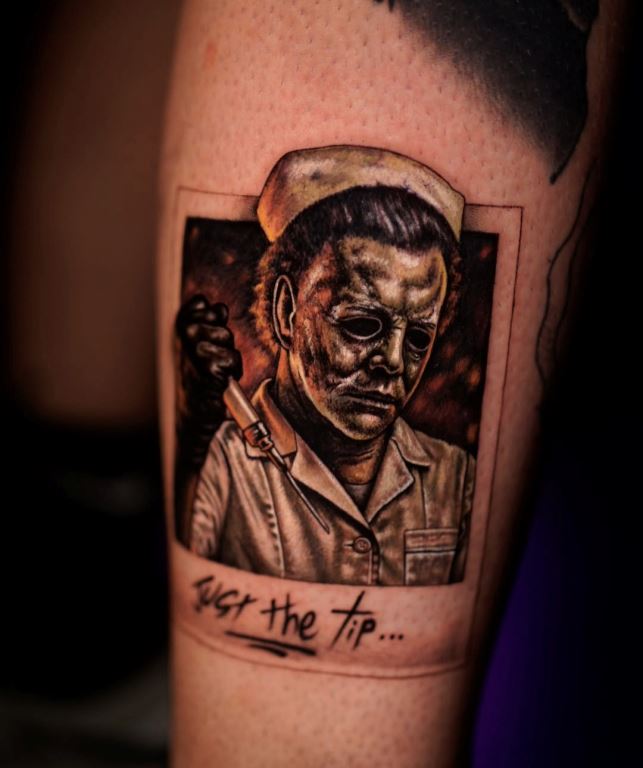
Q: That Michael Myers tattoo! Favorite! Who came up with the
design? I bet you have many creative clients and days spent on the
studio are full of fun. Any favorite stories you would like to share
with us?
A: Thank you so much for your kind words! I truly enjoyed working on
this tattoo as well. The client wanted Michael Myers, and since he
works as a hospital nurse, I suggested adding a syringe… and he
loved the idea. I really appreciate clients who are open to ideas,
because in the end we always achieve the best possible result
together. I’m also very grateful to work at the studio I’m in now.
We’re all like a family, and it genuinely feels like home. Our
studio is called Bloody Cherry: the first shop opened in
Thessaloniki, the second in Athens, which is now my base. What makes
it special is that we all met by chance in Mykonos, instantly
connected as a group, and not long after, the Athens shop opened
with all of us working together. It all feels so coincidental that I
see it as a sign, this is my team, and this is the path I’m meant to
follow with them.
Q: Your work is clearly in high demand. How do you manage
the balance between your booked schedule and the need to constantly
evolve your skill set? Do you set aside dedicated time for drawing,
painting, or planning outside of client sessions?
A: To grow, you need personal time. Personally, I believe it’s not
about how many hours you put into something, but about the quality
of those hours. I don’t believe in talent. The more time you spend
on something, the better you get, but if you do it all day, every
day, you eventually burn out. Even your favorite food, if you eat it
nonstop, will get boring at some point. That’s why changing stimuli
is necessary. For me, what matters most is spending quality time
when I’m tattooing, while also having something outside of it. A
hobby helps you clear your mind and take in different influences,
and over time those influences shape both your work and the way you
think. A hobby can be anything. Drawing definitely helps directly,
but at the end of the day, the brain knows how to translate
knowledge. You might learn a musical instrument and it may seem
unrelated, but somehow, in some way, it will still feed back into
your tattoo work. I could give endless examples, but I think you get
what I’m trying to say.
Q: As an artist focused on realism, the longevity and
healing of the tattoo are crucial. What are the most important
principles you follow in your technique to ensure that your color
saturation remains vibrant and the fine details stay sharp years
after the tattoo is finished?
A: The most important principle for a tattoo to last over time with
minimal loss is simplification. While details can make a tattoo look
impressive, the more details it has, the more it will fade over the
years. Simplification means expressing the subject with as few,
well-shaped, and intentional movements as possible. In realism, the
real challenge is not adding details, but removing them without it
looking like something is missing. Excessive details, especially in
faces, will eventually disappear with time. Finally, proper tattoo
technique plays a crucial role. I believe that 95% of proper healing
comes from correct execution, and only 5% depends on how the client
takes care of it during the first few days.
Q: How important is it to you to connect with other artists
and what is the most valuable thing you feel you gain from
participating at tattoo conventions?
A: Tattoo conventions are extremely important in many ways. They are
a place where you build new friendships, learn new things, exchange
ideas with talented artists, sometimes even better than yourself,
and discover opportunities you may have never imagined. Like any
community, they have both positives and negatives, which is
completely natural and happens everywhere. Tattoo conventions are
the best place for all of this. You always meet new people, and when
you attend the same conventions regularly, it also feels like a
small reunion, where you reconnect with friends you haven’t seen in
a long time…something that has its own special charm.
Q: Many conventions host competitions for categories like
'Best Color Realism' or 'Best of Show.' Do you specifically choose a
client and a design with the goal of competing? And how does winning
(or participating) push you as an artist?
A: I always choose to work on a friend I really like or a client who
gives off a warm and friendly vibe when participating in
competitions. I put my best self into every design and adapt it
according to my own style and the time I’m given, which in itself is
a great challenge. Personally, when I attend conventions, I like to
be “competitive,” but in a healthy way. I push myself to give my
absolute best and to surpass artists who, in my opinion, may have
something better than me. I see conventions as a key part of my
personal and artistic evolution, because each time I challenge
myself to go further. In the end, even if I don’t win an award, I
always leave satisfied, knowing I gave my best, reconnected with old
friends, and met new ones. No matter the outcome, I always feel like
a winner.
Q: Do you also dedicate time in your schedule to do guest
spots at other international studios?
A: I love traveling and I always try to include it as much as
possible in my schedule, although most of my time is spent working
from my main base.
I have done guest spots in Belgium, Germany, and several studios
across Greece. In the future, I plan to continue doing guest spots
in more countries, with Germany being my favorite destination for
guest work.
Q: Where are you located? Please write down your studio
location and website. Let us know if you are available for bookings.
A: Based in Greece, in the heart of Athens, Bloody Cherry (ig:
@bloodycherry_tattoo) is one of the most recognized tattoo studios
in the country. The Athens studio is the brand’s second location and
has been operating for about a year. Bloody Cherry originally opened
in Thessaloniki and later expanded to Athens. I am usually booked
three weeks to a month in advance, but I am available for
appointments year-round, which allows me to accommodate clients
relatively quickly.
Q: What's your take on the local tattoo scene? Do you see
progress?
A: I believe that the level of quality in my local area has improved
significantly, and not only locally but across Greece in general.
There is a strong and competitive level in the tattoo industry,
which is a positive thing because artists push each other to
constantly improve. However, what I do not agree with is the idea
that being a good tattoo artist automatically makes someone a good
business owner. As a result, many artists have opened their own
shops in the same area, instead of building strong teams, which
could help them grow faster by supporting and learning from one
another.
Q: What about the global tattoo scene? Do you think we as a
collective are heading in the right direction?
A: I’m not sure whether the tattoo industry is moving in a better
direction, but one thing is certain: over the last few years, the
overall level has risen significantly worldwide. Today, you see
tattoo artists with only two or three years of experience reaching a
very high standard, something that in the past could take older
artists seven or eight years to achieve. Back then, it was very
difficult to become a tattoo artist, but relatively easy to stand
out. Nowadays, it’s much easier to enter the industry, but much
harder to distinguish yourself. This shift comes with both positives
and negatives. Easy access to information has, to some extent, taken
away part of the industry’s old romanticism. In the past, even the
process of searching for rare information felt like a victory in
itself, you had to work for it. Today, you can simply visit the
profile of a top-level tattoo artist and find seminars that can help
you evolve immediately. I don’t consider this a bad thing, but I do
believe that some of the romantic spirit that once existed has been
lost.
Q: Looking ahead, what is one specific artistic challenge or
new style you are eager to explore or master in the coming years?
A: As I mentioned in a previous response, I have always admired
artists who work in freehand. With my current mindset and goals, I
would like to eventually reach a level where I can create freehand
color and BnG realism. I believe this will allow me to develop a
style that is very difficult for other tattoo artists to replicate.
Q: The United States is home to some of the world's most
renowned realism studios. Is working in the USA a long-term goal for
you, and if so, what specifically draws you to the American tattoo
industry or art scene?
A: At this point, given the current circumstances, I don’t plan to
move to the U.S. permanently, as my studio in Athens feels like
home, but you never know… and since it’s home to some of the best
studios in the world, I’d love to visit as a guest, see the studios
that inspired me from the early days of my career, and meet the
tattoo artists I’ve admired for years.
Q: If you were to work in the USA, is there a particular
city or artistic hub that appeals to you most?
A: I have three specific cities where I want to visit and work: New
York, because some of my favorite tattoo artists are based there,
Los Angeles, which is home to many artists I admire and also close
friends of mine who work as tattoo artists and Texas, as it also
hosts artists I truly respect. In the future, I am sure I will
explore more areas, but for now these are my main destinations.
Q: Are you looking at the possibility of a permanent guest
residency or perhaps opening a studio of your own in the future?
A: I’m definitely open to everything. Opening my own studio is a
long-term goal that I’m not sure when or if it will happen, but I
would certainly like to work in the U.S. for a significant period of
time and visit frequently.
Q: In Athens, you have a well-established reputation and
clientele. How would you approach building a new, dedicated client
base in the competitive US market?
A: It’s a good question! I’ll need to regularly work from a specific
studio, build strong connections, actively promote my work on social
media, research which areas best suit my style, and, as I said
before, with patience everything is achievable.
Q: Are there any American realism tattoo artists or studios
whose work you particularly admire and would like to collaborate
with on a major piece, such as a full back or a sleeve? Looking at
your large-scale realism work, one can only imagine the result of a
collaboration.
A: Some of the tattoo studios I would love to visit is: "L.O.V.E.
Machine" in New York, with artists
Sivak and Mashko. "Mona
Lisa Studio" in Los Angeles, with Sergey Shanko,
Andrey Kolbasin,
and Okharin. "Eden Body Art" in Dallas,Texas, with my favorite
artist Deanna. These are some of the tattoo artists I would like to
work with someday, among many others that don’t come to mind right
now, and while this is not my only goal, collaborating with artists
like these is something I truly aspire to.
Q: After all these years, what does the act of tattooing
mean to you personally? Is it still purely a professional skill, or
does it represent something deeper, a connection, a legacy, or a
form of personal expression?
A: Tattooing is many things to me at the same time. Sometimes it is
simply a skill, other times it helps me escape and clear my min, it
always depends on the period I’m in. Overall, tattooing is the
reason I wake up every morning and do what I do. I want to leave
something behind, something unique,and in the end, who doesn’t?…
More than anything else, tattooing gives me an extra reason to get
up every day. It is a strong motivation that pushes me to do many
things in life that, under different circumstances, I believe I
wouldn’t have done.
Q: What impact do you aspire to have on the tattoo
community?
A: At some point in my career, through seminars or other forms of
guidance, I would like to help the next generation of tattoo artists
grow with the right mindset. First and foremost, as human beings,
because in the end everything stems from that. This applies both to
tattooing and to life philosophy in general. My focus is not so much
on technique, since over time every artist finds their own path and
evolves toward what they want to express, regardless of how many
seminars they attend or influences they receive. That said, I don’t
yet know if I’m at a stage where I can truly do something like this,
because I’m not sure that I myself have fully developed the right
mindset. Still, having an impact like that someday would be ideal.
Q: If you could go back and give your younger self advice
about pursuing tattooing, what would it be?
A: If I could go back, I would tell myself to be more critical of
the information given by so-called “experts” and not to treat it as
the only possible truth. I would also remind myself to trust my
intuition more
Interview: Ivana Kancheska
Publishing Date: 20 December 2025


