
Interview with Blanca Meret
Hello Blanca Meret! Thank you
so much for taking the time to do this interview. We are honored to
have you here. Please start by telling us something about yourself
and your background, are you a self taught artist? First of
all, thank you for counting on me. I would have loved to start in
the world of tattooing as an apprentice to a tattooist, soaking up
everything with a good foundation, but I had no one in my
environment to teach me the trade. So I took one of those courses to
learn how to tattoo, but we already know what you learn there. I
soon realized that the only way I could improve and learn more was
by practicing. With no one to tell me what I was doing wrong, I had
a slow and somewhat difficult start.
Q: What sparked your interest in tattoo art? When did that
happen?
A: I have always been interested in the world of body modification,
since I was a kid I was attracted not only to tattoos but also to
piercings. I don't know what the exact moment was because I used to
paint my hands and arms at school, I came home full of ink almost
every day. Maybe in another life I was a tattoo artist for a tribe
and I felt it inside me. As soon as I could, I went that way.
Q: You have a really interesting tattoo style. Not only that
you are very talented but also very creative. I can't even pick a
favorite tattoo from your portfolio. Secret geometry, hmm ah?
Seriously, all are amazing. How would you call your style?
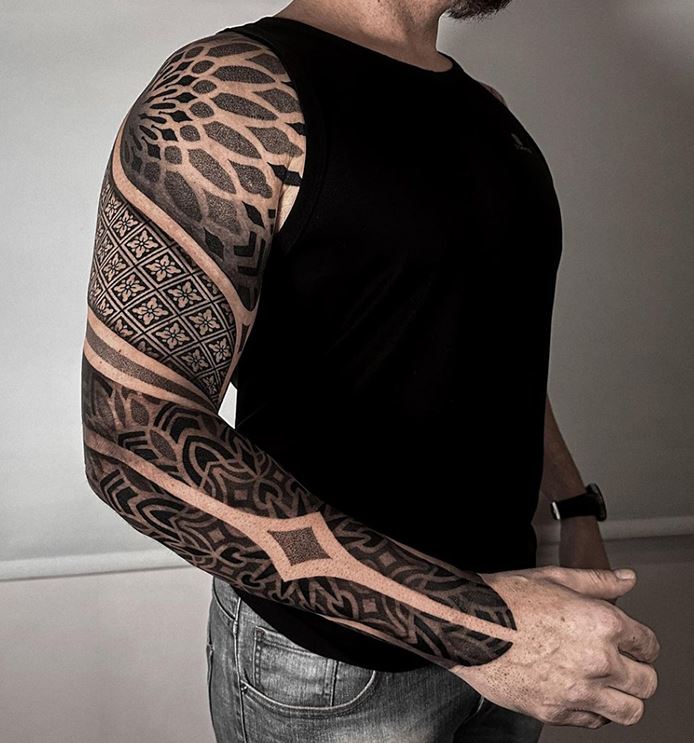
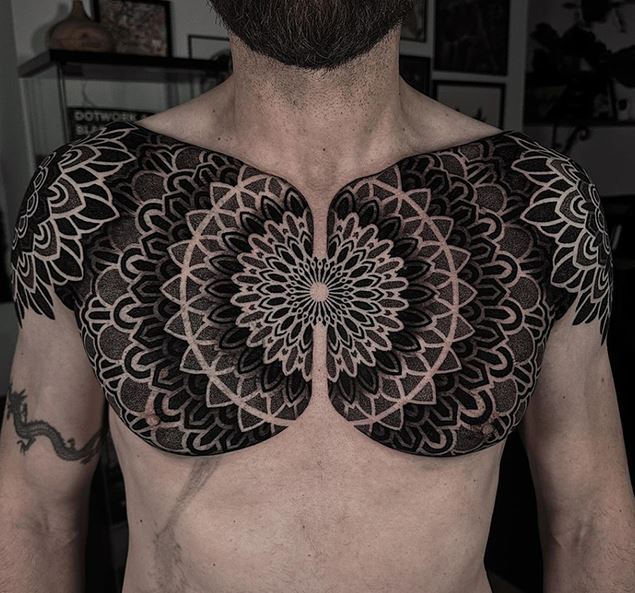
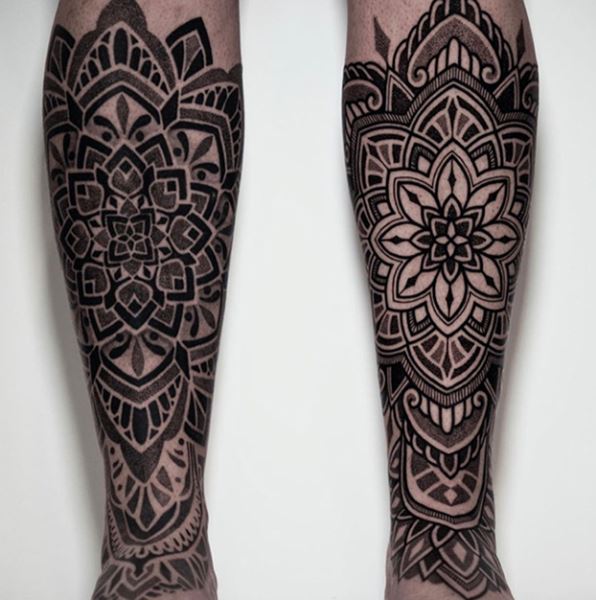
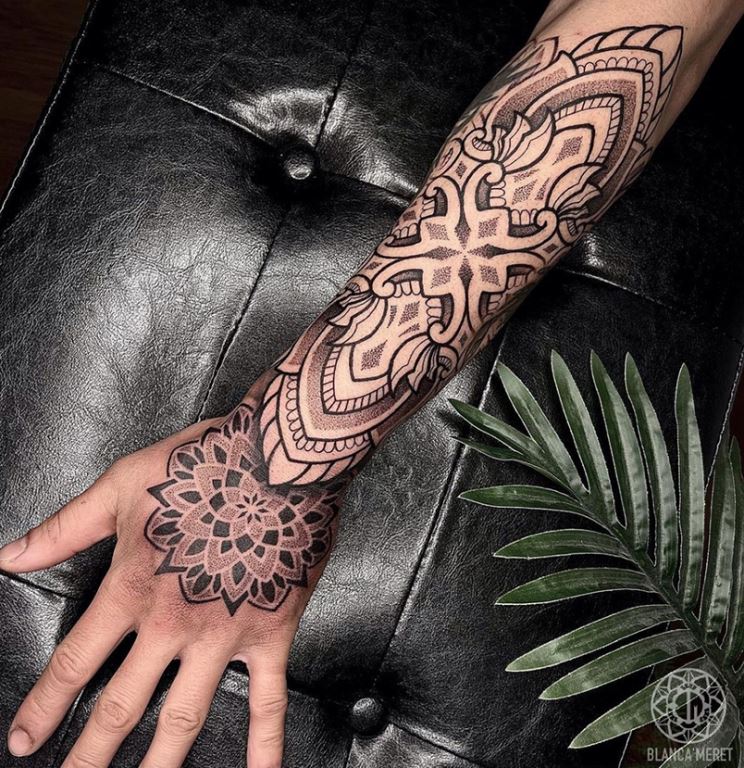
A: I would define what I do as ornamental, my main goal is to
decorate the body. Sometimes my tattoos have meaning and I always
use geometry to simplify ideas, so I feel like I have those two
styles together. The most important thing for me is, that it fits
the body, the movement and the anatomy of my clients. I like to
incorporate the meanings in a subtle way, in the details. I have
done several tattoos based on sacred geometry, but I don't like to
pigeonhole myself. I love it when clients come to me with ideas that
push me out of my comfort zone. I feel that is the best way to get
the best results. Some of my recent tattoos have concepts like
"flames", "autumn" or "the rough sea on a Malaga night".
Q: Is there any specific reason why you chose this type of
work, instead let's say color realism? Tell me more, I'm really
curious!
A: I was a very good student in high school, I loved math and
physics and I was very good at technical drawing. I started to study
Architecture because I wanted to combine Art and Engineering, but it
was there that I took my first Art Drawing classes and I realized
that building was not going to be my future. I think my style comes
from the love I have for technical drawing, I still do exercises in
that subject sometimes at home when I get bored.
Q: Since every piece is a unique masterpiece, I bet you
spend a lot of time designing and preparing the tattoo sketch?
A: Actually I can't quantify the hours I spend on each design, I can
start them a month in advance and keep thinking about them until the
days before the appointment when I give them the final look. During
the sessions when I am tattooing someone, I am thinking about
designs for the next clients. Does that count as design time? I
tattoo the same shape thousands of times, it is not a demanding
style during the session and I can invest that time in defining the
shape of other designs. For me, that's the most important thing, the
structure and the spaces. Once I have that, it costs me nothing to
fill it with geometry. In fact, I never show the designs before the
meeting. I can change them completely in the presence of the client
and it won't take me more than an hour.

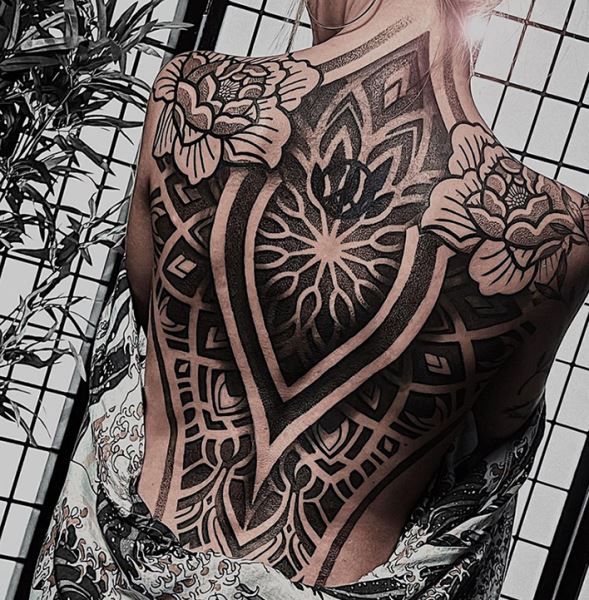

Q: Some are quite complex and I guess it
needs some proper planning when it comes to body placement. Do you
negotiate with your clients about this?
A: I think you mean advising them on the shapes that look good on
each part of the body. Obviously a joint like the shoulder, elbow or
knee calls for a mandala, which is a round shape, it refers to the
rotational movement, although there are other shapes that fit in
those areas. When I show the designs to the clients, they understand
it perfectly, it's something that no one has thought of before, but
once you see it, it seems obvious. Since I show them the designs on
the spot, I can also show them how it would look if we did what they
asked me to do versus what I prepared. Many times I have been
surprised and choose the client's version. As for placing the design
on the body, it is not so complicated if you divide it into layers.
I don't work with a complete stencil, it's impossible to put a piece
of paper on one part of the arm and turn it around for everything to
fit perfectly.
Q: Some will say, since it is not color tattooing, it's not
so difficult, shading is easy etc. I disagree. Clarify, what are
some of the technical challenges here?
A: People who have the luxury of saying that something is easy
without having tried it may not even value their own work enough.
Anyone who knows what it has cost him or her to get to where they
are now, knows that it is not easy to get to a good level in any
style. Doing pointillism is easy, making solid lines is easy, and
making homogeneous wide shadows is easy for many tattooists. But I
know that nobody can do it exactly the way I do it. What makes a
tattoo cannot be replicated or copied is not the technique, it is
the soul that each one puts into designing and tattooing, the style
that each one of us has, which is loaded with experiences and very
personal tastes. Geometry is gaining a lot of strength lately and
there are many new tattoo artists doing hexagons, mandalas and
geometry, but I see those tattoos and they have no soul.
Q: How important is proper ink application and the knowledge
of skin types so we will get that amazing final look and the tattoo
will look good, years after the skin heals? Are there any skin types
that are more difficult to work on?
A: We must be aware that the tattoo will be alive, the ink particles
will move over time and certain margins must be respected. It is
part of our professionalism to communicate this to the client, and
it also depends on the body part. Areas such as the neck, hands or
elbows will allow much less detail and delicacy. But this can be
improved if the clients are applied and take care of their skin
before the tattoo, not only after.


Q Oh the beautiful big tattoos... They are
amazing... One in particular caught my eye... I'm talking about the
back tattoo you did with Laura Ortiz... Unbelievable!! How long you
two worked on this tattoo, I assume there were at least 3 long
sessions?
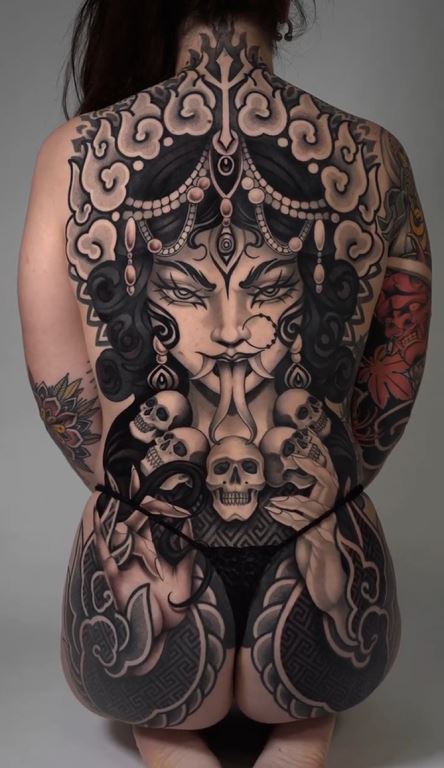
A: There were six sessions in total and I promise you that we both
worked on them at all hours. Laura and I wanted every detail to be
perfect and we took all the time in the world. This was our third
collaboration but the most personal and we wanted to take care of it
to the maximum, we had to take advantage of the ease we had with the
design, with the time and with the endurance to pain.
Q: Who was the main designer there?
A: Because our styles are so different and so defined, it was
natural for Laura to focus on the main character and for me to focus
more on the background, the ornamentation, and how the body shapes
would fit. But we really did all the work as a team, as we are very
close friends, we were constantly video calling each other to
discuss the composition, the light or dark areas of the design and
the details. In fact, during the tattoo process, we wanted to do
more and designed a collaborative print. Of course we will look for
the opportunity to do another collaboration together.
Q: So even both of you have different styles, I'm glad it
worked!
A: In fact, I think the most interesting collaborations happen when
the two artists are not so similar. They can complement each other
and strengthen each other's weaknesses or create that contrast.
Lately we can see many collaborations between numerous artists with
the aim to finish quickly and not to notice the difference between
the styles, I would not call that a collaboration.
Q: Tattoo collaborations are becoming very
popular nowadays and I'm so glad that finally tattooing is not a
"one man show" and the knowledge is not a "holy grail" type secret.
The new generation is sharing tips and working together, so as
result we have more skilled tattoo artists and better tattoos. Your
thoughts? Talking about modern day tattooing, I think it's very
different than what it use to be just ten - fifteen years ago...
A: I believe that sharing knowledge is the way to improve the
quality of tattooing in general and in particular. Healthy
competition will always make you better. I recently organized an
event with María Ruz and Laura Ortiz called Paradis, where 25 women
from the tattoo world came together to share a weekend. We all
learned a lot about tattooing, technique and drawing, but also about
breaking that barrier of "secret" knowledge. Whenever you give, you
receive.
Q: What's a good tattoo artist from an ethical point of
view?
A: I see a big difference between a tattooist and a tattoo artist
and it's just ethics that separates one from the other. We can do
all the tattoos that come through the studio door, or we can reduce
the amount and type of work, make a selection where I can give my
100% quality. We are responsible for predicting the future of these
tattoos, advising clients on design, creating a bond with them,
making them feel comfortable during the session, guiding them
through the pain... I want to bring out the best of me in each
tattoo, give it at least the same importance they give it
themselves, a tattoo can change your life.
Q: What do you like the most about being a tattoo artist?
A: Tattooing for me is the perfect middle ground between craftsman
and artist. If I only did tattoos, I would be missing something and
if I only drew or painted, I would also be missing something. That's
why I like architecture or furniture design, I love to make my own
furniture with wood, I need an activity that combines these two
worlds.
Q: Are you gonna stick to this style or you might surprise
us with something completely different in the future? Honestly, I
think you will be just as good at almost any style!
A: I always try to try new things and let myself go with what my
body is asking for at that moment. I feel that every year I do very
different tattoos, although it will always be within the ornamental
range, of course you won't see me doing neotraditional all of a
sudden. I don't rule out adding figurative elements, I already
started with flowers a few years ago, something I didn't think would
happen.

Q: I'm so glad that your talent was
noticed and appreciated by brads like Pepax. How this collaboration
happen?
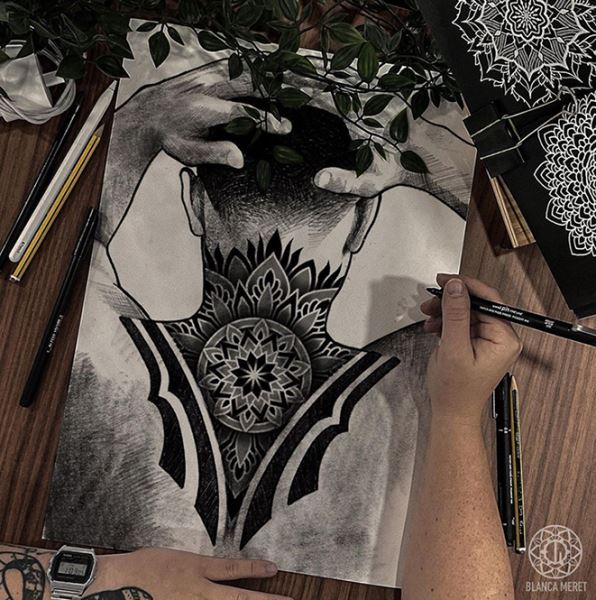
A: They wrote to me because they saw something in me, I would have
to ask them what it was. What is clear to me is that geometric and
ornamental is a style on the rise right now and there are few of us
tattooers who do it, we have new points of view to offer about the
materials and tools that are best for our techniques. Working with
such brands helps us to test the materials first hand, it helps you
to always stay up to date and thus improve the quality of the
tattoos much faster.
Q: You are also an award winning artist! Congratulations on
the last one at Gods of Ink! So well deserved. How much this means
to you as an artist, not only the award itself, but the recognition
from your fellow artists as well?
A: I like the way you approached the question, because what made me
happiest at the last convention in Frankfurt was not the award, but
the words of affection and support from my colleagues and artists I
admire. That's what I value most, to be able to share my time with
them at these events. We are having a very good season, we have won
other awards in Milan or Barcelona, which undoubtedly gives you the
energy to keep trying to do a little better every day.
Q: Do you also work as a guest artist? If yes, where was the
best experience? Did you learn something while working there?
A: I have done many guest spots in the past: in Germany, in
Switzerland and in my country, Spain. Currently the one I keep both
for the clientele and the atmosphere is Lola Tattoo in Marbella. I
love to get out of the routine and share a week or two with friends
who fill me with energy and creativity, to be able to ask them about
designs or techniques so I can keep improving when I feel stuck. I
feel like I learn something new every time I go.
Q: So not only busy working and traveling, you are also a
co-owner of the Wild Woman Tattoo studio in beautiful Madrid. I'm so
glad to see women so successful. Please tell me more about the
studio. When it was opened and who is the other owner?
A: I share the studio with my partner Nerea, she manages the whole
studio and the agendas of all my colleagues. Without her, I would
not be able to dedicate the time to drawing and tattooing and to
give my 100%. To be able to leave all the management behind and have
the peace of mind that you are in good hands is priceless. We opened
in the middle of the pandemic, I mean we had to do all the paperwork
and licensing by mail and phone. It was very difficult not to be
able to count on the help of someone physically, at least we had a
lot of time and nothing better to do, we were locked up. Now that we
have our own space where we can do things our own way, I wouldn't
trade it for anything.
Q: Are there any resident artists or guest spots? Or
preferred styles or you are open to work with any talented artists
no matter their style?
A: As long as they are good colleagues and respect the tattoo art
and the colleagues, I don't care what's their style. At the moment
it happens that all our colleagues work in black. Everyone is
specialized, we are not a walking studio because of the location and
the price of our studio. We simply work quietly with our loyal
customers from our agendas and that is why we have to work with
guest artists in advance.
Q: Your opinion about the local tattoo
scene? Do you see progress, like more artists, better quality and
more professional tattoo studios around? If you ask me... You guys
are super cool!
A: I think what is happening now, is that an important gap is
opening up between customers who are looking for a cheap tattoo and
those who are looking for quality. We have always been very clear
about where we stand. Locally, there is less research on this second
group, but there is a little bit of everything. Healthy competition
will always make us better and the kids are coming on strong.
Q: What about the global tattoo scene? Do you have any
favorite artists you would like to work with?
A: I have had many references since I started tattooing, geometry
can also be done in many different ways. Recently I met Marco Galdo,
one of my first references in geometry and the standard bearer of
the Italian style. I am now tattooing with Raimundo Ramirez, for me
the person who took mandalas to another level of beauty. At the
moment I am looking more at the delicacy and details of artists like
Nissaco, Fibs and Dino Valelly. Without a doubt, if I could work
with any of them and learn from their creative process, I would be
very happy.


Q: The American tattoo scene is huge and very diverse. If
given chance, would you consider working there? I think that would
be a great career highlight.
A: It is a very big country, the cradle of tattooing, with a lot to
offer. I will certainly look for the opportunity to travel there
soon to tattoo. I feel that geometry and ornamentation are not yet
fully developed there and I can contribute something with my
tattoos. There are already people asking me to tattoo with them or
to come to Spain, if I can save them the trip and take the
opportunity to visit the country, I would love to.
Q: Three favorite career memories?
A: I'll start with being able to go to the Frankfurt convention,
Gods of Ink, which was a dream of mine that I thought was
unattainable. Another very recent moment, the event we organized,
Paradís, which in a way changed my life. All in all, this last year
has been very beautiful. And finally, I would like to tell you that
setting up the studio was difficult at the beginning, but I have to
include it because without this more personal space, where I
dedicate more time and effort to experimenting and drawing, I would
not be where I am now. Having time for yourself is necessary and it
doesn't come by itself, you have to create your own personal space.
Q: Your advice for those who want to try getting into
professional tattooing?
A: My advice would be to go with what you feel, try to specialize,
but don't get too pigeonholed. It takes a lot of hours and hard work
and there are no shortcuts. That they look for happiness above all
else, day by day, in every tattoo and in every design. And I would
tell them not to throw away the decal until they have it completely
tattooed, you never know when you might need to glue a part back on
hahah.
Thank you for the interview,
Fredrik Lindstrom,
Editor at Skin Artists Tattoo Magazine


