
Interview with Callum Blaine
Hello Callum Blaine! Thank you so
much for taking the time to do this interview. Your work within the
realms of Abstract Realism and Surrealism has truly set a benchmark
in the industry, seamlessly blending cinematic lighting with a
deeply evocative, almost ethereal aesthetic. From your residency at
No Regrets Studios to being recognized among the 'Top 1% of Tattoos'
in the Masterpieces volume, your evolution as an artist has been
incredible to watch. To get us started, please tell us a little bit
about yourself and your background. Hi there and thank for
the kind words. I was born in Johannesburg South Africa and moved to
the UK almost 3 years ago. I now currently reside in Glasgow,
Scotland and have been tattooing for about thirteen years. Tattooing
and art is everything to me and to be able to do this for a living
and share my art with the world is an absolute honor.
Q: What sparked your initial interest in art, and at what
point did you realize that the human canvas was the right medium for
your vision?
A: At an early age I used to watch my mother paint and draw around
the house and I think this is what initially sparked an interest in
art and then a little later it was graphic novels. I would read them
as a kid and would just appreciate the artwork in each panel. When I
first got tattooed at eighteen, I realized this is something I
wanted to do and could apply my vision to. One failed attempt at an
animation collage and a couple of years later I finally got to start
my tattoo journey.
Q: You’re based in Glasgow. How has the
local art scene or the city's vibe influenced the grit and intensity
we see in your work?
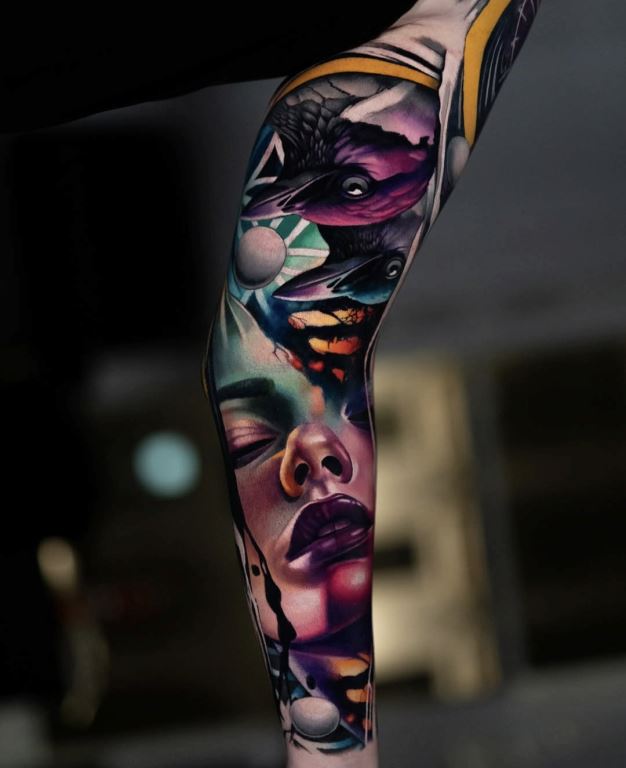
A: Glasgow definitely got a grittiness and raw feel to it and that’s
something I really enjoy. It has a feeling of the old world and new
world mixed together. There’s a lot of street art, fine art and old
architecture, some desolate and some pristine which works itself
into my work unconsciously. I’m always trying to create a contrast
between my subject matter and abstract elements, kinda like the city
and its contrasting elements I guess.
Q: Your profile mentions abstract realism and surrealism.
When you were first starting out, did you consciously move toward
these styles, or did they find you through your natural drawing
habits?
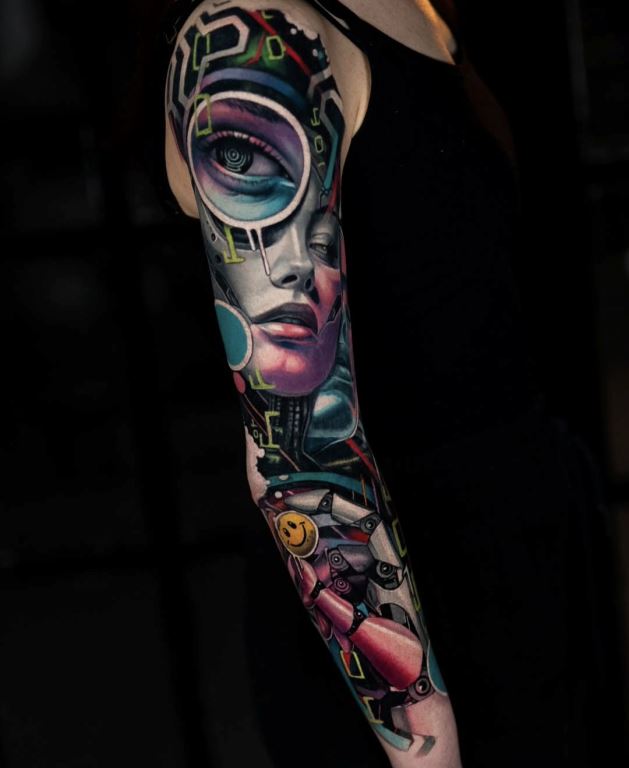
A: At first I wanted to push toward freehand horror and then started
focusing on realism as I knew, it would give me the right building
blocks to apply to the freehand stuff. I ended up doing a lot of
realism and never really went back to the horror route. I started
being more serious about my painting and this is when I found I
could be more creative and free with how I wanted to express myself.
Eventually I started applying this same mentality into my tattooing
as this art form was my main focus and I just wanted to have more
fun with it.
Q: Looking back at your early days, was
there a specific piece where you felt you finally 'cracked the code'
on the deep, saturated blacks and vibrant highlights that define
your work now?
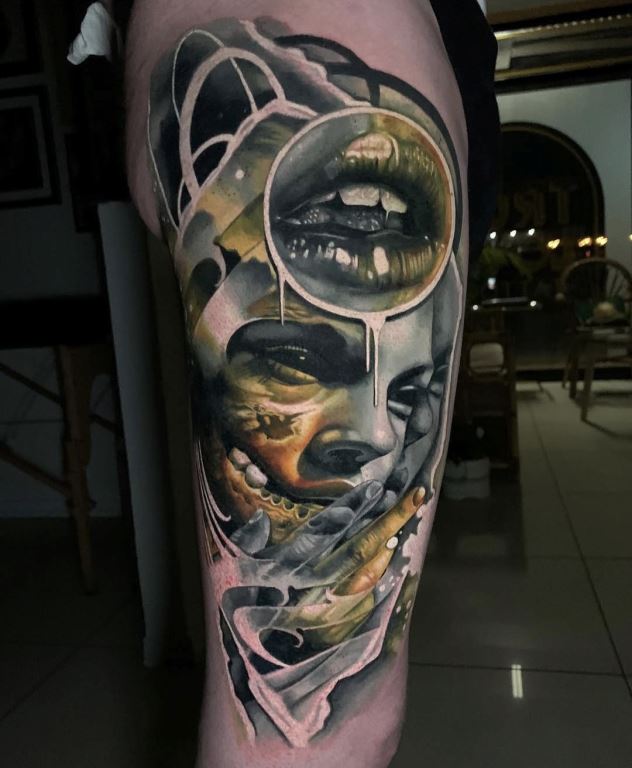
A: I had more than one of those moments. Definitely the first piece
I had one of those moments was just before moving to the UK. It was
the piece with yellow greens and grays skull lady with wet lips
circled and the transparent fingers. The second and main moment was
a couple of months into my residency at Noire Ink London. This was
due to having incredible artists around me on a daily basis and
getting to pick up and discuss new techniques all the time.
Q: You’ve done incredible pieces featuring Judge Dredd and
BioShock's Big Daddy. How do you approach 'surrealizing' these
established characters while still keeping them recognizable?
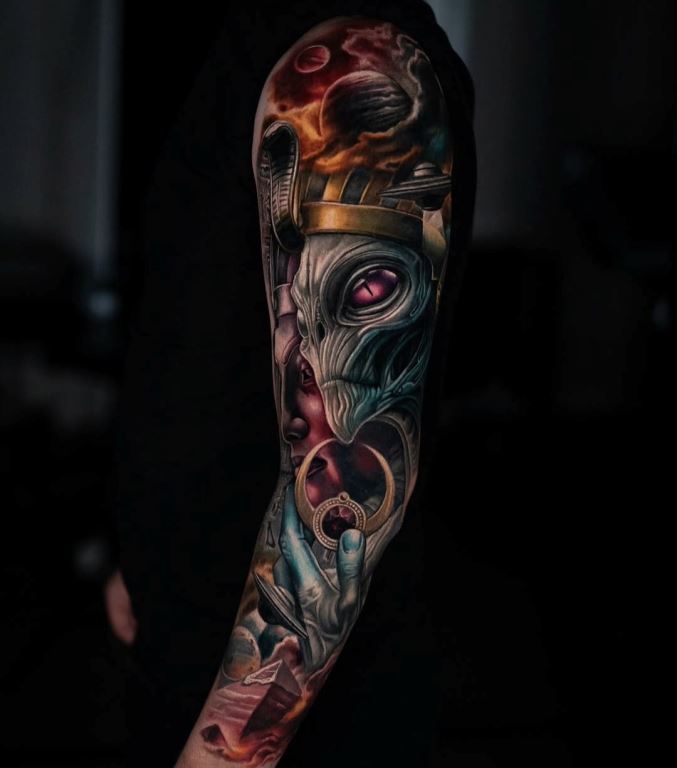
A: For me the main focus is to always keep the most recognizable
elements of this type of subject matter in, be it facial features or
symbols or even what they are known for wearing. This is because no
matter what the eye sees, it will still pick up on the elements that
make that character who or what they are.
Q: Your work uses very bright lighting,
almost a cinematic chiaroscuro. How much of that lighting is planned
in the initial digital design, and how much is an intuitive choice
you make while the needle is on the skin?
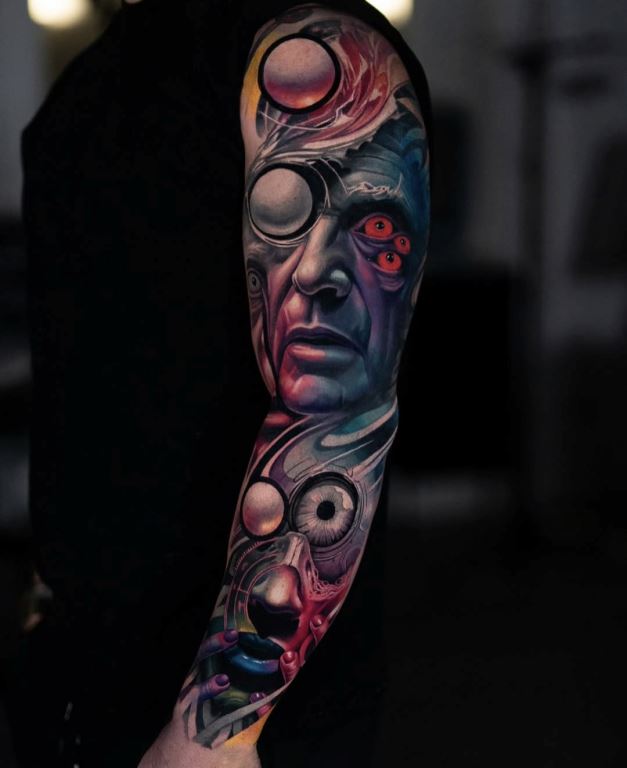
A: I try to plan it beforehand on the initial design. Contrast is
really important for me as I feel that’s what helps make a more
dynamic and strong long lasting tattoo. I might try and change the
colors as I’m tattooing but the base tonal contrast is always
planned first in the design.
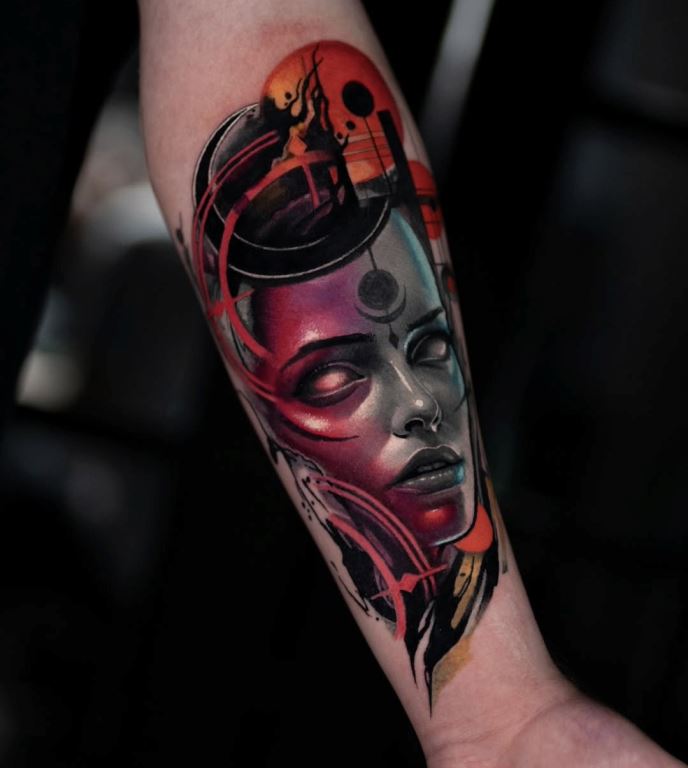
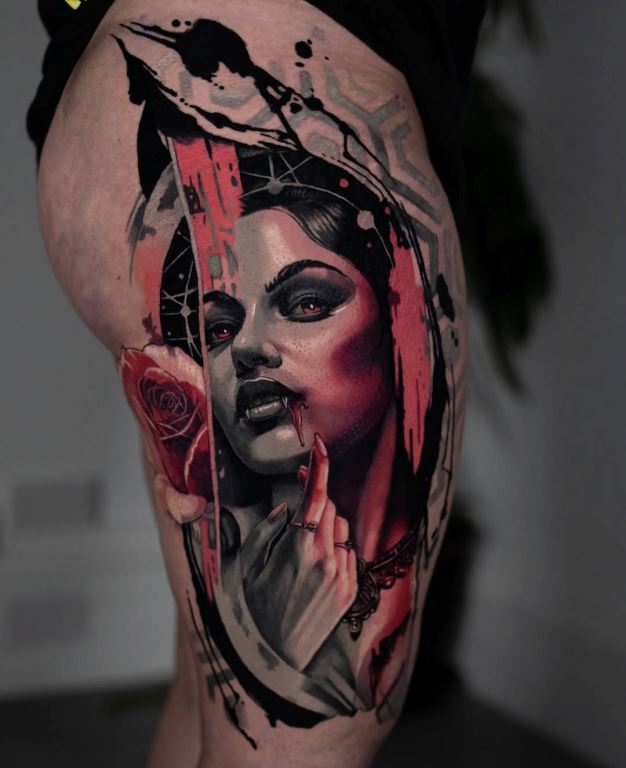
Q: Many of your portraits feature 'shattered' or layered
geometric elements. What is the narrative purpose of those
abstractions for you? Are they meant to represent a mood, or are
they purely aesthetic?
A: I add them to create flow or movement and a feeling of contrast
in the piece. I love how something organic and realistic can marry
with something flat and abstract and still look like it makes sense
and belong together. It can also be used to lead the eye to the main
subject matter.
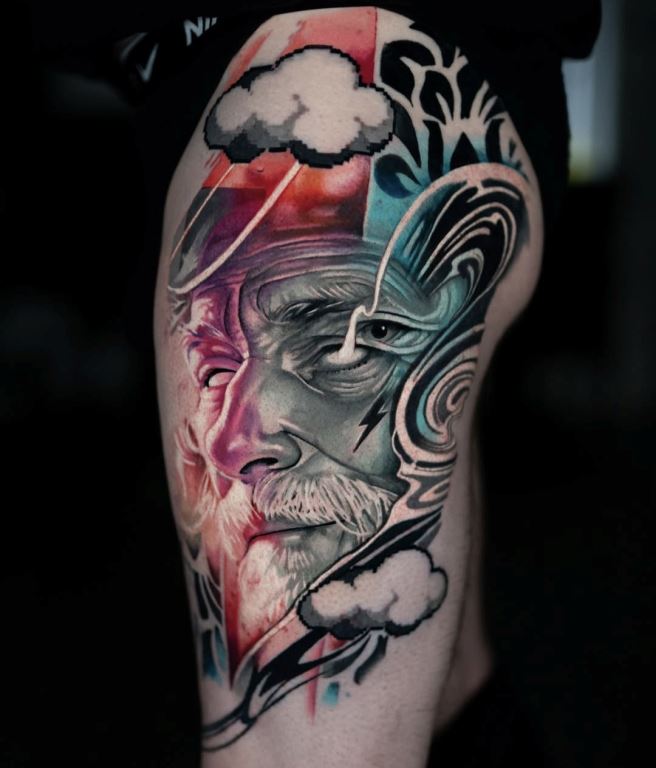
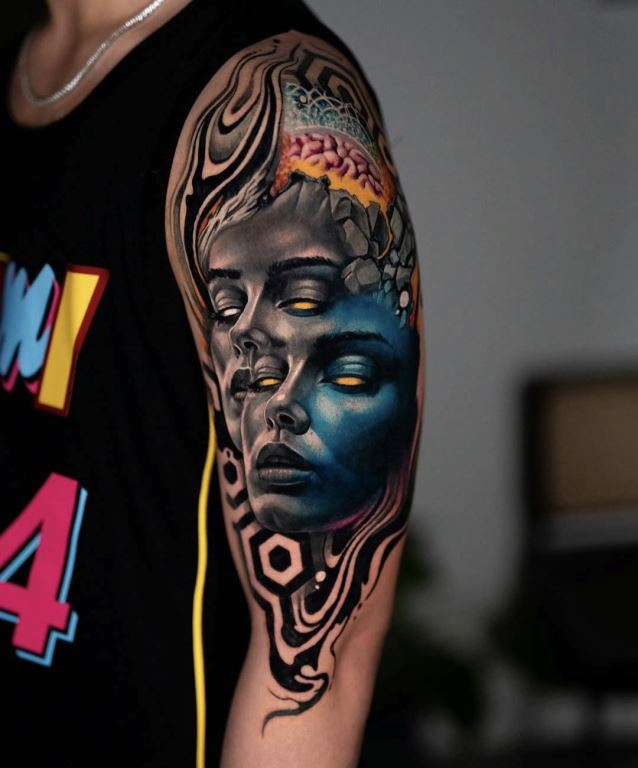
Q: Your use of 'neon' blues, purples, and oranges against
dark skin tones is a signature. Do you have a specific philosophy
for choosing your color palettes to ensure they heal as vibrantly as
they look on day one?
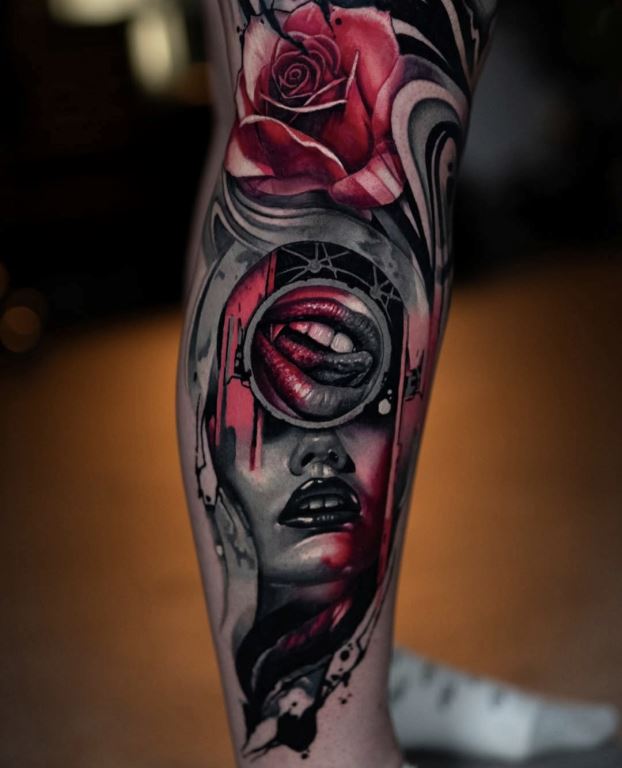
A: It first started out as a way to put more color into my work as
most people wanted black and grey. It started with just one color
added in as a color wash and now it has evolved into quite a few
more colors. For me it’s definitely to create more contrast between
colors to help make the image pop and feel more alive which in turn
helps the image appear stronger once healed.
Q: As a resident artist at No Regrets
Studios, how does being surrounded by other elite artists push your
personal boundaries?
A: It helps with progression and growth as an artist because ideas
and techniques can be bounced off each other or you might see
something that someone is doing that you’ve never seen before and
then try and apply it in your own way to your owns works. It keeps
things fresh and moving forward.
Q: You’ve been featured at major shows like the Big London
Tattoo Show and UKTTA. What is the biggest challenge of executing
such complex, colorful pieces in a high-pressure convention
environment?
A: To be honest, my biggest challenge is time management. I really
need to refine that lol. There are a lot of distractions at
conventions and if you are not careful you might not finish in time.
I normally try and get everything like stencil sizing, needle and
colour pallet choice done a day or two before the convention so once
I meet up with the client we are ready to go and there is less
stress to deal with.
Q: Tattooing is a unique collaboration.
How do you balance your artistic vision with a client’s personal
(and sometimes conflicting) expectations?
A: I always try to balance an even ratio between artist and client.
It has to be at a point where both client and artist are happy and
if one is not sure or unhappy then the tattoo won’t work. I always
try to ask my clients what works of mine they like and why, this
helps me see what elements or subjects they are drawn to, so I know
in which direction we go forward.
Q: What is the hardest lesson you’ve learned about the human
'canvas' that you can't learn from drawing on paper?
A: Each persons skin is different and with each individual person
different parts of the human body can have different types of skin
depending on the body part. Learning how and changing technique on
the fly to insure that the skin will have maximum quality and a good
heal. This is something you can only learn through experience and
tattooing many different skin types.
Q: When someone walks away with your work
on their body for life, what is the one thing you hope they feel
every time they look at it?
A: I hope that they walk away with the feeling of pride to wear the
artwork that I’ve made for them as well as having a great experience
that they will remember forever.
Q: With the rise of social media, the tattoo world has
become a global village. How do you feel this 'instant access' to
international styles has changed the way artists in Glasgow or the
UK approach their craft compared to ten years ago?
A: It definitely opened up the way people approach tattooing. People
are coming up with more unique styles as there are more great
artists to be influenced by. You have to now stand out to be noticed
and I think that can be a very positive thing.
Q: Traveling for conventions is a huge
part of the global scene. What is one thing you’ve learned from an
artist in a different country that completely changed how you look
at your own workstation or technique?
A: Go slower to go faster. You get more consistent saturation and
less trauma to the skin and at the same time you make less passes
which in turn makes the tattoo take less time to finish. This
clicked with me during the Big London Tattoo convention where I won
best avant-garde and second place - best of convention. I feel that
because of this technique, I learned I was able to create a large
piece of work over three days with very little damage to the skin.
Q: Global trends move so fast now (from 'Cyber-sigilism' to
'Micro-realism'). As someone specializing in Surrealism, how do you
stay true to your artistic voice while navigating the pressure to
stay relevant in an ever-changing global market?
A: I just do what feels right to me and create designs based on how
it feeds my soul and I feel that the right people that see or relate
to how I work will see that and want to work with me. Money has no
influence in how I work, it’s purely love and passion.
Q: The US has such a storied history with
tattooing. From a creative perspective, what is it about the
American tattoo sceneor perhaps specific cities like New York or LA
that draws you as an artist specializing in abstract realism?
A: It’s definitely the diversity of art mediums and styles in
tattooing and art as a whole. I feel like tattoo artists can
completely express themselves as individuals and as artists. America
has such a rich history of tattoo artists inovating and pushing
styles to new heights and to be able to be exposed to that would be
amazing.
Q: You've built a reputation at No Regrets in the UK. When
you think about working in the USA, are you looking more toward a
series of high-profile guest spots to experience different states,
or is the goal to find a more permanent artistic home there?
A: I would like to travel and guest spot with some of the world’s
best, attend and compete in some of America's most prestigious
conventions. The opportunity to do this is priceless.
Q: If you could pick any US-based studio or artist to
collaborate with for your first major American project, who would be
at the top of your list and why?
A: There would be two studios I would love to collaborate with the
first being Eden body art studios as I love and resonate with how
artist and studio owner Deanna runs her studio with an importance on
growing artists with seminars in almost all aspects of tattooing.
The other studio would be L.O.V.E Machine as I feel the artists
there are some of the best in the world when it comes to "out of the
box" creative tattooing and pushing the boundaries of what’s
possible.
Q: Please write down your studio location
and website/social media links. Also, let us know if you are
available for bookings.
A: I am located at Suite 111, Floor 1, 11 Bothwell St, Glasgow G2
6LY, United Kingdom. You can follow and contact me on my instagram
www.instagram.com/moosetattooart I am currently still accepting
bookings.
Q: Knowing the diversity of the US tattoo landscape, are
there any areas that particularly resonate with your artistic style
or that you feel would be a good fit for your work?
A: Texas and New York. Both have their unique appeals and I feel
people in these states are open and want unique tattoos. New York I
feel will fit as it will resonate with the grittiness and lowbrow
influence in my works.
Q: No artist reaches the 'top 1%' alone. As you look toward
the USA, who are the people or mentors you feel have been most
instrumental in helping you get to this jumping-off point?
A: Rich Harris, Thomas Carli Jarlier and Major ink Jackson and Draz
Palaming and have helped me in different ways and I will forever be
grateful for their help and advice.
Q: What impact do you aspire to have on
the tattoo community?
A: I would like to be known for my work and style and how hard I
have worked and will always work to be the best artist I can be. I
would also like to help other artists grow and achieve their goals.
Q: For the new artists entering the highly competitive
tattoo industry, what's one key piece of advice for developing their
unique artistic voice and navigating the business side of the
industry?
A: I would say to always stay true yourself and follow what makes
you happy. Try to create what you would be happy to wear. Always
follow passion and not money or fame. Passion will always push you
to achieve your goals. Always follow your gut when it comes to the
business side of things and do what best represent yourself.
Interview: Ivana Kancheska
Date: 03 February 2026


