
Interview with Coy Barrientos
Hello Coy Barrientos! Thank
you so much for taking the time to do this interview. It means a lot
having you here. Please start by telling us something about yourself
and your background. When the affinity for art first began?
Since my childhood, I've been drawn to the world of art like a moth
to a flame. Crafting, drawing, and exploring different creative
outlets were my favorite pastimes. My first real drawing book, not
just a stack of loose paper, came into my possession when I was just
five years old, and from that moment on, I was completely hooked up
with art. Although I briefly attended art school during my teenage
years, the traditional education system never quite resonated with
me. Instead, I found that my true school was dedication – pouring my
heart and soul into my craft, exploring new techniques, and pushing
the boundaries of my creativity. Art became not just a hobby, but a
way of life, a medium through which I could express myself and
connect with the world around me.
Q: Do you have any favorite artists who inspired you to draw
and maybe create your own style?
A: Absolutely, I've been fortunate to draw inspiration from a
diverse array of artists throughout my journey. Alphonse Mucha was a
significant influence, especially when I first started exploring
tattoo art. His captivating Art Nouveau style left an indelible mark
on my approach to design. Moreover, European and Japanese artists
have played important roles in shaping my artistic vision. From the
beautiful paintings of European illustrators to the dynamic
compositions of Japanese masters from the Edo Period, I've drawn
inspiration from several cultures. Additionally, manga and cartoons
have left an undeniable imprint on my work. These diverse influences
have collectively mixed through my art, guiding me to explore new
styles and blend them in my own work.
Q: What got you interested in tattoo art? How it all
started?
A: Since I was a kid, I've always been fascinated by tattoos and
piercings. Heavy music was a big part of my life, and I admired how
my favorite artists adorned themselves with tattoos. The aesthetic
resonated with me deeply, but at the time, the world of tattooing
seemed like a mystery to me. I had no idea how one could even begin
the process of becoming a tattoo artist or what it required. It was
something I admired from afar without ever imagining myself as part
of that world. It was only when someone suggested that I should
start tattooing, given my already decent drawing skills, that I
realized the potential of turning my passion into a profession.
Surprisingly, tattooing became more than just a career path; it
became a lifeline. I immediately fell in love with the craft, and
now, I can't even imagine a life without being able to tattoo. It's
transformed not only my career but also my entire outlook on life.
Q: Was it hard to learn the basics? Did anyone help you or
are you a self taught artist?
A: Learning the basics of tattooing was indeed challenging, but
incredibly rewarding. I am primarily self-taught, starting at home
with little knowledge, just watching youtube videos and going to
tattoo seminars. However, I consider myself incredibly fortunate to
have received an apprenticeship at a studio, where I had the
opportunity to learn from experienced artists and refine my skills
under their guidance. Their mentorship played a crucial role in
shaping my journey as a tattoo artist, and I am forever grateful for
their support and knowledge.
Q: What kind of tattoos did you use to do as a beginner?
A: As a beginner, I focused on mastering fundamental designs such as
symbols, small motifs, and simple compositions. These included basic
line work, small geometric shapes, and minimalist designs, you know
just the usual nothing fancy. I also practiced shading techniques
and experimented with varying line weights to understand how they
work and how they affected the result. Additionally, I often worked
on small-scale tattoos that allowed me to practice my precision and
control and most important the confidence you are required to have
in this craft.
Q: Did you have a period of finding
yourself creatively?
A: Absolutely, finding myself creatively has been an ongoing journey
filled with exploration, frustration and growth. Like many artists,
I've experienced periods of experimentation, self-discovery, and
evolution in my artistic style. I've learned that sometimes you just
have to be stoic and have lots of discipline to get out of your
comfort zone, try new techniques, and push the boundaries. I've
learned to trust my guts, and be me, and find inspiration in
unexpected places. It's just a matter of trusting in the process
being consistent and eventually the reward will be given to you.
Q: I really love your style. It's a beautiful mix of the old
traditional Japanese and some new vibe from you, very interesting.
Would you give your style a name or?
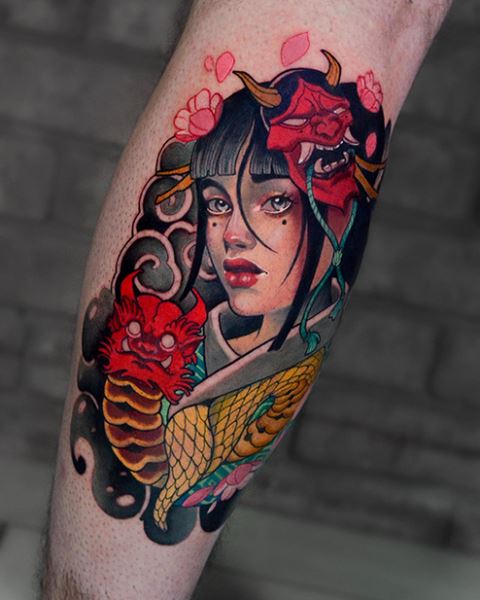
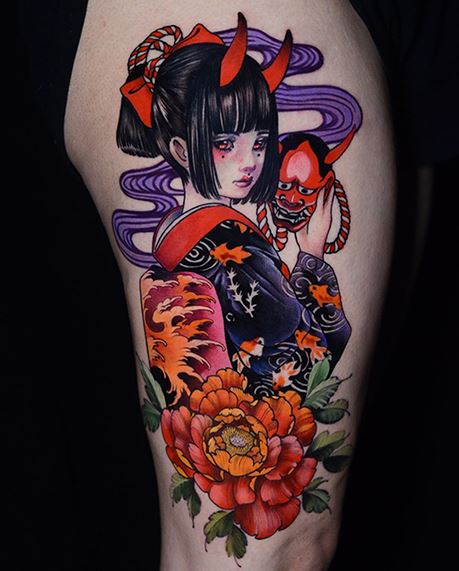
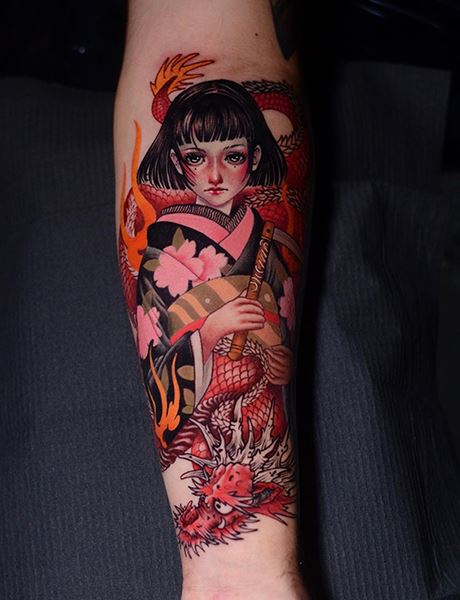
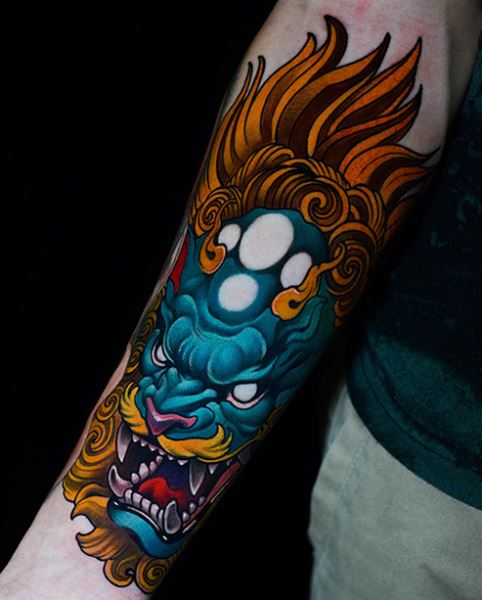
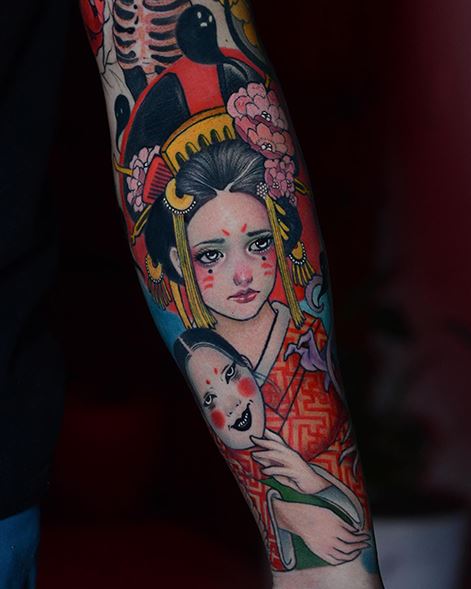
A: Thank you for your kind words! I don't think I have a specific
name for my style, I would describe it as a fusion of traditional
Japanese tattoo with contemporary elements. I often draw inspiration
from Japanese paintings, manga, and my previous work in
neotraditional tattooing. If I was to choose a name I would love to
call it Neo Irezumi.
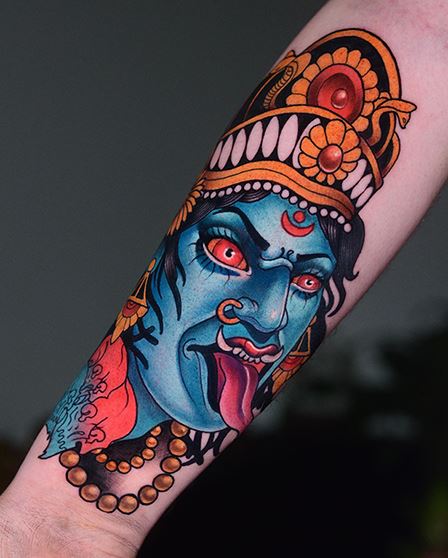
- Why this style, what do you like the most about it?
Alongside my deep appreciation the Japanese artists have for their
craft, it's the level of detail, complexity, and unwavering
dedication they infuse into every piece that makes it for me. I
think I approach my work with the same level of dedication, love and
passion. Also, since I was a teenager I had close contact with
Japanese culture as I attended a Japanese High School in my country.
So I've always had respect for Japanese art.
Q: I believe every tattoo artist's dream
is to have their own style (be known for) and with that, to have the
creative freedom while working for their clients. Your clients
already know what to expect and not only (the best from you) but
also a unique design. You are not a tattooer, you are a tattoo
artist! How do you feel about this?
A: I wholeheartedly agree. For me, having my own distinct style and
being recognized for it is not just a dream, but a driving force
behind my work. It's incredibly fulfilling to know that my clients
trust me to deliver not only the highest quality tattoos but also
designs that are uniquely tailored to them. Being viewed as a tattoo
artist rather than just a tattooer is a tremendous honor. It
signifies that my craft is not merely about applying ink to skin but
about creating meaningful and custom works of art. I see my tattoos
as art paintings on the skin.
Q: Do you negotiate with your clients when it comes to
design or placement?
A: Yes, I'm always open to discussing design ideas and placement
with my clients. I believe it's essential to collaborate closely
with them to ensure that their vision is fully achieved in the final
result. I always provide guidance and expertise based on my
knowledge and experience, but I also value my clients' input and
preferences. Ultimately, my goal is to create a tattoo that not only
meets their expectations but also exceeds them, so I'm always
willing to negotiate and find a solution that works best for both of
us.
- Have you ever refused to do a certain
design?
So far I have not, but most probably hate tattoos of any kind or
tattoos that would compromise the integrity of any person would be
something I would refuse.
Q: You are also very good at drawing. How important is it to
have good drawing skills in order to be good at tattooing?
A: Thank you! For me, dedicating countless hours to perfecting my
own style and approach to tattooing has been a labor of love. I
Personally believe that to truly give back to this craft, I must
immerse myself in the art of drawing, to create something you can
uniquely call your own. For me, creation is everything - I can't
imagine a life without it. It's my driving force, my passion, and my
purpose. I think the hardest part of tattooing is the art part,
creating something requires so much more mental processes, than just
trying to make something look the same as your clients reference,
but of course technique is a pretty important part as well, having
both makes you an excellent artist. I think both are equally
important at least for what I do.
Q: You sell some of your tattoo prints. Please write down
your email and how/where my readers can buy some. They look awesome!
I think you should design like a t-shirt collection or a whole
catalog with your designs.
A: I have made t-shirt designs in the past and that's something I
would love to do again. For inquiries or to place an order for a
print, please email me at zhinztoken@gmail.com.
Q: Do you have any favorite tattoo you did that is like a
creative "upgrade" and technically a bit challenging but still
turned out really good?
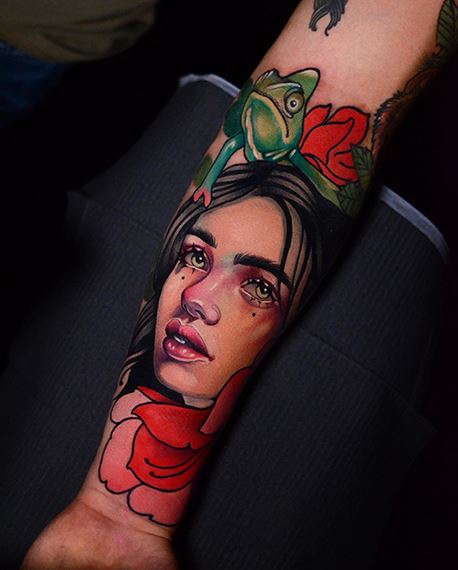
A: It was such a wonderful experience when a client brought me a
drawing of her 9-year-old niece and asked me to put my own spin on
it. Seeing how happy my client was and the surprise and joy on her
niece's face when they saw the tattoo was priceless. It's moments
like these that make being a tattoo artist so rewarding. Creating
connections and spreading happiness through my art is what it's all
about. Also doing my own pre-drawn designs it's always an
accomplishment.
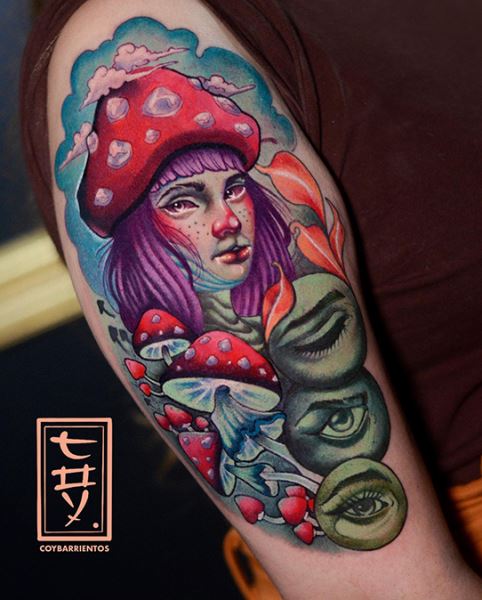
Q: Most of your tattoos are full color. Do
you prefer color tattooing?
A: I genuinely appreciate both methods. Each brings its own unique
approach, and the process varies slightly. I enjoy working with
multiple techniques. Above all, I prioritize providing my clients
with the freedom to choose what resonates with them, ensuring their
satisfaction with the outcome. However, when it comes to using
colors, trust me I go all out.
Q: Any specific rules when it comes to ink application and
skin types? Which ones are more difficult to work on?
A: I already have my own workflow, I know what color pallet I like,
which is also something that has become part of my style so ink
should not be that important, I think it's more important to know
how to read the skin when you are working with it, and that's
something only experience can give you. I'm pretty used to working
with all skin types.
Q: What would be the dream piece you want to tattoo and who
would be the client?
A: Dream pieces would always be full body pieces, it's almost like
you are just painting but on the skin. These types of pieces require
a lot of compromise from the clients, not only because they require
patience but also because you have to commit with pain and make it
your own.
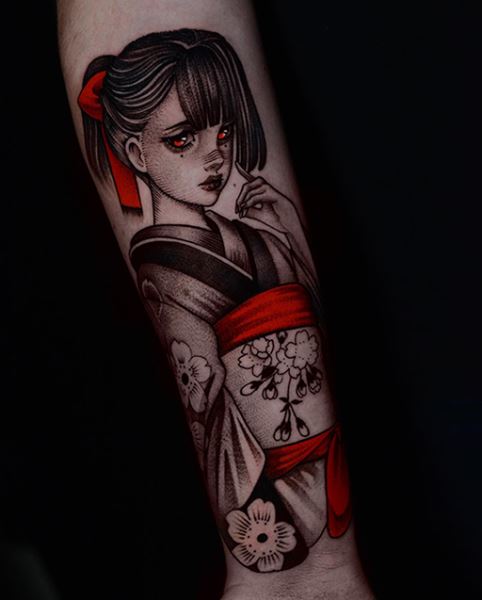
Q: I must mention, the style reminds me of those beautifully
designed japanese postcards, book covers and illustrations. Have you
ever thought to try your luck in this field? I think you will be
amazing! Or... "Just" an interesting comic book with crazy
characters and cool storylines. Just an idea!
A: I've never considered exploring those fields before, but I'm
intrigued by the idea. Thanks for the suggestion! Who knows, maybe
I'll steal it from you guys, haha! On a more serious note, I'm
currently working on a personal project and have plans to create
toys featuring my characters in the near future.
Q: Where are you located? Please write
down your contacts, social media links and studio address. Are you
available for bookings?
A: I am Currently located in Costa Rica, I have my own studio called
Token Tattoo Studio. You can visit us at tokentattostudio.com or
also through my instagram @coybarrientos and book and appointment
with me.
Q: What's your opinion about the local tattoo scene? Do you
see progress?
A: It's always great to see the local tattoo scene evolve and grow.
I've observed positive changes and advancements in recent years,
such as increased recognition of tattooing as a legitimate art form
and greater acceptance within mainstream culture. With more talented
artists emerging and a growing appreciation for diverse tattoo
styles, it's clear that progress is being made. Additionally, the
availability of professional studios and adherence to health and
safety standards contribute to the overall improvement of the local
tattoo scene. Overall, I'm optimistic about the future of tattooing
and excited to see how it continues to evolve.
Q: How is tattooing regulated in your country and do you
think it needs improvement?
A: Working in a professional tattoo studio, I adhere to all state
regulations and prioritize professionalism as a bare minimum
standard. In my country, tattooing is regulated by a combination of
health and safety guidelines, licensing requirements, and local
ordinances. These regulations are in place to ensure the safety of
both clients and artists, covering aspects such as hygiene
practices, equipment sterilization, and proper disposal of waste. I
believe that the current regulatory framework provides a solid
foundation for maintaining safety and quality standards within the
industry. However, there is always room for improvement. Continued
education and training for tattoo artists on the latest techniques,
safety protocols, and advancements in equipment can further enhance
the overall standard of tattooing. I've given some seminars myself.
Additionally, ongoing collaboration between tattoo artists, health
authorities, and regulatory bodies can help identify areas for
improvement and ensure that regulations remain effective and
up-to-date with evolving industry practices.
Q: What is a good tattoo artist from an ethical point of
view?
A: For me a good tattoo artist from an ethical standpoint
prioritizes integrity, professionalism, and client well-being. This
includes maintaining positive energy in the studio, fostering clear
communication with clients to understand their needs, and being
punctual to respect their time. Additionally, offering guidance and
assistance throughout the tattooing process ensures that clients
feel informed and supported in their decisions. By embodying these
principles, a good tattoo artist creates a welcoming environment and
meaningful experiences for their clients.
Q: What about the global tattoo scene? I think we, as a
collective, are heading in a good direction. Many new, talented
artists, tattoo conventions, seminars and opportunities. On the
other side of the coin, sometimes this can blur the line between
good, quality work and just fake publicity, zero talent and skills.
However, overall I believe it's better than it was just ten years
ago... What's your opinion?
A: The tattoo industry is changing, and like everything else, we
have to keep up. Some people are in it just for the money, but I
believe being a good artist also means being good at business. We're
responsible for a service, and what we put on someone's body matters
most. For me, tattooing is a passion. When you love what you do, you
naturally do it well and enjoy the process of getting better.
Becoming a tattoo artist has been a dream come true. I started as an
apprentice and learned that growth takes time. But if social media
or other distractions get in the way of doing great work, it's worth
thinking about why you're in this business. Art doesn't stay in one
place; it grows with the artist. I've seen more people taking
tattooing seriously lately, both artists and clients. There's so
much information available now, and it's making a positive
difference. It's important to focus on these good changes rather
than dwell on the negatives.
Q: How often do you participate in those types of events?
A: I've had the privilege of participating in numerous international
conventions, including the Barcelona Tattoo Convention, multiple
editions of the Mexico Tattoo Convention, and conventions in Costa
Rica. Additionally, I had the honor of judging at the Mayagna Tattoo
Convention in Nicaragua and will be participating as a judge at the
upcoming New York Tattoo Convention this year. In addition to
conventions, I've conducted guest spots at esteemed studios across
Spain (Barcelona, Madrid) and Mexico (CDMX, Guadalajara),
collaborating with places like Burial Art Gallery, BHORN Tattoo
Studio, Inkinctv, Karbon Tattoo, and Goldline Tattoo, among others.
I've also shared my knowledge and expertise through seminars, both
conducting my own sessions and participating as a guest. These
experiences have been invaluable in shaping my perspective and
evolving as an artist. Beyond tattooing, my work has been recognized
in traditional art magazines such as Beautiful Bizarre Magazine from
Australia, showcasing some of my pencil drawings.
Q: The American tattoo scene is huge and very diverse.
Oftentimes, the most influential artists are from some hotspot in
the USA... As a young and talented artist, would you consider moving
there? I think that would be awesome!
A: The American tattoo scene is massive for sure. For me, moving
there could offer great opportunities for growth and collaboration
within the industry. It's an exciting prospect to be part of such a
dynamic community, and I would love to contribute to that diversity
with my own unique style of tattooing.
Q: Would you consider working together
with someone on a big scale tattoo like a full back piece? Tattoo
collaborations are fun and sometimes a great learning experience.
A: There are so many tattooers I would like to collaborate with,
especially since I know a lot of styles are so different from what I
do. I think about all the fresh and new possible combinations we
could offer.
- If yes, who would that be?
A lot of artist such as Jacob Sheffield,
Kristina Taylor,
Green Vesper (Tania), Ryan
Ashley Malarkey, Bobby Johnson,
Arlo Di Cristina, Rinat
Mingazdinov, and so many others.
Q: With so much potential and undeniable talent, you can
achieve so much. I bet your friends and family are some of your
biggest supporters, am I right? How much does it mean to you?
A: Having the support of my family and my friends means everything
to me. Their encouragement and belief in my abilities have been
invaluable in my journey as a tattoo artist. Knowing that they stand
behind me gives me the confidence to pursue my passion
wholeheartedly and strive for excellence in everything I do. I am
really grateful and privileged to be able to have the family I have,
the blood and the chosen one.
Q: What would you recommend to those who want to try getting
into professional tattooing?
A: For those aspiring to enter the world of professional tattooing,
I would recommend starting with a strong foundation in art. Practice
drawing consistently to develop your skills and find your unique
style. Additionally, seek out apprenticeships or mentorships with
experienced tattoo artists to learn the craft hands-on. I think it's
not only for the best but also because along the way I'm pretty sure
it's easier and faster than doing it all alone. Be prepared to put
in hard work, dedication, and patience as you hone your skills. It's
also essential to prioritize hygiene and safety practices, as well
as to stay open to continuous learning and growth. Networking within
the tattoo community can also provide valuable opportunities for
growth and collaboration. Overall, passion, perseverance, and a
commitment to excellence are key to success in professional
tattooing.
Mr.Coy Barrientos, thank you for the interview,
It really means a lot,
Kind Regards
Fredrik Lindström
Editor at Skin Artists Tattoo Magazine


