
Interview with David Oliva
Hello David Oliva! Thank you so much for
taking the time to do this interview. We really appreciate it.
Please start by telling us something about your background.
Hello! My name is David Oliva, I am 31 years old, and I am from
Lima, Peru. I've been tattooing for over six years. I got into
tattooing after finishing my automotive mechanic degree and working
in a mechanic shop for several years. As a child I drew a lot, it
was my favorite hobby, and when I entered university I gave it up
completely to dedicate myself to my studies, without thinking that
years later my hobby would be my way of making a living.
Q: When did you first recognize you possessed this unique
artistic talent, and how did that moment of self-discovery steer you
specifically down the path of tattooing?
A: I've always liked tattoos, ever since the 2000s when tribal
tattoos became popular, and it wasn't until 2016 that I got my first
tattoo. I kept getting tattoos until 2019, when, while waiting for
my tattoo artist at his studio, I started drawing. He encouraged me
to tattoo synthetic skin, and when I did it I felt quite good and
comfortable, especially with the shading, and that's how little by
little, as a hobby, I got into it.
Q: What type of tattoos you used to do as a beginner and how
long took you to figure out your creative direction?
A: I started out doing everything: old school, tribal, black and
grey, oriental, full color, fine line, etc. But I always liked black
and grey; it's the style I have tattooed, the style I've always
drawn, and also the style that, over time, made me happy to tattoo.
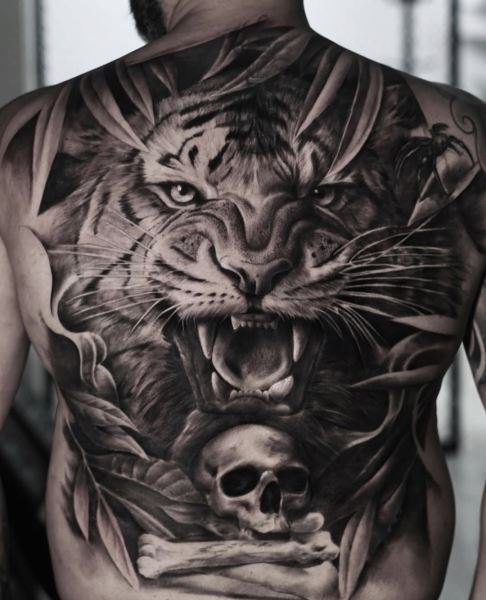
Q: I love how your art blends tattoo
realism and fantasy. What inspired you to create this unique fusion,
and what do you enjoy most about working in this style?
A: Thank you, I really appreciate it. The fusion of realism and
fantasy came quite naturally to me. I've always been fascinated by
the technical precision of realism, how light, texture, and detail
can bring an image to life, but at the same time, I felt the need to
go further. Fantasy allows me to break the rules, to create
atmospheres, characters, and elements that aren't limited by
reality. For me, combining both languages is a way to balance
control and freedom: on the one hand, I enjoy the technical
challenge of building something believable, and on the other, I love
being able to take it to a more emotional or surreal level. What I
enjoy most about working in this style is that it allows me to tell
visual stories that couldn't exist otherwise. It's a space where I
can explore very personal ideas and, at the same time, connect with
clients who are looking for something more symbolic, more intimate,
or more imaginative than a traditional portrait.
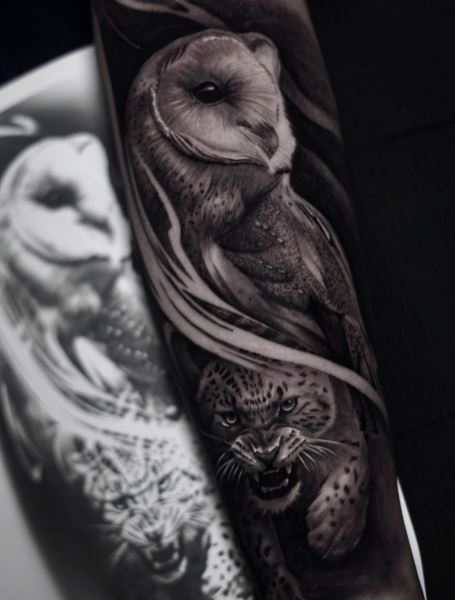
Q: Realism relies heavily on the initial
drawing. Can you describe your process for creating and applying the
stencil? Do you freehand any elements to enhance the organic flow or
detail?
A: In realism, the initial drawing is fundamental, so I'm very
careful with my stencil creation and application process. First, I
work on the digital design, adjusting highlights, shadows, and
proportions to match the exact anatomy of the area where the piece
will be placed. This allows me to control the values from the
beginning and ensure the tattoo maintains consistency even with the
body's natural movement. When preparing the stencil, I simplify the
information into clear lines and references: main contours, anchor
points, deep shadow edges, and areas where I need pinpoint accuracy.
I don't transfer all the details; I leave room to work the values
directly on the skin, where the volume truly comes to life. Yes, I
do some freehand work. I like to hand-draw elements that need a more
organic flow, such as smooth transitions, secondary textures,
atmospheric backgrounds, or details that need to adapt to the body's
curves. This freehand approach allows me to better integrate the
piece, break down the stencil's rigidity, and make the tattoo feel
more natural and dynamic.
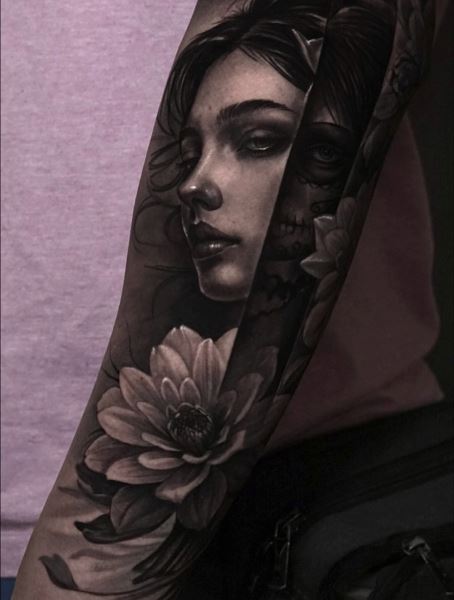
Q: Your work features incredible contrast
and fine detail. What specific techniques do you employ to achieve
such a smooth tonal gradient in black and gray, especially when
working on skin texture and hair/beards?
A: To work I always start with the volume of the piece, then I
contrast little by little and at the end I add the details and
textures. I use the Magnum RM needles a lot to create soft shadows.
I use the pendulum technique, applying my shade gently and trying to
blend it as much as possible, in areas that require a lot of focus,
such as the eyes, nose, or beard, I use a round liner to better
define those areas.
Q: How do you approach the deepest blacks in your work to
ensure they heal effectively without looking solid or flat, while
still maintaining the necessary depth and contrast?
A: Lots of drawing, it shows you everything you need to know so it
doesn't look flat. I use voltage 6, and I gently saturate as needed,
according to the design, applying the correct tone without trying or
guessing. Besides being very careful not to damage the skin during
saturation, I always ask my clients to be extra careful during the
healing period, and almost always, for large projects, I perform
several sessions, where I personally observe the healing process and
always apply a second layer.
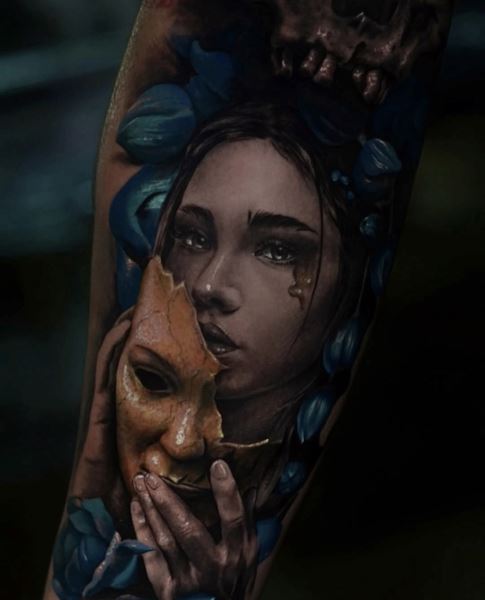
Q: You specialize in black and gray. What,
in your view, does the absence of color allow you to express or
emphasize in a portrait that color might detract from?
A: Working in black and gray allows me to focus on the essence of
portraiture: light, shadows, and emotions. Without color, there are
no visual distractions; it all comes down to expression, texture,
and depth. I feel that the absence of color makes the image more
honest and timeless.
Q: Many of your pieces feature mythological figures or
intense, emotional faces etc. What draws you to these subjects? Do
you have any favorite?
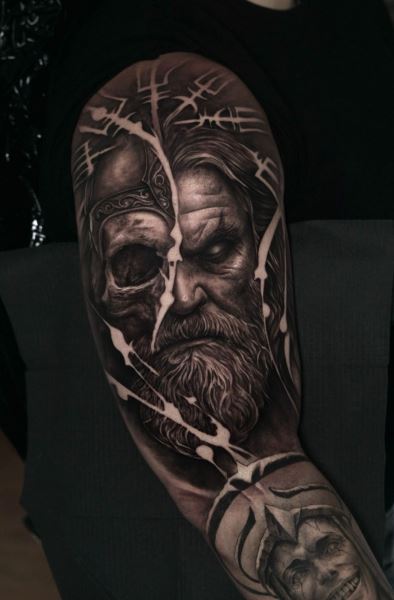
A: Yes! I really enjoy drawing faces with strong expressions. My
favorites are beings from Norse mythology; I particularly like that
mythology, as well as Greek mythology. It's not just the volume in
those Nordic faces, or Greek sculptures, but also the textures,
whether it's beards, dirt, hair, or the stone material of some
sculptures; all of this helps to give the tattoo much more
expression.
Q: In realism, lighting is critical. How
do you plan the lighting on a client's specific body part (like an
arm or back) to make the tattoo look as three-dimensional and
dramatic as possible?
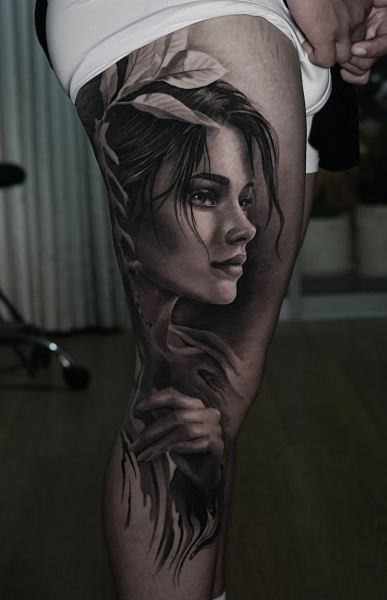
A: When I work in realism, lighting is the factor that defines the
three-dimensionality of the tattoo. That's why I plan the lighting
based on three pillars: anatomy, light direction, and value control.
The first step is to analyze the body structure where the piece will
be placed. Each area, such as an arm, shoulder, or back, has
different curves, protrusions, and depressions. I take photos of the
client from various angles and observe how natural light highlights
these volumes. This allows me to anticipate where the tattoo will
need strong highlights and where the shadows should be placed. I
create a preliminary sketch, adjusting the reference to the client's
actual body angle, defining highlights, midgrounds, and hard
shadows, and verifying how it will look from different perspectives.
This control of values is what ultimately creates the
three-dimensionality.
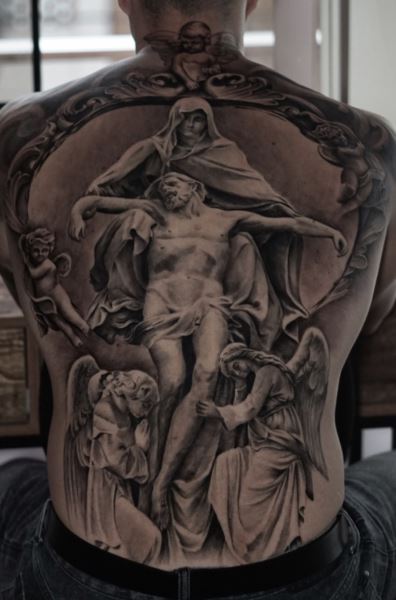
Q: When starting a full leg sleeve or back piece, how do you
map the composition to ensure the hyper-realistic elements look
correct and undistorted as they wrap around the body's curves and
contours?
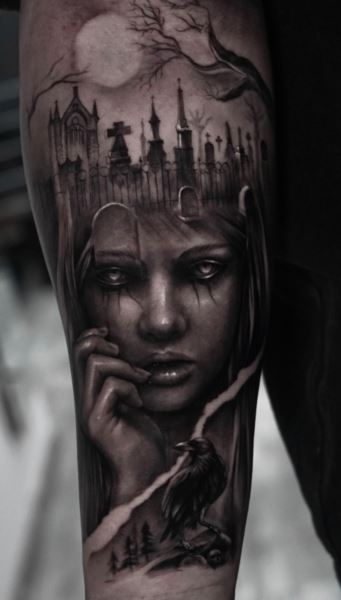
A: As we discussed in the previous topic, musculature is also a key
point in defining the placement of light and shadow. Whenever I do
jobs that are big, in a previous appointment I analyze everything,
the idea, the client's muscles, etc. And with that I start working
on the design, and above all, study it very well. Sometimes it took
me up to 4 hours to fit perfectly each stencil to avoid deformations
when placing elements.
Q: Realism demands precision. How do you plan out the
workflow across multiple long sessions, specifically, how do you
ensure the tonal values and contrast remain consistent from the
first session's healed work to the final session's fresh work?
A: When it comes to work requiring many sessions, it allows me to
see the healing process of each shade I apply. Over the years of
working and experimenting with multiple techniques, I can trust that
the shade I apply will heal as the shade I want. And always, for
example, on a back, in the last session I work on some layers over
all the work, to ensure the complementarity of all the sessions and
all the tones that I have been doing during those last months of
work.
Q: What are the key points you discuss with a client before
starting a large-format tattoo (time commitment, healing, cost,
breaks) to ensure they are mentally prepared for the demands of a
multi-session realism project?
A: I believe that every client who comes in for a large project
already has the mindset and commitment to do their part. In those
cases, what I find difficult is convincing them that their entire
back won't be finished in one week, as some believe, but that it's a
project that requires weeks and months of work, from correctly
planning the idea to execution and healing. Many times it has also
happened to me, that some sleeves or legs, I have started with a
single session, and after seeing the work, the client little by
little is completing the arm, something that at first he believed
that it was a single tattoo, without wanting and over time, It
turned into a full sleeve or a leg. It has happened to me so many
times that since I make a single tattoo, for example on a forearm,
the project to which it can be extended, and if later the client is
encouraged to continue his manga, it is much easier for me to be
able to attach it to what we do later.

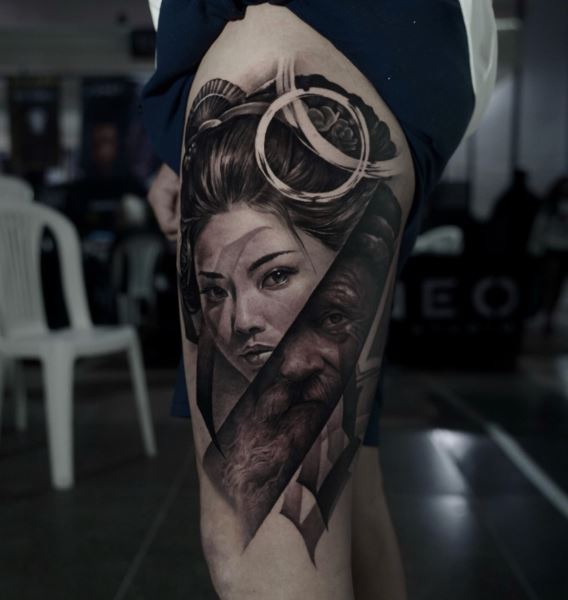
Q: So far, any favorite tattoo you did?
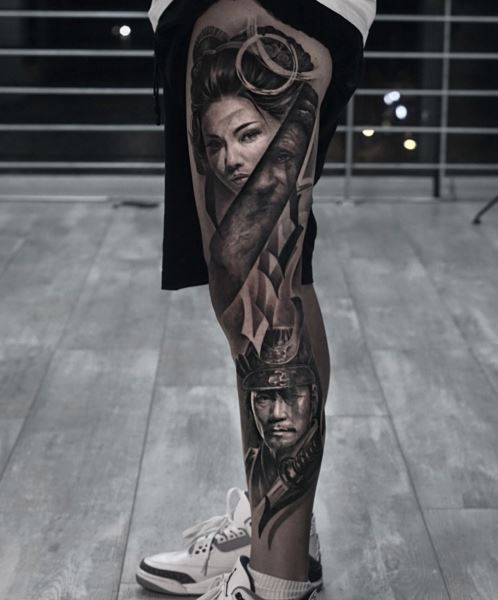
A: I really liked that of a Japanese woman with a diagonal cut,
where the face of an old man could be seen inside. I feel that in
addition to the technique, the proposal that came out.
Q: Witnessing clients in such vulnerable and personal
moments during the tattooing process must be a unique aspect of your
work. How does it feel to be a part of these intimate experiences,
and does it influence your approach as an artist?
A: Of course, I firmly believe that tattooing itself is something
very spiritual. As a tattoo artist, we sometimes don't perceive it,
but another day at our job is a unique day in someone's life. Is
marking their life forever, and we are witnesses to it. The client
will always remember us, that's why I like to have a special
connection with each client, to make them feel that this day is also
very special for me. I've had clients who have become great friends;
sometimes, after hours and hours of talking sessions, it becomes
inevitable.
Q: What's your take on the local tattoo scene? Are you
seeing any exciting developments, like new artists, styles, or
events?
A: At the last convention in my country, I was very happy to see so
many talented people who were just starting out, and above all, I'm
very pleased to know that there are more and more tattoo artists who
prioritize this art as just that, art, and not as a simple business,
always constantly evolving, both in courses and materials, and
social media has helped a lot in that too.
Q: Where are you located? Please write down your studio
location and website/social media links. Also, let us know if you
are available for bookings.
A: Sure! Mi Instagram profile is @davidoliva0908.tattoo I am located
in the city of Lima, Perú.
Q: How often do you attend tattoo conventions? In your
experience, how valuable are tattoo conventions for artistic growth
and building client relationships?
A: I like going to conventions; it's a great opportunity to make
artist friends, whether they're local or from other countries. I
usually go 2-3 times a year. Last year I went to two, and I won
prizes at both, one in Lima and the other in Mexico. This also helps
you grow your name in another country. The last convention I went to
was in Lima, my hometown, and I won an award in the large shadow
category. Next year, I already have several conventions planned in
Europe and some Latin American countries. In short, going to
conventions helps you tremendously, both in meeting people in the
industry (artists, brands, clients) and in improving your art. The
pressure at conventions is always special and contributes greatly to
your growth.
Q: What about guest spots?
A: It's incredible to meet artists from other countries, with a
different perspective, regardless of their style. It's enriching,
gives you much more wisdom, and above all, another point of view.
Q: Given the significant presence and variety within the
American tattoo world, is that a landscape you might be interested
in engaging with professionally at some point in your career?
A: Definitely. The tattoo scene in America is incredibly diverse and
offers tremendous creative opportunities. I'm drawn to the idea of
being involved in an environment with so much history, so many
different styles, and such a broad audience. I believe that working
there would allow me to continue growing, connect with other
top-tier artists, and contribute my own perspective to the scene.
It's definitely a place where I'd like to work professionally at
some point in my career.
Q: If you were to consider establishing a presence in the
American tattoo scene, what kind of environment, in terms of
location and studio ethos do you envision would be most conducive to
showcasing your style supporting your continued artistic evolution?
A: If I were to establish myself in the american tattoo scene, I
envision an environment that combines a strong artistic identity
with a solid professional approach. I would be drawn to a studio
located in a city with a vibrant creative community like Los
Angeles, New York, Austin, or Miami, where diverse styles, cultures,
and visual references converge. As for the studio itself, I would
look for a space that values quality over quantity, with a work
ethic based on respect for art, the client's time, and the artist's
individual evolution. A place that encourages experimentation, isn't
afraid to take on more narrative projects and highly detailed
pieces, and where there's a constant exchange between artists with
different visions. For me, such an environment would be ideal for
showcasing my style, further refining my realistic technique, and
simultaneously continuing to grow within a community that inspires
and challenges me to improve.
Q: Do you have any favorite American tattoo artists you
would like to work with?
A: Yes, there are many, but to mention just a few: Steve Butcher,
Arlo, Polina Cohen, Nikko Hurtado, Daniluz, Michael Perry, etc.
Q: As an artist specializing in black and gray realism,
you've clearly reached a high level of professional recognition. How
did securing a sponsorship or partnership with major tattoo brands,
specifically help to increase your visibility within the industry,
and what future professional opportunities (like guest spots,
international conventions, or educational roles) have materialized
directly because of that affiliation?
A: Having brand support is good any way you look at it. First and
foremost, it demonstrates the quality of your work. Then there's the
issue of exposure; collaborating with sponsors opens doors and puts
you on the radar of many other people (artists or more brands). At
conventions, especially the international ones, having the support
of your sponsor is a special relief, it releases the pressure and
lets you focus only on tattooing.
Q: What impact do you aspire to have on the tattoo
community?
A: No amount of work will ever be enough to thank tattooing for
everything it has done for me. I think I would like to reach a point
where I can help and inspire other artists to have a different
vision of tattooing, a vision that is not commercial, but more
guided by inspiration and the ability to perfect their art.
Q: If you could go back and give your younger self advice
about pursuing tattooing, what would it be?
A: I would definitely tell him to do it. I don't think there's
anything I regret, because I believe everything that happened is
part of the process of becoming who I am now. I would just tell him
to focus on the art, not to get distracted along the way, and to
treat tattooing with great respect.
Interview: Ivana Kancheska
Date: 18/11/2025


