
Interview with Everton Carlos Jordao
Hello Everton Carlos Jordão! Thank you so
much for taking the time to do this interview. Please start by
telling us something about yourself and your background. When did
you first got interested in art? Since a very young age, I
have always been interested in the world of arts. At the age of 14,
I joined a graffiti group in São Paulo, Brazil, where I painted
murals all over the city. When I turned 17, necessity led me to take
a job in a slaughterhouse. There, I met some tattooed people, and
one of them introduced me to the world of tattooing, around 1999. At
that time, there wasn’t much information available about tattoos,
but since I didn’t want to make mistakes on people’s skin, and I
worked at a slaughterhouse, I used to take pieces of pig skin home
to practice and improve my techniques.
Q: When tattooing came into the picture?
A: At the beginning of my career, there were many people who
inspired me. Coming from the graffiti world, I was drawn to vibrant
colors and distorted designs. That’s when my admiration grew for
tattoo artists such as Joey Capobianco, Jimmy Litwalk, Jesse Smith,
among others. I do consider myself a self-taught artist, but there
were also very important people throughout my journey as a tattooer,
including some renowned Brazilian tattoo artists of that time, such
as Duel Soares and Sidney Jacobina.
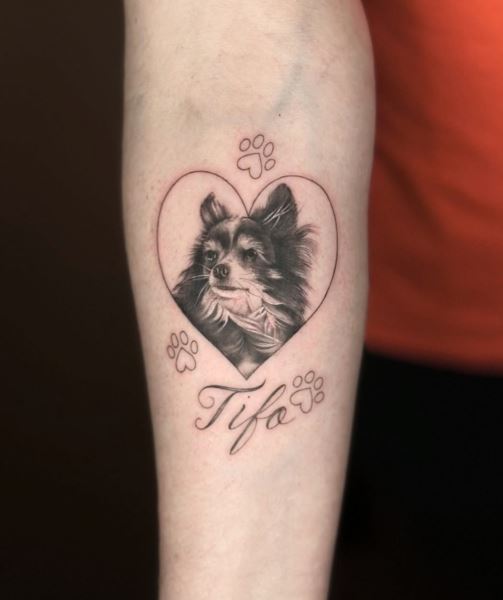
Q: Thinking back to when you were just starting out, what
was the single most surprising or difficult thing you had to learn
about the tattoo industry that no one really prepared you for?
A: In the beginning, everything was difficult. I had to solder my
own needles, which was extremely hard. I also had to find my own
clients, which was another big challenge, especially because around
1999 there was still a lot of prejudice against tattoos. At that
time, tattooing wasn’t seen as a respected profession like it is
today. So, in the beginning, I treated tattooing more as a hobby, I
didn’t think about making money or becoming a professional artist. I
simply did it for fun and out of passion.
Q: Your style is really unique. When you were first
developing your style, was there a specific pivotal moment or a
single piece that you felt really defined the direction your art
would take?
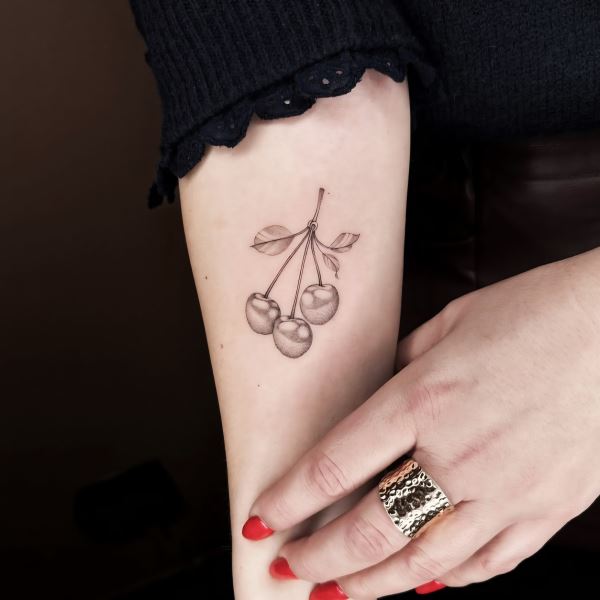
A: For many years, I worked with all possible tattoo styles - from
new school to old school. However, between 2016 and 2017, I noticed
a new movement emerging: the fine line style. These tattoos were
more delicate and subtle, with thin lines, sometimes combined with a
touch of realism. I was immediately fascinated by this style. Around
that time, I started creating my own designs and focusing on
refining my techniques, which led me to develop my own artistic
identity within fine line tattooing.
Q: Can you describe what the vibe or environment was like in
the first shop you ever worked in, and how that experience shaped
your approach to tattooing today?
A: The first professional tattoo studio I worked in was located in
the East Zone of São Paulo. It had a very pleasant atmosphere, kind
of underground, but really welcoming. That experience was extremely
important because it taught me how to deal with clients and how to
provide proper customer service. It made me realize how essential it
is to offer a high-quality experience, not only in the tattoo itself
but also in the way you treat people. At that time, I started as a
resident tattoo artist. I didn’t really go through the beginner
phase inside a shop, because I had already gone through that stage
at home, practicing on pig skin in a small room at my parents’
house. So when I entered a tattoo studio, it was already as a
professional tattooer. Of course, my first tattoos weren’t as good
as I wanted them to be, and it took me around two years to reach a
level of quality that I could truly consider professional.
Q: How would you define your style?
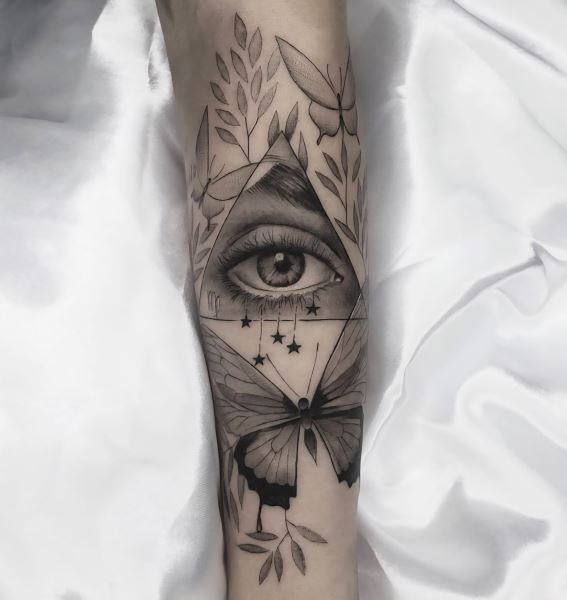
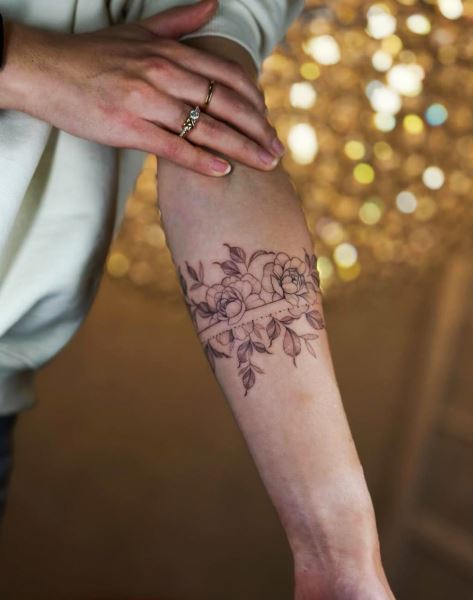
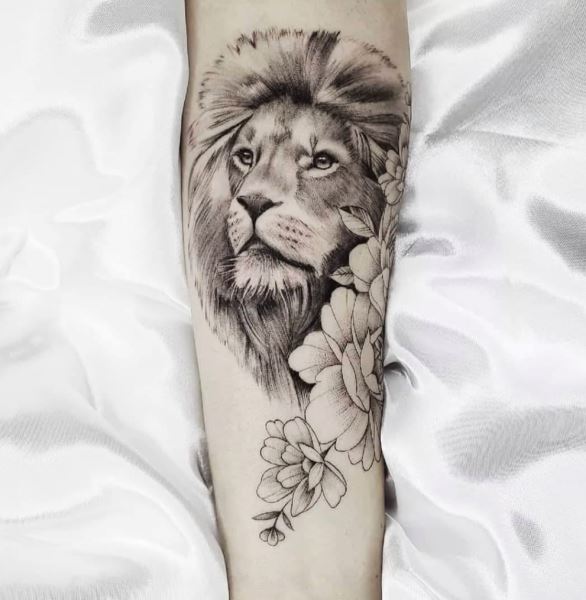
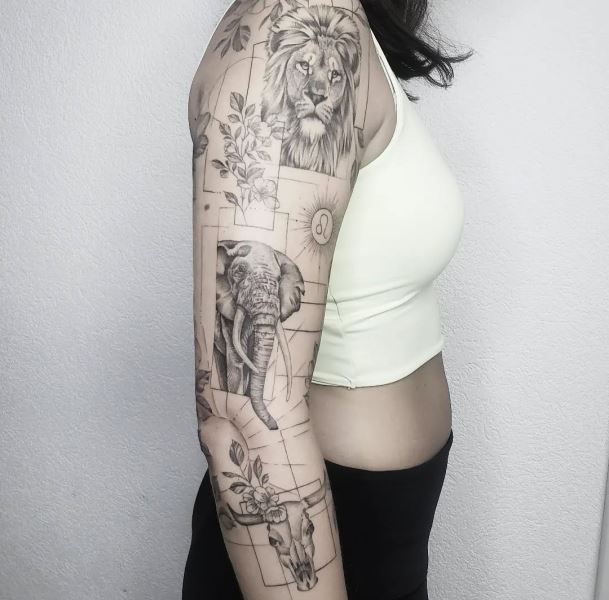
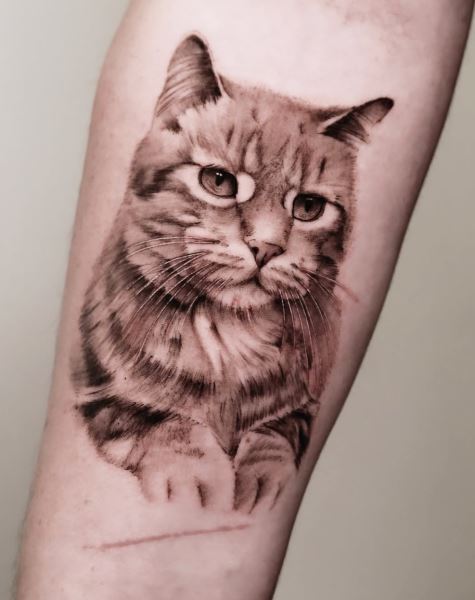
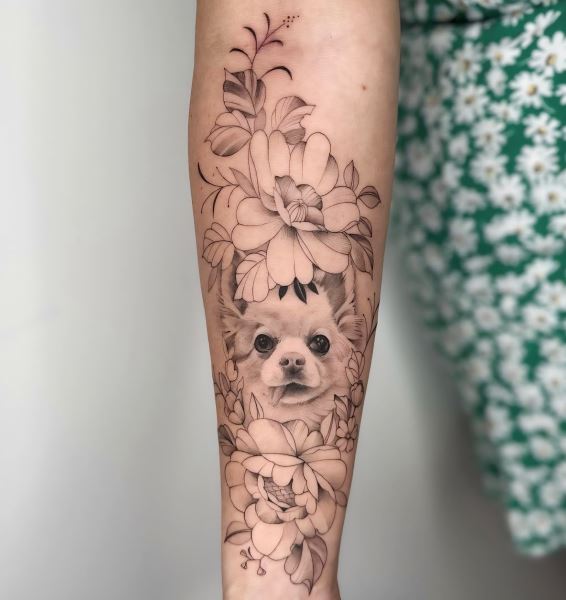
A: Today, I would define my style as fine line, but with a touch of
micro-realism. It’s a style that blends graphic elements and
geometric compositions, often incorporating a bit of storytelling,
aiming to tell a piece of the client’s life story through the
tattoo.
Q: What do you like the most about this style?
A: To be honest, what I love the most about the style I work with
today is being able to tell a person’s story through the art of
tattooing. It’s about helping someone eternalize a story, a moment,
or a phase of their life, and sometimes even helping them overcome
that moment. Of course, I also really enjoy the challenge of
creating small, highly detailed tattoos and turning multiple tiny
elements into a cohesive composition that looks beautiful and fits
perfectly with the body’s anatomy, all while telling a meaningful
story.
Q: Would you be open to exploring and developing new
techniques, perhaps integrating more color or different stylistic
elements, to broaden your range?
A: Yes, I’ve always been open to exploring new techniques and
improving my style. Tattooing is in constant evolution, and if you
stop learning or don’t seek to refine your techniques and evolve
your style, you end up falling behind. I believe growth as an artist
comes from continuous learning and adaptation.
Q: How do you guide your clients' vision while maintaining
the integrity of your art?
A: Usually, when a client contacts me, I like to schedule an initial
consultation. During this first meeting, I get to know my client and
listen to their story. The entire process begins with truly
understanding what the person wants to express through their tattoo.
I take all the notes I need and then schedule a second appointment
to present the design. In most cases, clients approve the design
right away. But if they don’t, we schedule a third appointment to
make all the necessary adjustments. Once the client approves, we
book the tattoo session. I always make sure to communicate openly
and clearly with my clients to understand exactly what they’re
looking for, so I can deliver a result that meets their expectations
100% while staying true to my artistic vision.
Q: Based on your experience, what design styles or subjects
are currently the most requested by clients, and which of those do
you consider the most difficult to execute technically?
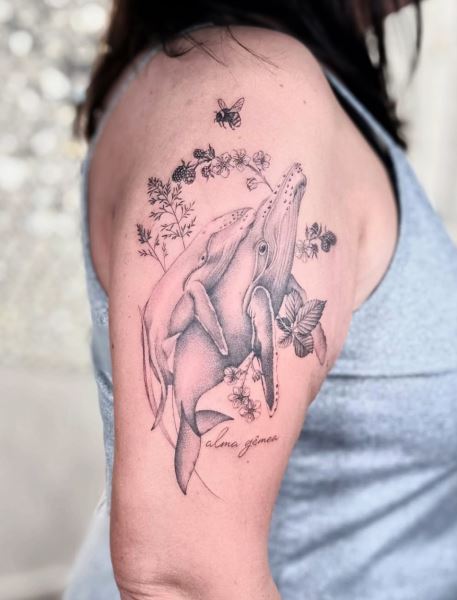
A: Currently, most of the clients who come to me are looking for
tattoos that tell stories of personal growth and overcoming
challenges. Recently, for example, a client came to me wanting to
get a tattoo of a whale, her favorite animal swimming alongside a
baby whale. She also asked to include some fruits and vegetation to
symbolize nature, which was where she found strength during her
recovery from cancer. To represent freedom, we added a small bee
flying above the fruits. And finally, the word “alma gêmea” which is
her favorite word in Portuguese, beneath it all, bringing harmony
and emotional balance to the entire composition. Each story is
unique and carries its own challenges. It’s up to the artist to have
the sensitivity to capture the essence of that story and use the
right elements to compose the design as a whole, creating a tattoo
that is both beautiful and deeply meaningful to the client.
Q: Do you have any favorite tattoo you did recently?
A: Yes, I do have a favorite tattoo. It’s a piece I recently created
for a client who is passionate about Ancient Egypt and astronomy. I
designed a tattoo that combines Egyptian figures with planets,
geometric shapes, and a central line that unites and balances
everything. It’s a composition that represents both her love for
history and her connection to the universe, a design full of
symbolism and harmony.
Q: Being a sponsored artist is a significant achievement. In
your experience, how has that sponsorship helped accelerate your
career development, not just in terms of supplies, but in aspects
like public recognition, networking opportunities, and securing a
higher level of respect and trust from your industry peers and
high-end clientele?
A: Being a sponsored artist is truly a privilege, and I’m very
grateful to my sponsor, who provides me with excellent tattoo
supplies. Having high-quality materials always helps us evolve as
artists. The sponsorship has also been a big help when it comes to
networking, especially at conventions, where other tattoo artists
notice who the sponsored artists are and often come to talk,
exchange experiences, and build connections. Many times, even
beginner tattooers approach me to ask how I achieve certain
techniques, and that’s very rewarding. What makes me happiest about
being a sponsored artist is the visibility it brings, not only among
clients but also among fellow artists, both beginners and
experienced ones, who show genuine interest in my work, my
techniques, and my style. And when it comes to clients, they feel
truly proud to get tattooed by a sponsored artist, because they
understand how difficult it is to earn that kind of recognition. To
receive a sponsorship, you really have to prove that your work
stands above average, that you’ve achieved a high level of
professionalism and consistency in what you do.
Q: Beyond tattooing, what creative outlets or pursuits do
you engage in that influence or fuel your work as an artist?
A: Today, as a full-time tattoo artist, I have a very busy schedule,
which doesn’t leave much room for other activities. When I’m not at
the studio, I’m at home being a father of two and a husband, so my
free time is very limited. However, what truly inspires me is seeing
new tattoo artists emerge, especially those who come onto the scene
with incredibly high-level work. When I see that kind of talent and
dedication, it really motivates me and inspires me to keep evolving
as an artist.
Q: Where is your tattoo studio?
A: Currently, I don’t have my own tattoo studio. I chose not to own
one so that I could have greater geographic freedom. I work mostly
as a guest artist and do many tattoo tours in different studios.
However, when I did own a studio, the most challenging part of
balancing those responsibilities, managing the business while
keeping up with a full tattoo schedule, was definitely the lack of
time to do both with the quality they deserve. Running a studio
requires a lot of energy and attention, and it can easily take focus
away from the creative process.
Q: Are you currently taking on new clients, and if so, what
is your typical wait time for an appointment?
A: Yes, I’m always open to taking new clients. However, I work with
a waiting list. I keep clients’ names on the list, and whenever
there’s a cancellation or rescheduling, I contact them to fill the
available spot as soon as possible. On average, the typical waiting
time for an appointment is between 30 and 60 days.
Q: What's your take on the local tattoo scene? Do you see
progress?
A: In my opinion, the tattoo scene has changed a lot over the past
few years. Tattooing has evolved from an underground culture into
something that has become increasingly popular over time. Today, I
see an industry that is extremely profitable and constantly growing,
every year it expands even more. With this popularization, the
market has opened doors for different styles and new kinds of tattoo
studios. Nowadays, we can even see studios focused exclusively on
female artists, or studios that specialize only in oriental styles.
I think that’s a very positive sign, tattooing is definitely
progressing and continuously evolving. And I truly hope it keeps
growing and improving for the next 20 or 30 years.
Q: Could you share how the experience of traveling as an
artist around the world has specifically advanced your career and
unique style?
A: Traveling and doing guest spots in several studios around the
world has definitely played a huge role in my development as a
tattoo artist. It allowed me to learn different techniques, discover
new materials, and continuously refine my own style. Beyond that,
getting to know new cultures and tattooing in different countries
has been an incredibly enriching experience. You can clearly see the
differences between countries when it comes to tattoo styles and the
type of clientele. Today, I mainly work in Germany and Belgium, but
I recently had the opportunity to tattoo in Dubai and it’s amazing
to see how the artistic approach and client preferences change from
place to place. As an artist, you always have to adapt to the local
audience, understand, and respect those cultural differences. It’s a
beautiful and enriching process, both professionally and personally.
Q: Do you participate at tattoo conventions?
A: For many years, I was quite reserved about tattoo conventions. I
always believed that art couldn’t truly be judged, and for a long
time, I held on to that idea. However, recently I decided to
participate in a few conventions, partly to challenge myself and
also to open my mind and see if I wasn’t overlooking something that
could be important for my career. This experience turned out to be
extremely enriching. So far, I’ve participated in three tattoo
conventions. In 2024, at a convention in Belgium, I won first place
for Best Black and Grey Tattoo. And this year, again in Belgium, I
won first place in the Black and Grey category and also received the
award for Best Tattoo of the Day. Testing myself as an artist after
so many years in the industry and receiving this kind of recognition
was deeply gratifying. It made me change my perspective about tattoo
conventions and appreciate them as a great way to grow, connect, and
evolve as a professional. And I definitely plan to keep
participating in tattoo conventions, bringing my art and my
technique to different places, and showing people the quality of my
work. It’s also a great opportunity to network, meet new people, and
exchange experiences, something that’s always very valuable and
enriching for any artist.
Q: Given your current international recognition and
experience is exploring long-term professional opportunities or a
permanent move to the USA part of your career plan, and if so, how
do you feel your style would translate into the American tattoo
market?
A: I’m always open to new opportunities, and the United States is a
country that truly fascinates me. I would love to start by
participating in tattoo conventions there, bringing my art,
showcasing my work, and sharing my style at major events. I believe
my style would fit very well in the American tattoo market, because
there aren’t many artists in the U.S. who focus on fine line, micro
realism, and especially storytelling tattoos. The scene there is
still dominated by traditional American and realism styles, so I
think my approach could add something new and different. In the
future, if everything goes well, moving to the United States could
be a very interesting and exciting possibility for me, both
personally and professionally.
Q: Where in the USA do you believe the market dynamics, such
as artist community, demand, and potential for studio ownership,
create the strongest environment for a top-tier tattoo artist to
maximize their long-term success?
A: I don’t know the American market deeply yet, but I follow many
artists who live and tattoo there. I believe Miami is a great place
for tattooing, and I also think Texas offers many opportunities for
tattoo artists. I have a close friend who lives and works in
Colorado, and he always speaks highly of the tattoo scene there.
However, considering my lifestyle and my vision of tattooing, if I
had to choose one region in the United States, without a doubt, I
would choose Texas.
Q: What impact do you aspire to have on the tattoo
community?
A: The impact I’d like to have on the tattoo community is to show
that tattooing goes far beyond aesthetics. Tattooing is art,
expression, emotion and, many times, healing. I want to inspire new
artists to believe in their own style and understand that there
isn’t just one path to success; everyone can find their own through
authenticity. I also want to be remembered as someone who helped
elevate the standard of tattooing, always striving for growth,
sharing knowledge, and showing deep respect for this craft that
completely changed my life.
Q: For the new artists entering the highly competitive
tattoo industry, what's one key piece of advice for developing their
unique artistic voice and navigating the business side of the
industry?
A: The advice I would give is the same one I’ve shared with many of
my students: focus on the art. Focus on your art and on the quality
of your work, because money will always be the natural consequence
of a job well done.


