
Interview with Gaijin
Hello Gaijin! Thank you so much for taking the
time to do this interview. Please start by telling us something
about yourself and your background. What sparked your initial
interest in art? My name is Gaijin. I am 31 years old, originally
from Ukraine, and I have been tattooing for 8 years. I studied at an
art college majoring in applied arts, specializing in wood carving.
I was always surrounded by art because my father also studied in
that college, and I wanted to follow in his footsteps, that’s how my
artistic journey began.
Q: When and how tattooing came into the picture? Did you
have a mentor or took an apprenticeship?
A: During my studies, I explored different methods, techniques, and
ways to express my inner world, but it still wasn’t enough, I wanted
something more. So I decided to use a more delicate and refined
canvas: the human body. I started learning on my own because in my
small town there was almost no information about tattooing at that
time. I had to find everything myself. I began with handpoke, trying
to understand the interaction between the needle and the skin. Over
time, the tattoo industry grew more popular, and more people became
interested in it. Then someone appeared in my life who saw something
in me that I didn’t see in myself and gifted me my first tattoo
machine, it was unbelievable.
Q: How long did it take you to find and define your tattoo
style?
A: In the beginning, like everyone else, I tattooed everything I
could, searching for what resonated with me the most. It took about
five years to realize that I wanted to create something abstract and
more brutal than just clean, illustrative tattoos.
Q: What was the transition from a beginner level to working
in a professional tattoo studio?
A: Everything unfolded naturally, I worked, and more people learned
about me, and eventually it was time to move from an informal
environment into a more professional one. A friend recommended me to
a local studio, where I finally started to grow and find myself as
an artist.
Q: You have a really cool style. How would you define it?
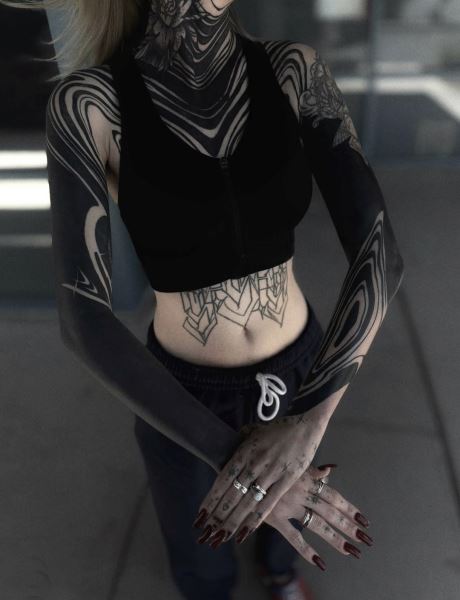
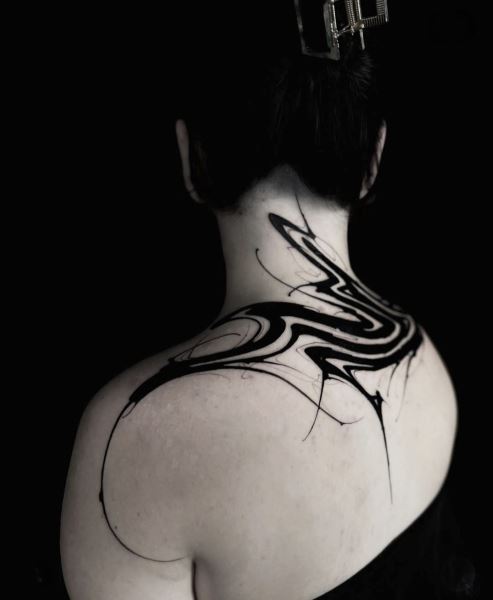
A: An interesting question. I was mostly inspired by Japanese
culture and discovered the technique called “suminagashi.” But I
don’t follow it literally I try to find a symbiosis between this
technique and what I feel inside. I’m still exploring, so for now I
call it abstract expressionism.
Q: Where do you draw the most inspiration for these
abstract, sometimes almost organic or liquid shapes? Are there
specific art movements, nature elements, or other tattoo artists
that heavily influenced this direction?
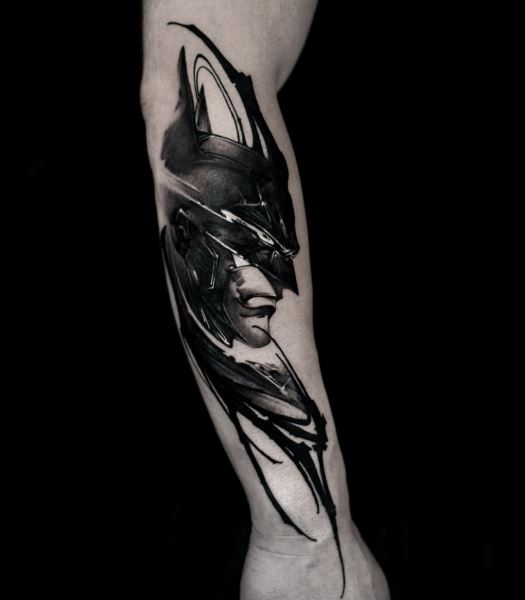
A: When I started building my own style, I didn’t look up to anyone.
I simply searched for a harmonious combination of movement, shape,
and interaction with the body’s anatomy. Nature helped me a lot, I
used to work with wood and its textures, and I drew a lot of
inspiration from that. In reality, everything in nature inspires and
motivates you to try something new, helping you create new forms and
solutions.
Q: Your pieces look designed for the body. When designing a
piece, especially a large one like a full sleeve or back piece, how
do you plan the 'flow' and movement of the lines to ensure they
complement the client's anatomy?
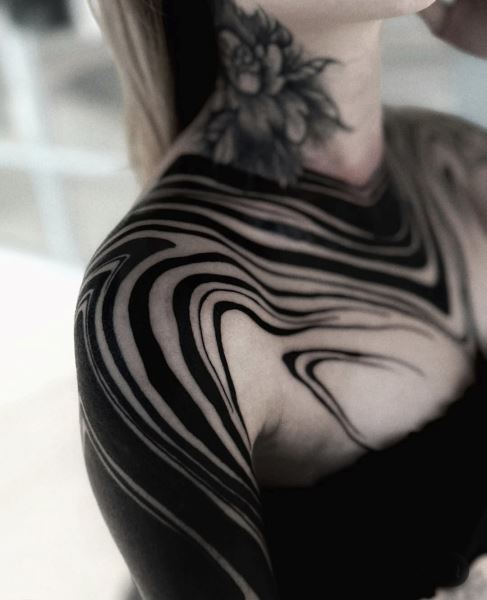
A: What’s interesting is that neither I nor the client ever knows
what the final result will be. It’s always a process interaction,
conversation, and inner feelings. Eventually, through communication,
I create something that fits the client’s personality, harmonizes
with their inner self, and highlights their anatomy.
Q: How much of your work, particularly the highly abstract
pieces, is done freehand directly onto the skin versus using
stencils?
A: Ninety-nine percent of my work is freehand. Sometimes, if the
project is small and simple, I may use a stencil, but I still prefer
freehand because it connects more naturally with the body.
Q: Since the designs are often abstract, how do you
communicate the vision to a client? Do clients come to you seeking a
specific feeling or energy rather than a concrete image, and how do
you translate that into ink?
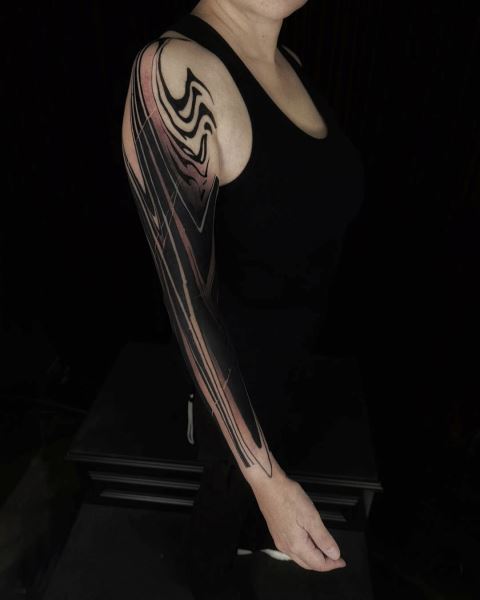
A: I’m lucky to have clients who usually give me full creative
freedom, only sharing general preferences like adding more black,
more flow, or more details. For them, it’s a process of merging
energies with the artist - emotions and experience.
Q: Many of your pieces don't have a clear narrative,
inviting the viewer to project their own meaning. What do you hope a
client or an observer feels or interprets when they see one of your
abstract tattoos?
A: The first impression is often mixed, people don’t always
understand what’s happening. But as soon as they start looking
closely, more and more meanings and images appear. I love watching
their reactions when they first see the complete project. Everyone
sees something different, some see what they want to see, others see
what they need at that moment. It’s priceless.
Q: Blackwork, carries a certain weight and history. For you,
what is the power or philosophy behind choosing black ink for such
large, definitive statements on the body? Are you open to experiment
with color?
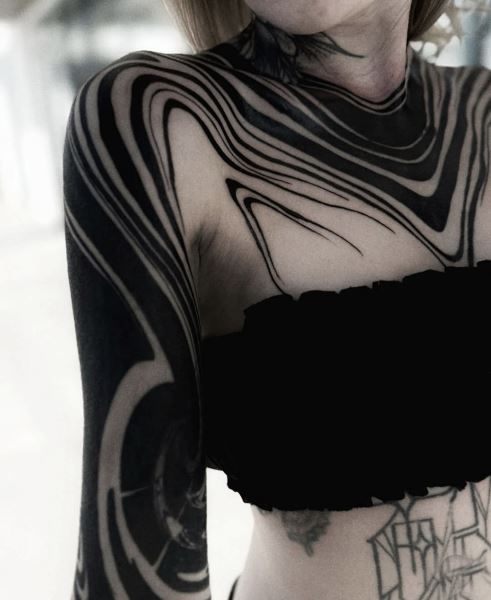
A: For me, blackwork isn’t always about brutality or aggression.
That’s what I love about it, the range of emotions. It becomes
whatever its wearer is, expressing what is hidden from others. I
have long wanted to experiment with color in my style, but I still
haven’t found the path that would support my ideas and mood. I hope
to solve this puzzle soon.
Q: A tattoo of this size and style is a profound
transformation. How do your clients describe the change in their
self-perception or identity after receiving one of your large-scale
pieces? Any interesting stories from your clients?
A: Such projects definitely change lives and influence self-esteem,
that’s the point. Many clients come back and tell me how much more
confident they’ve become and that their tattoo was one of their best
decisions. Some overcame depression, some found love, some improved
their careers, some even became models. When you hear such stories
and know you contributed to them, it’s incredibly inspiring.
Q: On your Instagram, you regularly feature 'Wanna Do'
designs in a story highlight. What is the motivation behind creating
a dedicated collection of pre-drawn pieces? Are these designs meant
to explore new directions in your style, attract a specific type of
client, or perhaps challenge yourself with shapes and placements you
haven't tackled yet?
A: Yes, I create and post many designs, but I never use them as
final versions. They are rather examples of how certain ideas may
look on the body. While drawing new designs, new forms and flows may
appear, but during the actual session everything can change. I also
avoid reusing these designs because someone might take them and
tattoo on another person and repetition is not my approach.
Q: For our readers, could you please provide your studio
location, website, and social media links? Additionally, please let
us know your current availability for bookings.
A: I was lucky to join Basilica Tattoo, where I worked for almost
two years. They welcomed and supported me. But soon I will return to
Europe and work mainly there while traveling. Bookings will open in
February, and I’m open to collaborations.
Q: What projects or opportunities are you most excited about
pursuing, and how do you envision them contributing to your
continued artistic growth?
A: I want to collaborate with clothing, footwear brands and others.
I want to leave a part of my art on canvases and create exhibitions
so more people can experience it. I have many ideas and creative
impulses that will contribute to artistic and cultural development.
Q: What's your take on the local tattoo scene? Are you
seeing any exciting developments, like new artists, styles, or
events?
A: The tattoo industry is developing rapidly, new tools and
application methods appear, young artists bring unusual ideas.
Culture doesn’t always accept these changes easily, but I think it’s
great the new generation can transform the industry. This craft will
never stand still, and I’m glad about that.
Q: What's next?
A: Who knows what the future holds, life will show. But I want to
leave behind more happy people, change their lives for the better,
and give them joy through meaningful projects.
Q: If you could go back and give your younger self advice
about pursuing tattooing, what would it be?
A: Don’t be afraid to experiment, communicate more, and open
yourself to the world.


