
Interview with Gennadiy Golovach
For Gennadiy Golovach, the journey to becoming one
of Glasgow’s most sought-after artists began long before he picked
up a tattoo machine. Originally a painter, Gennadiy’s work carries
the soul of a fine artist into the permanent world of skin. By
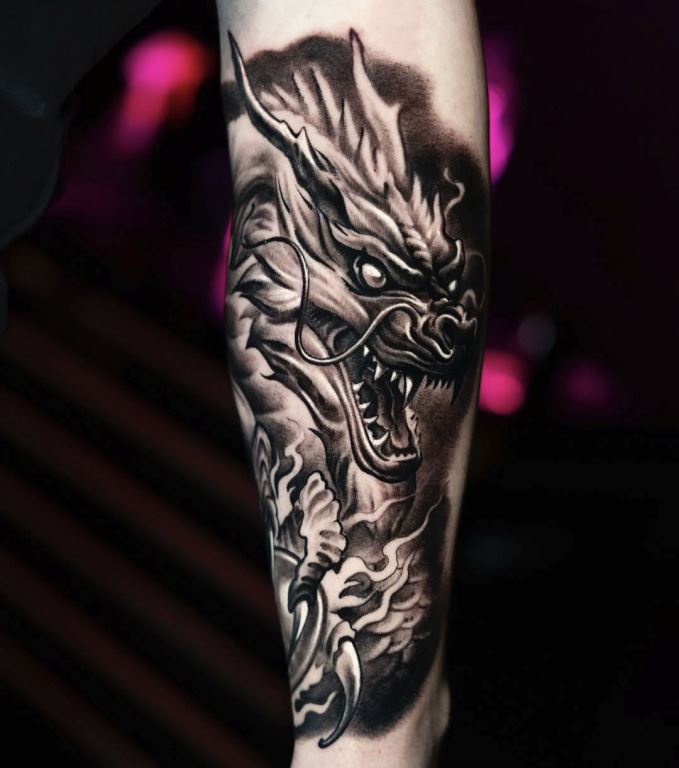
fusing the delicate storytelling of Japanese mythology with the
sharp, high-contrast impact of modern realism, he creates pieces
that don’t just sit on the body they flow with it. From vibrant,
electric-hued dragons to hauntingly soft black-and-grey portraits,
Gennadiy’s portfolio is a masterclass in how tradition can be
reinvented for the modern age.
Q: Your bio mentions you are a painter as well as a
tattooist. During your early years, how difficult was it to
translate your knowledge of 'brush and canvas' to the vibrating
needle and the varying textures of human skin?
A: At first, my biggest challenge was a total lack of technical
knowledge. While I could draw, I didn't understand fundamentals like
the correct needle angle, how to handle the machine, how to create
clean lines, or how pigment interacts with living tissue. I was
largely self-taught, and at that time, there wasn't nearly as much
information available as there is today. I had to experiment and
gradually figure out what worked. I vividly recall working on a
tribal tattoo: I applied a solid layer of color that looked perfect
initially, but once healed, it turned into a patchy texture of dots.
That experience showed me firsthand the difference between immediate
results and how tattoos actually settle into the skin. These days,
beginners have it much easier thanks to abundant resources and
training.
Q: Every artist has a steep learning
curve. What was the most frustrating technical skill for you to
master in the beginning?
A: I think the hardest skills to master were creating deeply
saturated colors and achieving a gentle softness in blacks and
grays, especially with clean transitions and no visible "peppering."
While stippling is a popular style today, it was actually frowned
upon when I began back then, soft, smooth gradients were held in
much higher regard.
Q: When you were starting out, what drew you to the
symbolism of animals and nature rather than more 'Western' tattoo
styles?
A: Initially, it was accidental. A client requested that type of
subject matter, and as we worked on it, I discovered how much I
enjoyed the flow. Later, a client gave me a book on Japanese
mythology, which sparked my own curiosity. The stories, symbolism,
and imagery felt like stepping into another world with endless
opportunities for discovery and personal interpretation. Over time,
I realized this was the direction I wanted to pursue permanently.
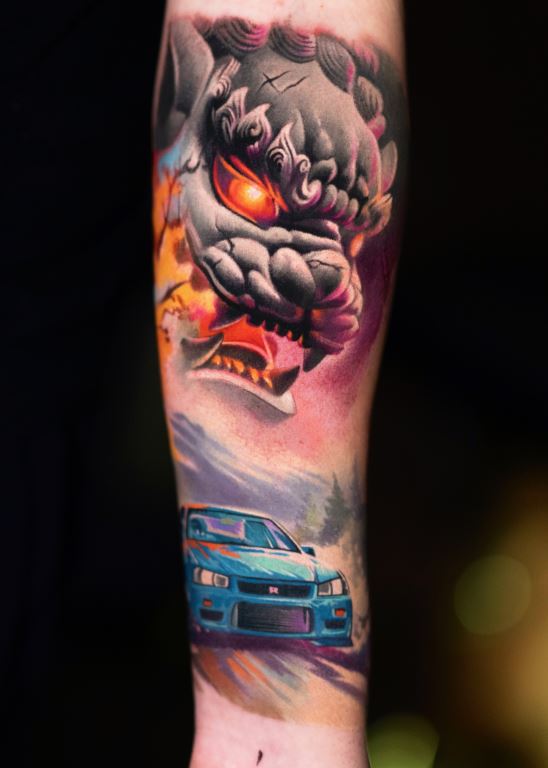
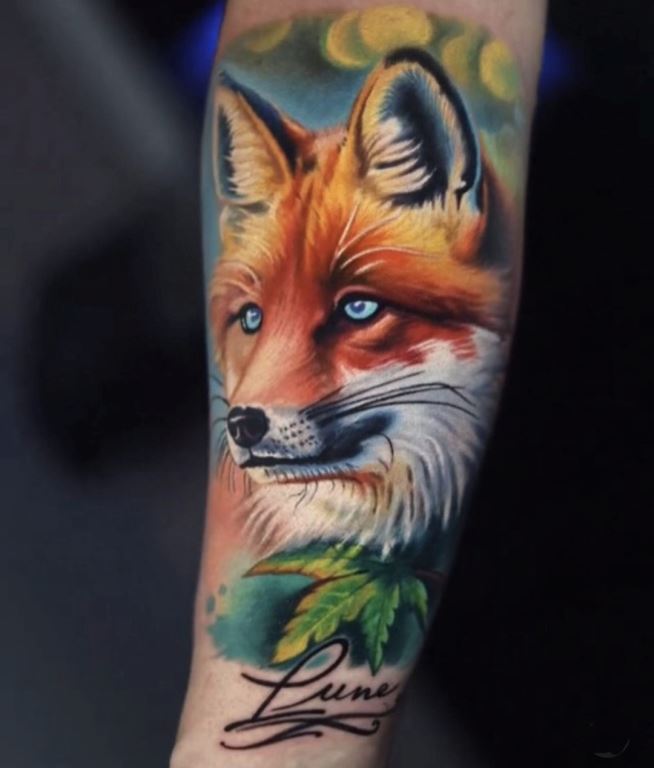
Q: How do you approach color theory differently on skin
than you would on a canvas? Your use of vibrant reds and blues has a
specific 'glow' what is your secret?
A: The technique differs substantially from canvas because skin is a
living medium that naturally reduces saturation as it heals. You
have to account for this before the needle even touches the skin.
Achieving the best results requires precise pigment density and an
understanding of how colors shift once fully settled. Rather than
chasing immediate brightness for a photo, my process ensures
long-lasting, vibrant tones after recovery. Saturation is achieved
through a balanced approach of dense pigment placement, high
contrast, and thoughtful composition. Color alone isn't enough; you
need overall harmony.
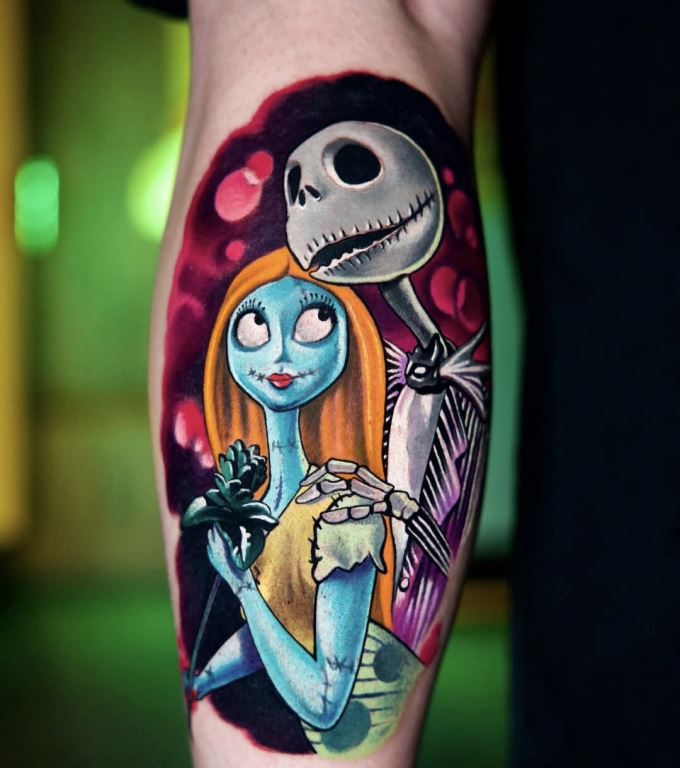
Q: Do you consider high-detail realism or
illustrative Japanese your 'primary' language?
A: I don't think it's necessary to limit yourself to one or two
styles. It is perfectly natural to explore various paths for growth
even when you have a preference. Gaining knowledge of different
methods is incredibly beneficial. For instance, if a black-and-grey
artist decides to work in color without prior experience, the piece
may lack the strength of their usual work. Additionally, sticking to
one style can quickly become monotonous. Mixing styles and project
sizes keeps the work interesting and prevents creative stagnation.
Personally, I prefer having a diverse toolkit rather than confining
myself to one approach.
Q: How much of a large-scale design is planned on a computer
versus 'freehanded' onto the body?
A: The core design composition, narrative, and body movement is
planned ahead on a computer. However, since every body is unique,
final adjustments always happen on-site. I watch how the piece fits
and moves with the muscle structure, making tweaks directly on the
skin to unify the look. The concept is set, but the finished result
truly emerges during the application.
Q: How do you handle the 'negotiation'
when a client’s idea might not age well?
A: I make it a point to explain not just how a design looks now, but
how it will look in ten years. If I see a design that won’t hold up
or will lose clarity, I suggest adjustments immediately. This
usually leads to a constructive conversation rather than conflict.
My aim is to find a solution that respects the client’s vision while
maintaining the quality of the art. I wish every client knew that
tattoos aren't like pictures on paper they are art on living,
changing skin.
Q: Which of your projects demanded the most 'intellectual'
labor?
A: It’s hard to pick just one, as most large-scale pieces involve
overlapping challenges: intricate anatomy, grand scale, and dense
composition. Often, as a piece evolves, you realize the original
plan falls short, prompting on-the-spot redesigns that demand total
adaptability. Working with clients who welcome fresh ideas allows
for much richer results. Ultimately, these dynamic collaborations,
where the plan can shift for the sake of the art, yield the most
impressive outcomes.

Q: What is the most moving story a client
has shared with you?
A: I hear many moving stories, though they are often too personal to
share in detail. People often approach me to commemorate loved ones,
milestones, or significant life shifts. It's in those long sessions
that you realize a tattoo is far more than just an image; it is a
deeply meaningful part of someone’s identity.
Q: Have you had 'regular' clients since your early days?
A: Yes, I have clients who have been with me since the very
beginning. It’s been rewarding to see their tastes evolve alongside
my professional growth. Over time, we develop a mutual trust that
allows for much greater creativity and efficiency. Several clients
even travel to different cities to continue our work. These
relationships eventually extend beyond the artist-client dynamic;
they become enduring friendships.
Q: How does the 'tattoo culture' differ between Glasgow and
Europe?
A: The differences aren't as significant as they used to be.
Europe’s understanding of tattoo art is very advanced now. I have
noticed a rising trend in requests for Japanese-style work over
time. Generally, there is a growing desire for unique, personal
designs rather than generic ideas, which is very encouraging for an
artist.
Q: Studio location and bookings?
A: I work across several European cities, including Glasgow, and I
frequently travel for guest spots. For updates and appointments, the
best place to check is my social media. Appointments are arranged
individually based on the specific needs of each project.
Q: How have you evolved your discipline and stamina to stay
at a high level?
A: Endurance comes from consistent practice. Over time, you learn to
listen to your body, manage your workload, and avoid burnout.
Physical fitness and nutrition are crucial they directly influence
your stamina and performance during long sessions. Inner calm is
also key; it’s impossible to stay focused for eight hours without
it. Finally, having hobbies unrelated to tattooing allows me to
mentally recharge and expand my outlook.
Q: How do you define success today?
A: In the past, success was about technical milestones: clean lines
and precision. Today, success is about harmony. It’s about the work
fitting the wearer perfectly and fulfilling a shared vision. I value
the feeling of being satisfied with both the process and the
outcome. Success isn't just a skill level; it’s about meeting the
high ambitions you set for yourself.
Q: How have REACH regulations pushed
innovation in Europe?
A: These standards have fundamentally shaped the industry. Artists
now pay much closer attention to their materials and how they
perform during healing. While black-and-grey work hasn’t changed
much, colored pigments have been heavily impacted. Many new pigments
are being developed, but it will take years to see how they hold up.
In some ways, we’ve taken a step back to ensure long-term safety,
which requires more testing and observation.
Q: Why are clients moving toward bold, illustrative
mythology?
A: Clients are becoming more sophisticated and have higher
expectations. As generic "Pinterest-style" tattoos lose their
appeal, there is a return to classic, thoughtfully designed styles.
People want cohesive, personalized pieces and are showing greater
trust in the artist’s vision. Classic styles, like Japanese
iconography, are now viewed as fine art. Both technical skill and
the artist’s unique "author voice" are more valued than ever.
Q: Has Instagram helped or hurt the 'local' flavor of tattoo
shops?
A: The internet is a double-edged sword. It’s a great tool for
staying updated on trends and learning, but the sheer volume of
"noise" can be overwhelming. I’ve actually decided to cut back on my
screen time because it can hinder creativity more than help it. It’s
important to stay informed, but more important to trust your own
path. Face-to-face interaction at shops and conventions provides an
energy and motivation that the internet simply cannot replicate.

Q: What was the biggest surprise when you
entered the UK scene?
A: It wasn't so much a surprise as a shift in environment. You can
immediately feel the intense competition and the high concentration
of talent here. I also noticed that price competition affects the
atmosphere and the format of the work. However, these are common
challenges in any country. You quickly adapt to the logic of the
local scene and find your place within it.
Q: Do you participate in conventions often?
A: For me, conventions are about connection and exchanging ideas
rather than winning awards. Seeing another artist’s creative process
firsthand is far more valuable than browsing an online gallery. Even
a brief conversation can inspire a change in your own technique.
These events are high-energy and open your mind to styles you might
not encounter in your home studio.

Q: Do you see a future where your oil
paintings and tattoos are exhibited together?
A: Absolutely. The line between "Fine Art" and "Tattoo Art" is
blurring. Tattooing is increasingly recognized as a form of
contemporary art rather than just a craft. Personally, I see
painting and tattooing as two different expressions of the same
creative drive. They share the same roots in composition and
narrative, and it makes perfect sense for them to share a gallery
space.
Q: What does the level of trust from your clients mean to
you personally?
A: It is a serious commitment. Your art becomes a permanent part of
someone’s life, and that responsibility never fades, no matter how
much experience you gain. The goal is always to create something
that lasts. It is a true privilege when someone invites you to put
your vision onto their skin forever.
Q: What's next?
A: I want to keep refining my path. I’m eager to explore my current
style in greater depth and take on more meaningful, large-scale
projects. I’m looking for collaborations that push me to grow both
professionally and personally.

Q: What is one thing about 'traditional'
tattooing you hope never changes?
A: The fundamental values of quality and technique. I’ve recently
returned to using coil machines, even though I once thought of them
as outdated. Now, I see their irreplaceable benefits for lining.
Using traditional tools and needles provides a level of satisfaction
that I don't think modern technology will ever fully replace.
Q: What is the first step for an aspiring artist to develop
your level of discipline?
A: Master the basics and don’t rush. You need a rock-solid
understanding of line, shape, and volume before you move on to
complex details. There are no shortcuts; true progress comes from
steady, diligent effort. Draw every day and practice on artificial
skin it allows you to experiment and improve your technique without
the stress of working on a person. I still do it myself
occasionally, just for the enjoyment of it.


