
Interview with Gustavo Bulldog Tattoo
Hello Gustavo Bulldog Tattoo!
Thank you so much for taking the time to do this interview. Please
start by telling us something about yourself and your background. Do
you have any formal art training? Hello, I'm Gustavo. I was
born in Venezuela, but I have lived in Spain for the last 20 years,
which is my current residence. I have traveled extensively
throughout Europe and the Americas. I love traveling, and thanks to
my job, I have been able to enjoy many cities and countries. I am
passionate about music, motorcycles, and cars. I could say that from
a young age, drawing came more naturally to me than painting. Later
on, I began experimenting with techniques such as pastels and
airbrushing (my mother will remember this well, hehe). I am
self-taught, although I did take some painting classes at some
point, but they didn't have a significant impact. Currently, I never
stop learning because in this profession, one must continuously
update and learn.
Q: Since when you got interested in art, especially
tattooing?
A: I started with art at a very young age and switched from
airbrushing to tattooing. That happened when I was 14 years old.
People are often surprised when I say I started at 14, but it's
true. I alternated between painting and selling t-shirts and
practicing tattooing on friends. At the age of 16, I decided to
dedicate myself to tattooing more professionally while still
studying.
Q: Do you have any favorite artists you look up to?
A: I have many favorite artists, some related to tattooing and
others not, such as Gustavo Dore or HR Giger. But in the world of
tattooing, my greatest influence from the beginning has been Paul
Booth. Others include Victor Portugal, Edgar Marquez, Robert
Hernandez, Rob Borbas, among others.
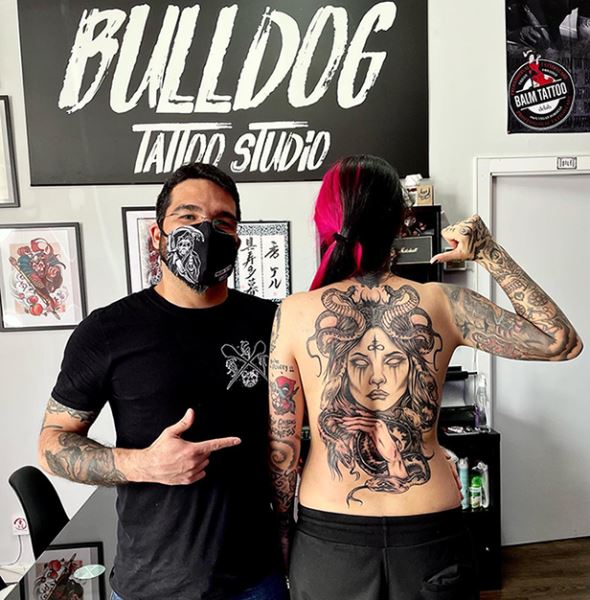
Q: So how did it all start?
A: It all started at the age of 6 when a friend of my father had an
anchor tattooed. Seeing that drawing on his skin, which didn't fade,
fascinated me. Even now, mentioning it brings back that feeling.
That's when I began to inquire and inform myself, although at that
time, it was difficult to learn about tattoos. About 6 years later,
thanks to my passion for music, I saw the tattooed arm of Nikki
Sixx, the bassist of Mötley Crue, which added to my fascination with
tattoos. If we count from when I started considering tattooing as a
career, it's been about 27 years since I rented a small space in a
beauty center.
Q: How long took you to figure out your creative direction
and learn the basics?
A: I believe the first step would be the basic notions, which I
already had because I've always drawn, and in reality, my first
tattoos were freehand. Then comes the creative direction, which I
developed over the course of my career by experimenting with various
styles from different eras, focusing on what I enjoy the most and
where I feel most comfortable to unleash my creativity.
- Did you have any help? Or you are self taught artist?
Speaking of the beginnings, I didn't have much help. I learned
tattooing and hygiene measures through common sense or by asking for
advice from a friend's father who was a doctor. Keep in mind that
we're talking about almost 30 years ago. It's true that later on, I
did receive formal training as an apprentice in a studio, even
though I had been tattooing for about 3 years.
Q: Talking about creative direction, there are many new,
interesting tattoo styles nowadays, but you seem to lean towards
tattoo realism. Why, what do you like the most about this style?
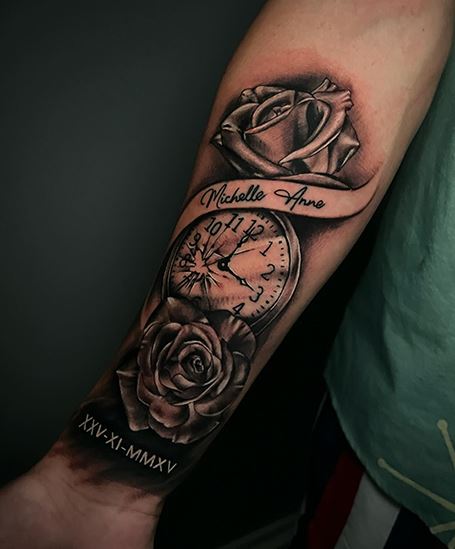
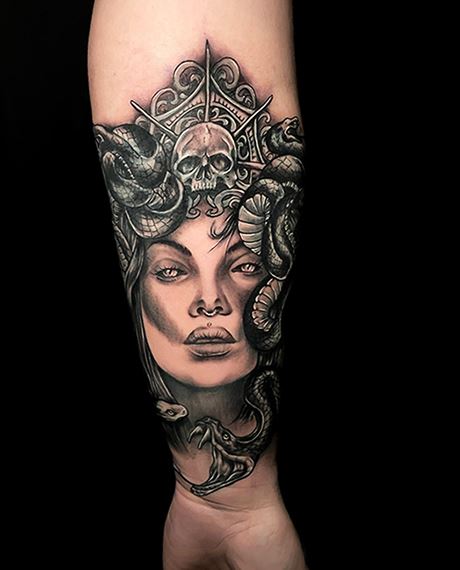
A: To be honest, it's a style that I enjoy, but it has come to me
because it's popular. I really enjoy working with shadows, textures,
realism embodies a part of that, especially animal realism, which I
enjoy the most. However, I would prefer to be asked for more
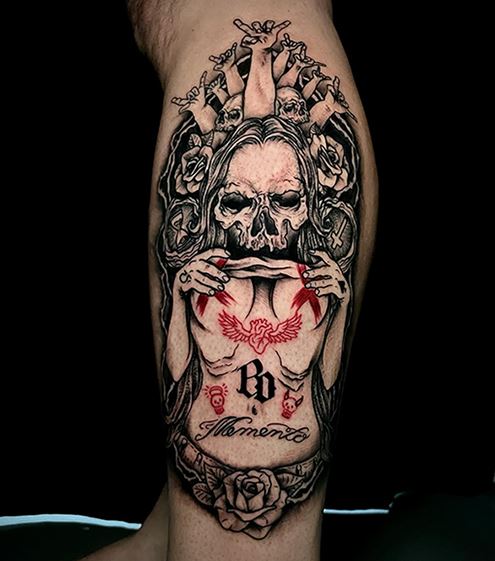
freehand designs, leaning towards dark terror or surreal dark
styles, which don't often come from most clients.
Q: Mostly back and gray, however there are some really cool
color tattoos in your portfolio. Which technique you like more?
A: Definitely black and grey. For my taste, it's more elegant. I
enjoy working with black tones and contrasts. There are techniques
typically used for color tattoos that I apply to black and grey
works, but I'm one of those who use all shades of black gradients.

Q: What do you say to someone who doesn't know what they
want, they're indecisive. Do you have any ready-made designs for
inspiration?
A: If someone comes indecisive, I always offer them a skull! Lol.
Usually, I have some designs, but I start by asking them about their
interests, hobbies, etc to have at least some reference. In most
cases, this approach works, but if it doesn't, I have some designs
available for them to choose from. I think it requires a
conversation, dedicating time to the client, and reaching an
agreement.
Q: I'm sure most of your clients want a unique tattoo. Do
you draw for each client? How long that could take and what do you
do if someone changes their mind "least minute" do you have any
rules for this?
A: Most of my clients come with a reference, from which I create a
personalized design, not only in terms of the design itself but also
by adapting it to the body. The process depends on the project and
the time I personally have to design. There are single-session
projects, which are usually easier, and then there are multi-session
projects that require composition, discussing more about what they
like, offering them an initial sketch to see if I'm on the right
track. That's why last-minute changes aren't common. Regarding
changes, it depends on the project. If they're minor changes, I have
no problem making them as long as the client is also sure of what
they want, but if it is a big change, a larger project or very
radical change, it's better to reschedule the appointment. Although
that hasn't been the case for me.
Q: How important is it to be open minded when it comes to
ideas, are there any designs you simply won't tattoo?
A: For me, it's very important to have an open mind when designing
and creating, especially when you want to do something personalized
or with a special meaning for the person. Regarding designs I
wouldn't do, it would be more related to those that don't endure
over time, or if what they're asking for isn't suitable due to size
or location.
Q: I bet every creative person strives to be better, learn
more and improve. Would you try maybe a different style?
A: Yes, in fact, I like to step out of my comfort zone and face new
challenges. Although my portfolio predominantly features realism and
black and grey, I've also done other styles like traditional or
neo-traditional.
Q: Do you have any creative hobbies like painting, digital
art etc?
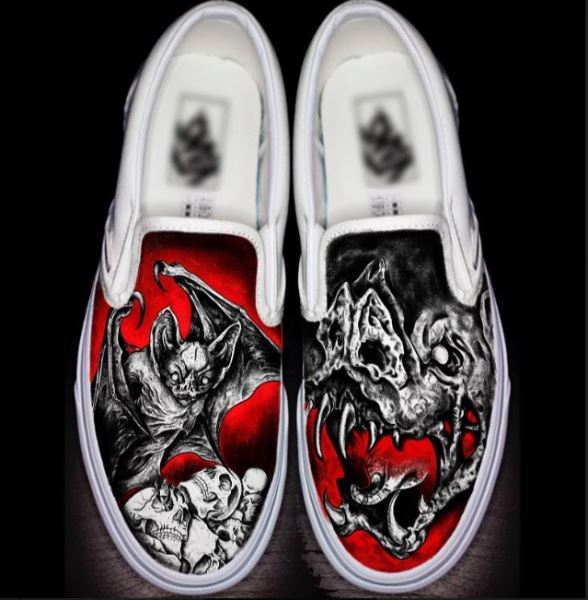
A: Not particularly, but a few years ago, I discovered that I really
enjoy and find it relaxing to paint sneakers.
Q: Today's the tattoo scene, globally is very different and
I think there are many opportunities for growth and success. Unlike
just ten years ago. We should cherish this and make the most of it.
Do you agree? What's your opinion about the global tattoo scene?
A: It's a question with a rather complex answer that covers a lot.
Yes, I agree. Nowadays, it's much easier to access information,
courses, supplies, and tools are much simpler and more accessible
than before. Consequently, growing as an artist and learning this
art form becomes easier. It's true that being more accessible means
there are many more artists, and very good ones at that. Contrary to
what many tattoo artists think, for me, it's another reason to
improve and grow as an artist.
Q: As a traveling artist, where do you like to go again?
Which country has the best tattoo scene and are you looking forward
to exploring more?
A: I think for all artists, without a doubt, the United States is
the best place to continue developing. So that's my next goal. I've
had it in mind for a while now, and I believe it's the right time to
advance in my career.
Q: Are there any artists you would like to work with?
A: I would love to work with Edgar Marquez. He's an artist whose
style I really like, how he works. I know I could learn a lot from
him.
Q: Tattooing is a creative job, very demanding but also very
rewarding. It's not like any other profession gives a lifetime gift
and a beautiful memory like a tattoo artist gives their clients.
What do you like the most about being a tattoo artist?
A: It allows me to discover new cities, new places, different
cultures, to meet new people with different ways of thinking. On a
professional level, the contact and coexistence with other artists
make you learn much more. It's also a plus to be able to distribute
your time as you see fit.
Q: What are the three top challenges you overcame throughout
the years?
A: One of the first challenges was in the beginning when learning
was based on trial and error, and nobody knew how to advise me on
setting up my workstation with all the hygienic-sanitary measures.
No one knew about the topic. Another challenge, in Venezuela, there
were no supplies, and I had to order them from the United States by
regular mail, which took a long time. You could consider a third
challenge, which hasn't been in a specific stage, it's everything
I've had to adapt to new trends, styles, techniques, there have been
many artists from my time who have become stuck for not facing these
challenges.
Q: And the best parts?
A: It has been, or is, a fun journey. It may sound repetitive
because I think I've mentioned it before, but being able to organize
my own schedule, travel, try traditional food in different
countries, meet new people, each day is different. There are many
good things, it would take a magazine to list them all!
Q: Your girlfriend Raquel is also a tattoo artist, how much
her support means to you? Do you plan to work together maybe? Like
an interesting big sleeve or a back piece? That would be great!
A: Every day, I feel fortunate to be doing what I love and making a
living from it, and even more fortunate to have my partner who
shares the same lifestyle. She understands what it means to be a
tattoo artist and to constantly travel seeking improvement and
learning. I'm sure that for someone who doesn't live this first
hand, it would be very difficult to understand and accept. I know I
have her full support, just as she has mine. We make a great team
and complement each other well. We've worked and lived together for
the past six years, and we have many more ahead of us! Of course, we
have an art fusion pending that we're saving for a convention. This
year, we'll announce more!
Q: Any advice for those who want to try getting into
professional tattooing?
A: It takes a lot of patience, practice, practice, and more
practice, and being open to learning always. In a way, all artists
are always apprentices. We know that beginnings are not easy and
that both learning and building a client base require a lot of
effort and responsibility.
Gustavo
Bulldog Tattoo Studio
Tlf.: +34 694 46 98 46
info@bulldogtattoo.es
@gustavo.bulldogtattoo
You can read our interview with Kaorukel Tattoo on this link.


