
Interview with Mumia
Hello Raul Felix Mumia! Thank you so much for taking the time to do this interview. We really appreciate it. Please start by telling us something about yourself and your background. Before tattooing skin, what was your primary artistic medium, drawing, painting, or something else? I was born and raised in Portugal, and since I was a kid I was constantly drawing. I could spend hours completely immersed, creating my own worlds on sheets of white paper. As a teenager, the first time I saw my older friends getting tattooed, something clicked, the idea of putting my artwork permanently on someone’s skin blew me away. I grew up as an alternative kid, playing fast and heavy music in bands since I was 14, so the whole energy and culture around tattooing felt like something I naturally belonged to. Even though tattooing was always in the back of my mind, my path first took me through university, where I studied graphic design and illustration. That period gave me a strong artistic foundation. Drawing, painting, visual identity, which later became crucial when I finally decided to take the step into tattooing. I started late, at 29, which made me commit fully, if I wanted to make a living from this, I had to give everything I had. That pressure became motivation, and it pushed me to immerse myself completely in the craft. Before starting this new journey, creating music was my biggest passion, and in a way tattooing became an extension of that same creative drive. What started as curiosity quickly became a passion and then a full lifestyle. Tattooing wasn’t just a career shift; it became the path that tied all my creative influences together, and shaped who I am today.
Q: Were you largely self-taught in your early days, or was
there a key mentor or formal training that helped you refine your
talent into a professional skill set?
A: I’m fully self-taught. Back then, I hoped to find a traditional
apprenticeship, but there were no studios in my hometown, so I just
started tattooing my friends at home. Things evolved quickly, and
before I even realized it, I was already deep in the craft. The real
turning point came when I began guest-spotting and traveling around
Europe. That opened the door to meeting other artists, building
friendships, and sharing ideas. Exchanging techniques, concepts, and
approaches in that environment was huge for my growth. Being
surrounded by talented artists who pushed themselves, and pushed me,
helped shape my skills and set a higher standard for the work I
wanted to create.
Q: Early on, what kind of feedback were you getting from
your first clients or mentors that validated your choice to pursue
tattooing, especially in a detailed style like Black and Grey
Surrealism?
A: In those early years, I was lucky to have a few pivotal friends
who played a huge role in my development, people like Dave Paulo,
Diogo Nunes and Bruno Vilela. We spent long stretches guest spotting
together in Denmark, all of us at a similar moment in our careers,
hungry to learn, pushing to find our own voice, and trying to shape
our technique and artistic identity day after day. We were
constantly brainstorming, talking about design, application, ideas.
Both in the studio and long after we left it. Even though we
eventually developed completely different styles, that period was
where we each started to make a breakthrough and gain visibility in
the global tattoo scene. Those friendships, built through sharing
and pushing each other, were some of the strongest validations I
had. It showed me that tattooing its not just about the craft, but
also bringing like-minded people together, that gives you a
community to grow with and creating meaningful comradeship.
Q: Your style is characterized by its dramatic contrast and
fluid, yet intricate, mythological elements. How did you work to
blend realism, portraiture, and pure surrealist fantasy to create
your signature look?
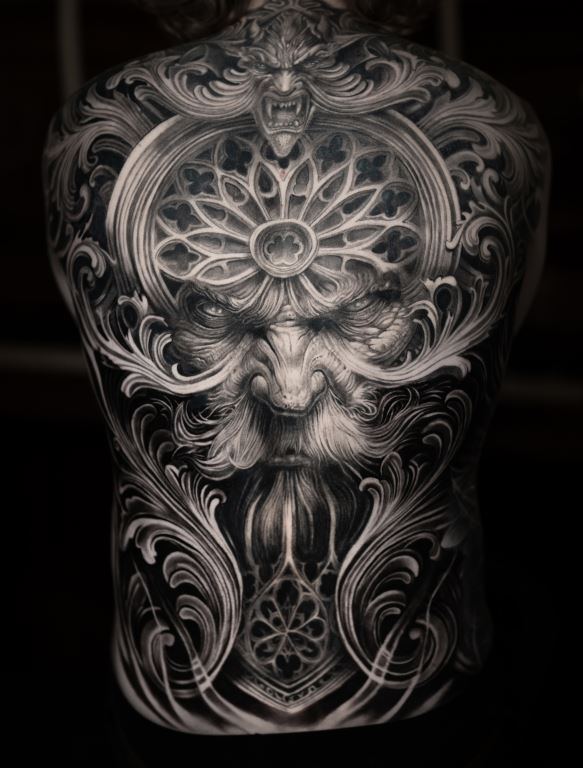
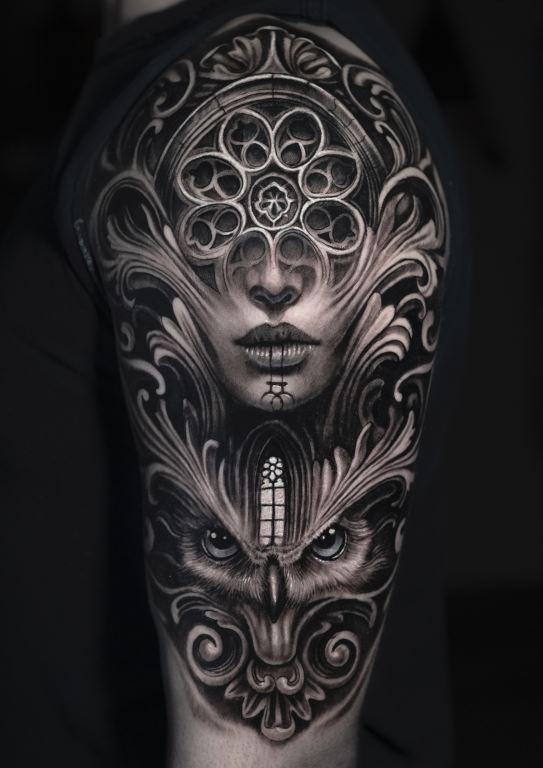
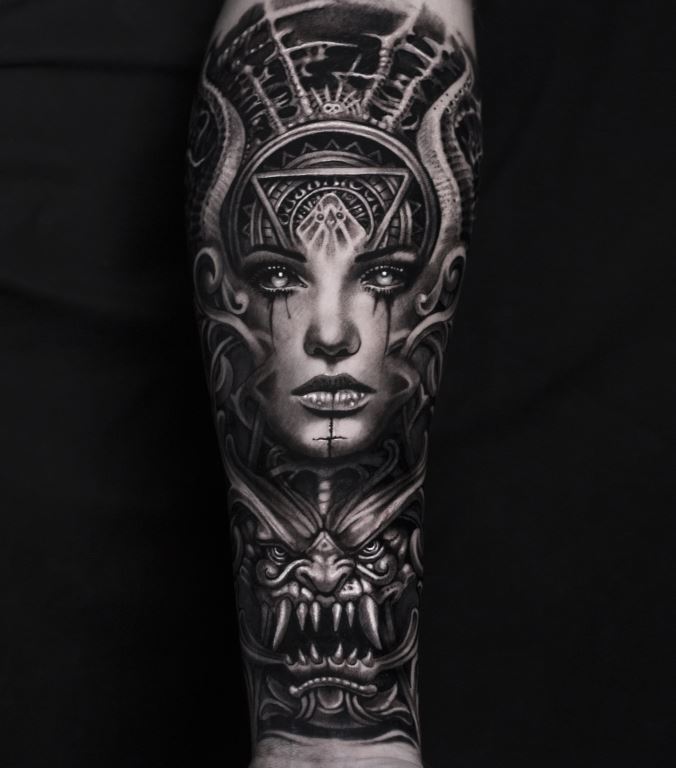
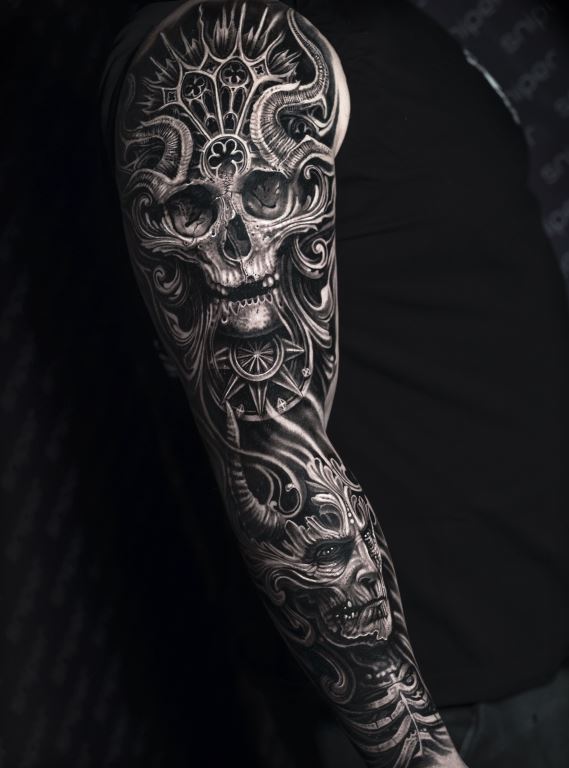
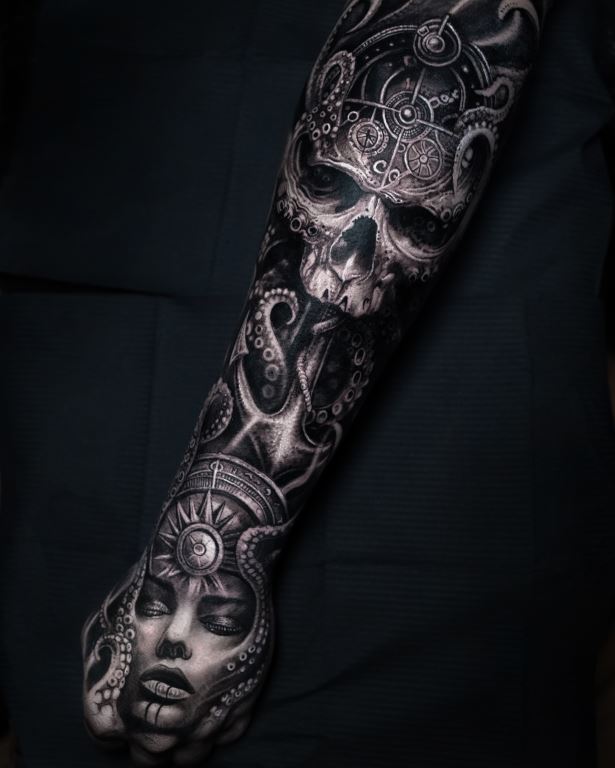
A: My style grew from the urge to merge technical discipline with
imaginative freedom. I’ve always been drawn to black and grey
realism from the start, but realism was only the technique, because
the most important thing for me was always to find my own visual
identity and signature style, that could differentiate me from the
others and be the outlet for my self expression. I’ve always been
drawn to symbolism, ancient imagery, and darker narratives, so
blending these worlds felt natural. The realism grounds the viewer,
while the dark surrealist fantasy gives the piece its emotional and
narrative depth. Over time, I refined how these elements interact
through contrast, atmospheric flow, and composition. I design each
piece around a strong visual movement, using light and shadow as the
connective tissue between the real and the unreal.The intricate
details and fluid shapes grow inside that structure, creating a
cinematic feel that people recognize in my work. What became my
signature look is essentially the delicate balance between beauty
and darkness, an interplay of worlds that feels both dreamlike and
nightmarish, grounded in the repetition of a visual language, and
elements that creates a sense of recurrence and familiarity to the
viewer.
Q: We see the phrase 'Realm of Shadows' in your work. Can
you elaborate on the philosophy behind this concept? Is it a
personal universe you draw from, or a description of the emotional
depth you aim to achieve in your pieces?
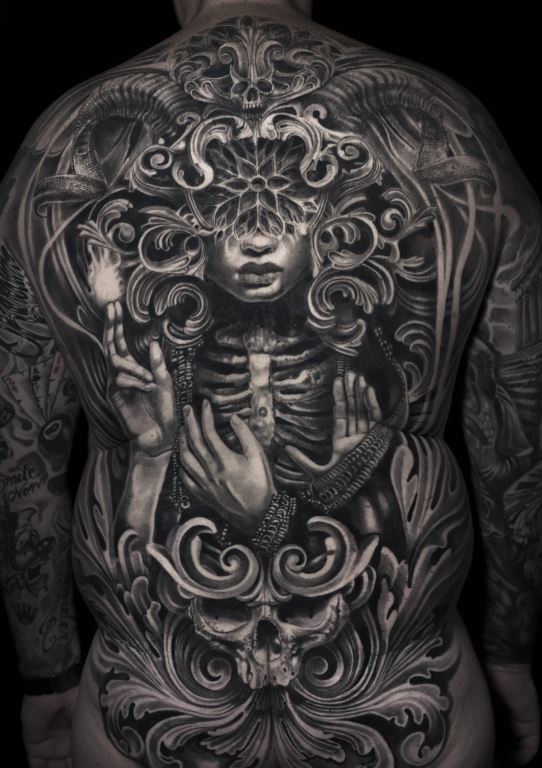
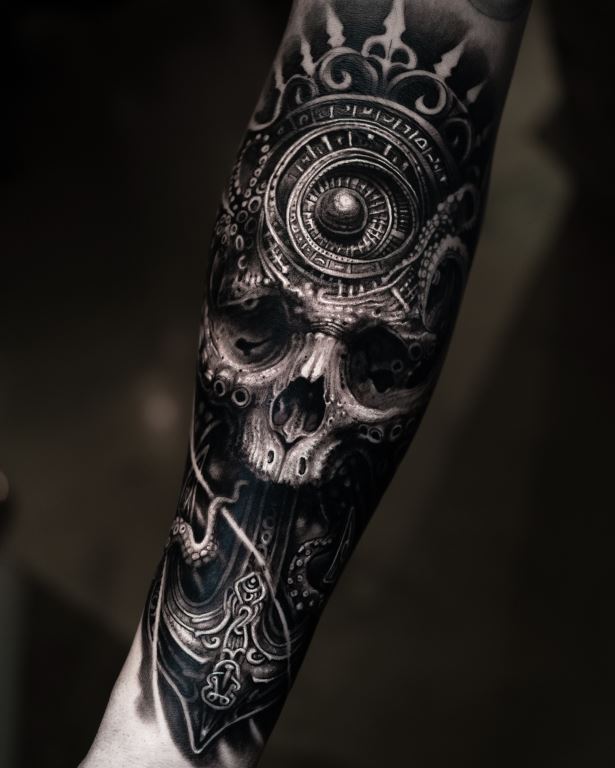
A: “Realm of Shadows” is the conceptual space where my work lives. A
territory between reality and fantasy, dreams and nightmares, where
beauty and darkness coexist. On a technical level, I create
realistic black and grey tattoos, but conceptually, I’m always
reaching into that undefined universe where the familiar transforms
into something mythic or surreal. I’ve always been drawn to
monochrome and to the darker, more introspective side of imagery, so
building this personal world felt natural. It’s where my
architectural influences, ornamental structures, and human or
skeletal forms all merge into characters that feel both haunting and
symbolic. The emotional depth I aim for comes from this same place.
I use a dark-hued tonal range, strong contrast, and deep flow to
create atmosphere. Something that feels immersive and timeless, not
just visually striking. “Realm of Shadows” describes both the inner
universe I draw from and the impact I want the viewer to feel. A
sense of movement, mystery, and introspection that becomes my
signature visual identity, and a trademark that ensures the tattoo
endures both physically and emotionally over time.
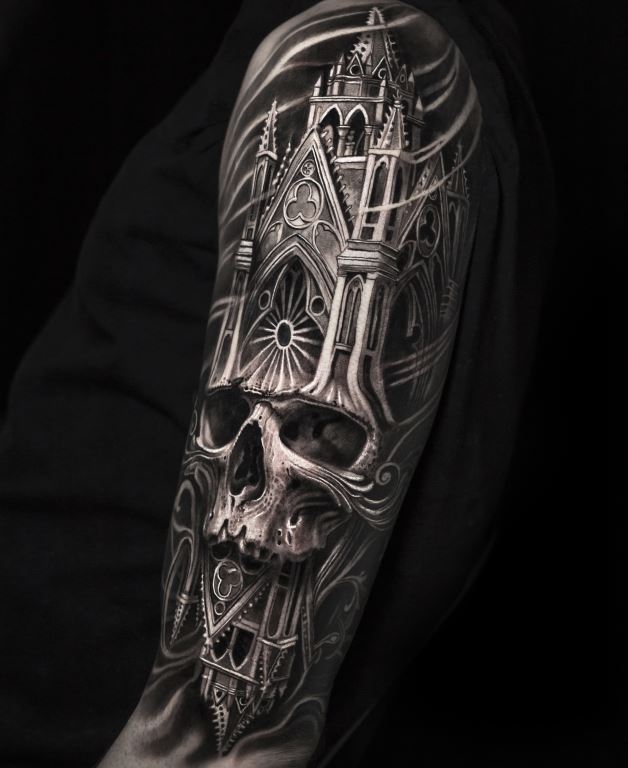
Q: When a client comes to you, how do you translate their
initial idea into a powerful, surrealist narrative? What role does
storytelling play in your design process?
A: Most clients come to me because they connect with the atmosphere
and visual language I’m known for, so their initial idea is often
just a starting point. They usually give me a broad concept or vague
idea, and I build from there. I take that spark and translate it
into a narrative shaped by the themes I naturally work with, with
imagery that moves between beauty and darkness in a way that feels
both elegant and unsettling. I want each piece to feel like it lives
somewhere between dreams and nightmares, where the familiar becomes
slightly unreal. My goal is to create something dramatic and
immersive, but still elegant. Something that transports the viewer
for a moment into a surreal world of dark fantasy. In the end, the
tattoo becomes more than an image, it becomes part of the client’s
own story, carried on their skin as a living piece of dark art.
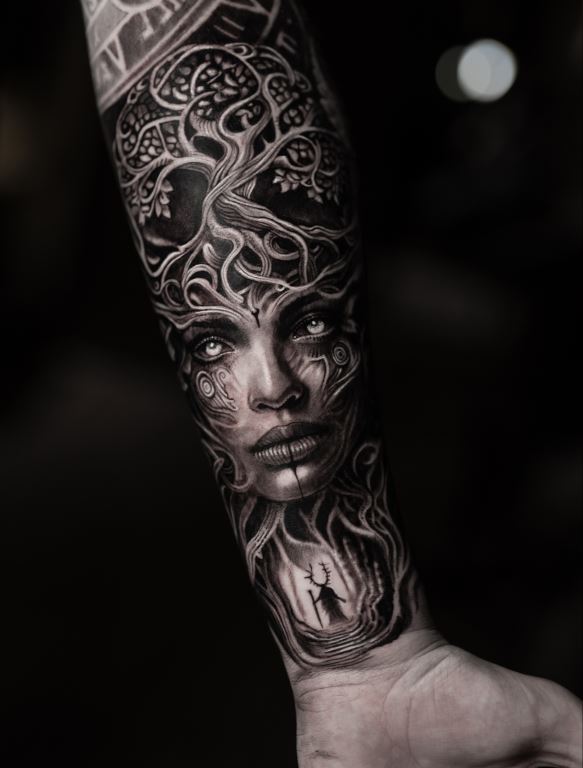
Q: Your large-scale pieces require immense trust and
collaboration. How do you cultivate a relationship with a client
that ensures they are comfortable with the lengthy, often abstract,
journey of a custom black and grey surrealism tattoo?
A: Most of my consumers come for a long ride, it takes a lot of
trust and dedication, and it's always great to get to know the
customer after such a long process. We sit long hours for multiple
days, that can be difficult for both of us, which in a way becomes
form of bonding, sometimes when I look at my calendar and see who is
coming, I think “yeah, it's gonna be some fun days ahead!” So in the
end it's a journey, that has a very rewarding outcome - to see the
piece come together and follow the customer for life.
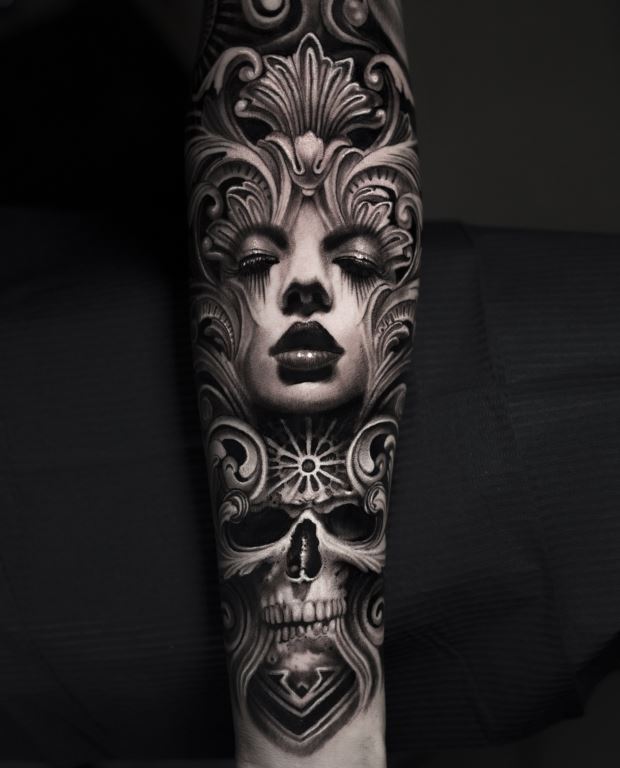
Q: Your work often involves complex textures, from flowing
hair to intricate metalwork. What is the most technically
challenging element of this style, and how do you approach it to
ensure longevity and clarity on the skin?
A: Longevity is always at the front of my mind, so I build every
piece around solid contrast, saturation, and controlled detail,
that’s what keeps the tattoo strong as it ages. I love working with
complex textures, they add realism and emotion, but they have to be
handled in a way that stays readable on the skin. My approach is to
push detail where it matters, simplify where needed, and balance
everything with depth and movement. That way the tattoo stays
expressive, dramatic, and clear for years to come.
Q: Given the level of detail and deep blacks in your work,
what is the most critical piece of aftercare advice you give your
clients to ensure the tattoo heals perfectly and retains its
intensity over time?
A: The first few days are everything. Keep it clean, keep it lightly
moisturized, avoid training, avoid sun, and let the skin rest. I
always tell my clients that it’s a team effort: I do my part in the
studio, but the final result depends on how well they care for it
afterward. If they follow the basics and give the tattoo the respect
it needs in those early days, it will heal beautifully and keep that
intensity for years to come.
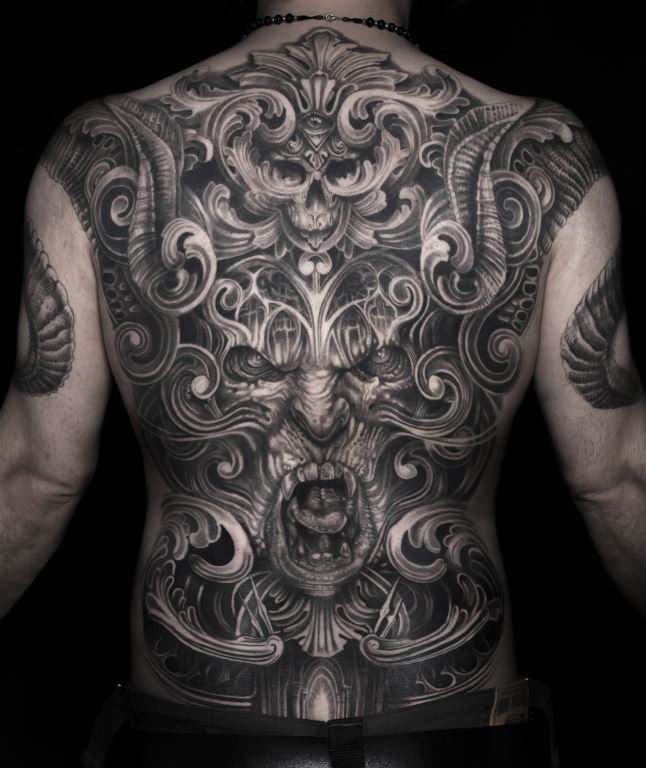
Q: Is there one piece or one client experience that stands
out, perhaps a design that pushed your creative boundaries or a
client who shared a deeply personal connection to the surrealist
concept you created?
A: It’s hard to pick just one, because every large-scale project
becomes its own experience and carries a different weight. I
genuinely love all the pieces I create, but the ones that push my
boundaries are usually the bigger ones, the multi-session sleeves,
torsos, or full concepts where everything eventually connects.
There’s something powerful about watching those scattered ideas
slowly turn into one cohesive narrative across the body. It’s a long
process for both me and the client, and when it finally comes
together, it feels incredibly rewarding. Each of those projects
stays with me, not just as artwork, but as a shared journey that
leaves a mark on both sides.
Q: Your Black and Grey work is known for incredibly smooth
transitions and a vast range of values. Can you explain your process
for mixing and layering the black ink to achieve such deep
saturation and smooth gradients, especially in large areas?
A: There’s no magic formula, just black ink mixed with water,
needles piercing the skin, a lot of patience and focus. What matters
is knowing your values, understanding how the skin reacts, and
taking the time to saturate each area properly. Layering, building
gradients, to achieve a consistent result. It really comes down to
vision and discipline: knowing the effect you want, and working
toward it with consistency.
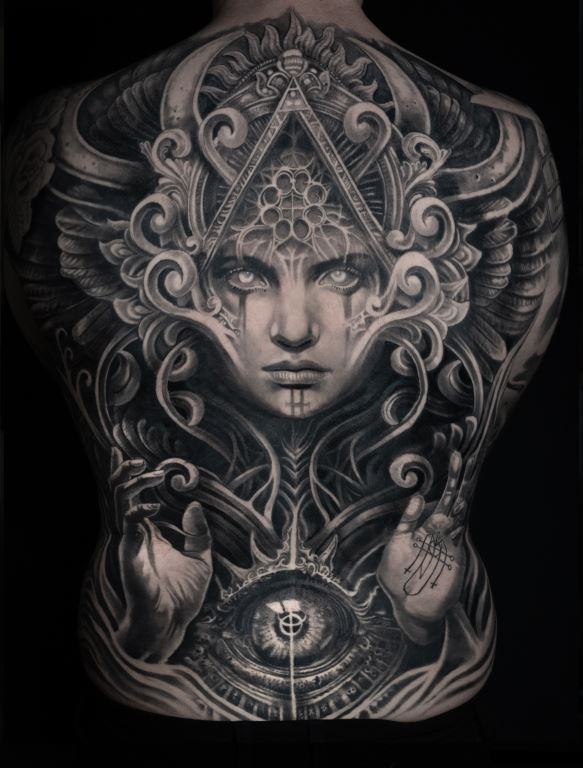
Q: Your designs flow exceptionally well with the anatomy.
When designing a full sleeve or chest piece, what is the most
important consideration for ensuring the surreal elements enhance,
rather than fight, the natural movement and contours of the body?
A: For example when I design a sleeve, the main focus is to let the
tattoo move naturally with the body. I work in sections rather than
creating the entire design at once, leaving flow lines open so I can
connect new elements organically as the piece expands. It may look
fully planned, but a lot of it is intuitive. I improvise while
keeping a strong sense of direction and movement in mind. For me, a
tattoo shouldn’t feel like a static image stamped onto the skin, it
should follow the anatomy in a way that enhances the curves,
dynamics, and posture of the client. That’s what makes the surreal
elements feel alive and integrated, turning the body into a moving
canvas rather than just a surface.
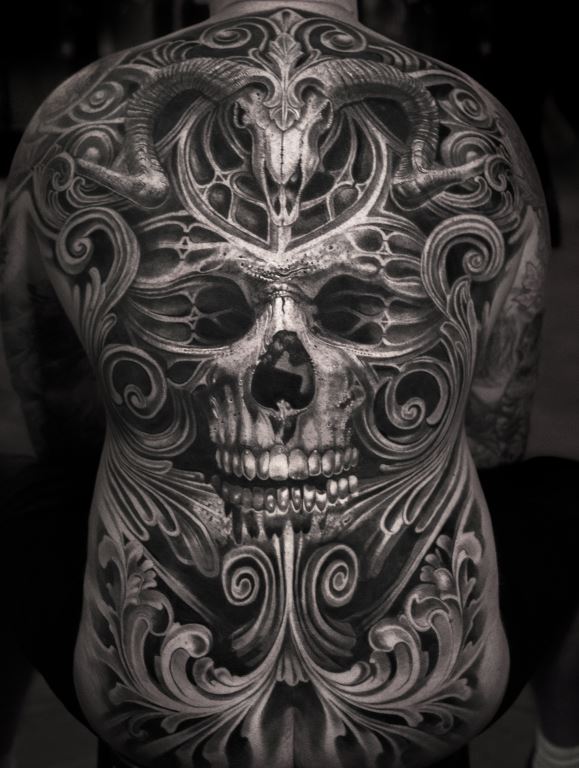
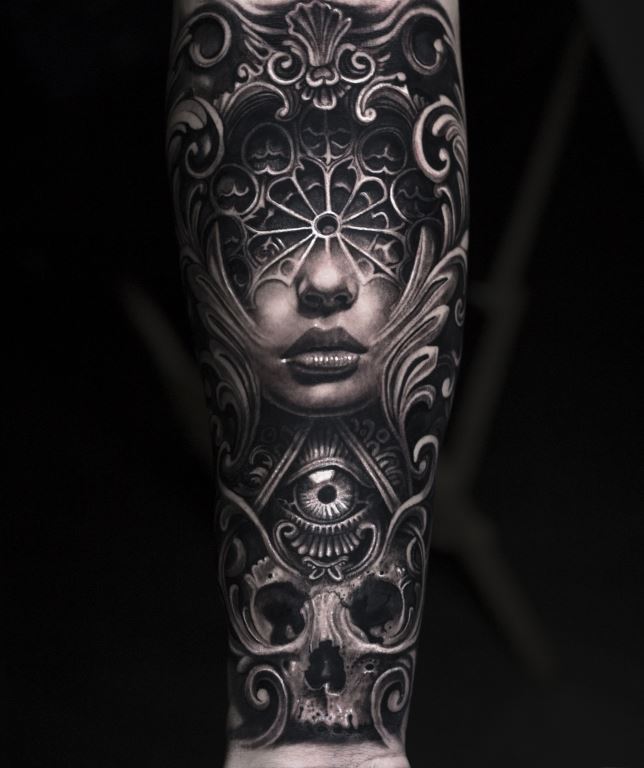
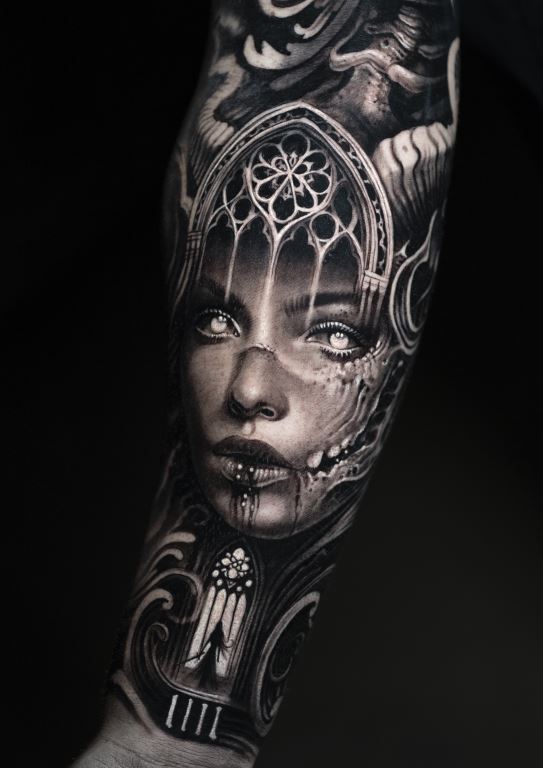
Q: We often see powerful, often androgynous or female, faces
in your work, frequently adorned with crowns, masks, or elaborate
headdresses. What do these recurring symbols represent to you and
your overall aesthetic?
A: I’ve always been drawn to faces that feel timeless, expressive
features that carry both beauty and a sense of awe. Female faces
naturally fit the balance I look for, because they bring a softness
and elegance that contrasts with the darker atmosphere I like to
create. They become the anchor points in my compositions, the human
presence inside the surreal. The ornamental shapes, rose windows,
and architectural forms morph into the main element in a mythic and
surreal tone, and tie everything together. They are a crucial part
of my aesthetic that ground the foundation of the worlds that I’m
trying to create.
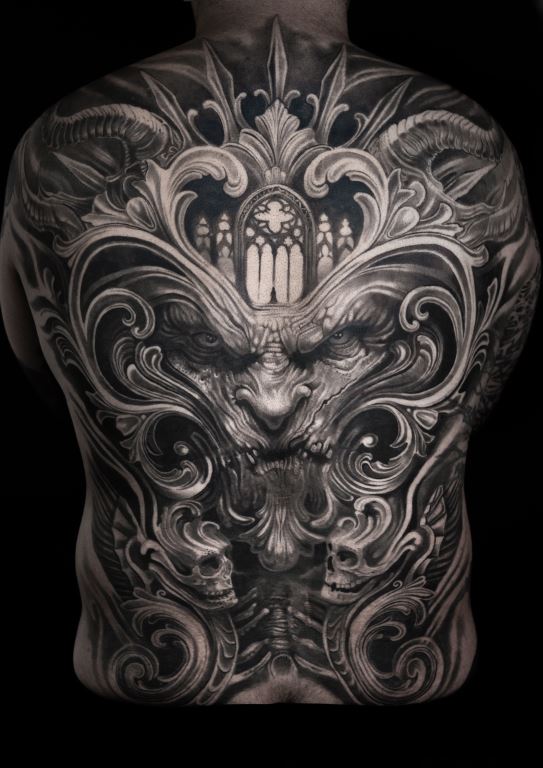
Q: The influence of classical sculpture and ancient
mythology is evident. How do you decide which mythological or
classical elements to break or distort to achieve that surrealist,
dreamlike effect?
A: A lot of it comes from a very natural progression in my work.
Over the years, my compositions became more ambitious, more
intricate, and more experimental. I started with simple and
classical structures, and as my confidence and visual language grew.
I began bending and twisting those elements to create something more
surreal and dreamlike. Each tattoo opens the door to the next one,
and one idea naturally evolves into another, and the style keeps
moving forward. I just follow the direction that feels right in the
moment, letting the classical elements bend, merge, or transform in
ways that keep the work dreamlike while still staying true to my
visual identity.
Q: Surrealism is rooted in dreams and the subconscious. Do
you ever draw inspiration directly from your own dreams or the
surrealist works of masters like Dalí, Giger etc or is your process
more about creating a new, structured reality?
A: Yes, that definitely happens. There have been moments where I
wake up from a dream with a very clear image or strange concept in
my head and think, “oh shit, I need to write this down before it
fades.” The subconscious can throw some wild ideas at you, and
sometimes those become the seeds for a concept. The same thing
happens with music, I’ve woken up in the middle of the night, and
had to grab my guitar, and record a riff or melody that came to me
while I was dreaming on my phone.
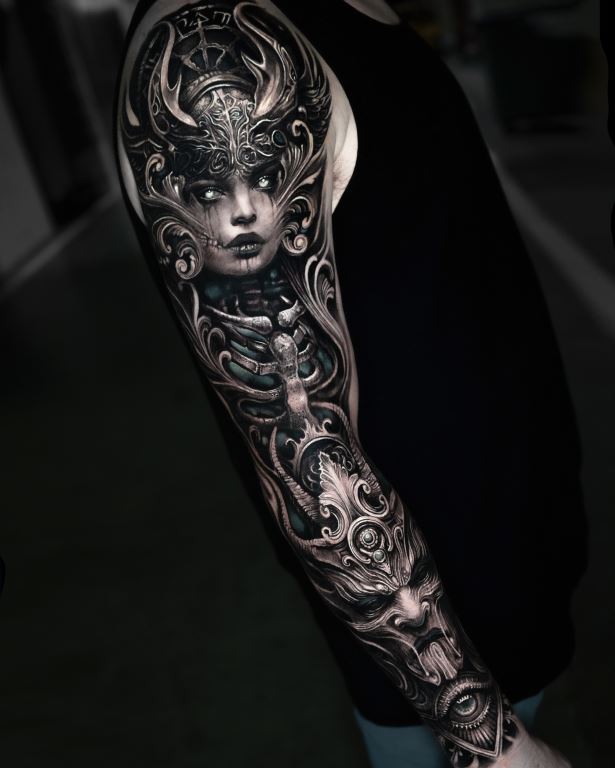
Q: Occasionally, there appear to be subtle hints of color or
a slight patina effect, particularly in the eye areas. Is this a
deliberate technique, and if so, what artistic purpose does this
subtle accent serve in an otherwise Black and Grey piece?
A: I’m a black and grey artist at heart, and that will never change.
My whole aesthetic naturally gravitates toward monochrome. But every
now and then, subtle hints of color can elevate a piece in a very
intentional way. I use them mainly to accent reflected light, create
a back-light effect, or separate the main subject from the
background without breaking the overall mood. These small touches
can give the tattoo a different type of energy and make it stand out
from the rest. Over the years I’ve experimented with purple and blue
silvery grey tones, and more recently I used golden yellow on a full
back piece, a direction I’d like to explore more. It’s always about
adding something meaningful to the composition while keeping the
core identity of the black and grey intact.
Q: You've moved from being an artist to an influential
figure, demonstrating your techniques globally (Copenhagen,
Stockholm, NYC, LA). What do you feel is the most important lesson
you try to impart to younger artists looking to specialize in
complex blackwork?
A: Follow your passion with intention and discipline. It takes years
of repetition, patience, and real drive to keep improving. You have
to push your boundaries every single day, stay curious, and stay
inspired. Try to develop your own voice instead of chasing trends.
Technique can be taught, but identity comes from the work you put in
when no one is watching. If you stay committed to that, everything
else will fall into place.
Q: Conventions like the New York City Tattoo Convention are
vital platforms. What do you find is the most rewarding aspect of
participating in these events, is it the competition, the
networking, or exposing your work to a broader audience?
A: My favorite thing about conventions is the people. Seeing old
friends, meeting new ones, and getting inspired by the energy that
gathers when so many artists come together. Travel is also a big
part of it; conventions give me the chance to work in new places and
stay connected to the global scene. For me, it’s less about the
competition and more about staying present, sharing my work with a
broader audience, and maintaining real human connections. Those
moments of inspiration and camaraderie are what make conventions
truly rewarding.
Q: What is the next frontier for your style? Are there new
techniques, mediums, or concepts you're eager to explore in the
coming years?
A: I just want to stay true to the art and stay passionate about
what I do, always aiming to go bigger and bolder with each piece. I
don’t feel the need to reinvent myself for the sake of change, I
just want my style to keep evolving naturally, the same way it
always has. One thing I’ve been planning for a long time, and that
I’ll finally be focusing on next year, is taking the same conceptual
approach I use in my work and bringing it into a three-dimensional
form, and translating my tattoo aesthetics into a jewelry line, same
expression but in a different medium. This is something that I have
been dreaming about for years, but things are finally aligning for
it to become a reality.
Q: Moving and establishing a career in a new country like
the USA is a monumental decision. What was the primary professional
motivator that made you feel the US was the essential next step?
A: I’ve always seen myself as a global artist, and part of my
professional growth comes from experiencing different cultures and
creative landscapes. The United States has been a major hub for
modern tattooing, and a significant portion of my clientele has been
traveling to Europe for years specifically to get tattooed by me.
Establishing a working base in the U.S. became a natural next step,
not only to meet the strong demand for my work, but also to
contribute directly to the artistic community that helped shape the
evolution of the style. Working regularly in cities like New York
and Long Beach CA, allows me to bring my own niche style of black &
grey surrealism, that is distinct and recognized internationally,
into one of the most influential tattoo markets in the world. My
goal is to bridge that gap, offer my expertise to a wider American
audience, collaborate with top studios and artists, and continue
elevating the artistic standards of the field. While Europe remains
my primary home base, the U.S. plays a crucial role in my career’s
trajectory, and my ongoing presence here reflects both the demand
for my work and my commitment to contributing meaningfully to the
American tattoo community.
Q: The US tattoo scene is highly competitive but also offers
vast exposure. How do you approach positioning your unique brand of
'Realm of Shadows' Surrealism within a new market that is already
saturated with incredible realism and blackwork artists?
A: The U.S. has always had a big role in the industry, so many of
the most important brands, pioneers, and movements that shaped
modern tattooing came from there. Stepping into a market that’s
already full of incredible artists, can be very challenging. But my
style is very specific and appeals to a niche group of clients who
want something that has a very distinctive aesthetic, that isn’t
widely offered. So even in a saturated scene, there’s space for it,
because when someone is looking for that exact visual identity,
there aren’t many people doing it. I already have a big customer
base from the US flying to Europe for my work, but being here makes
it much easier for them.
Q: You've worked in major cities globally. What specific
qualities, be it the artistic community, the local clientele, or the
overall energy, drew you to your chosen base of operations in the
USA (e.g., LA, NYC, Miami) over other major international cities?
A: What drew me to the U.S. was the energy and openness of the
tattoo scene. Cities like NYC and LA have a constant flow of driven
artists and clients who appreciate bold, ambitious work. The pace,
the diversity and the level of creativity pushed me to grow, so it
felt like the natural place to base myself and keep evolving. Being
able to work side by side with some of the biggest names in the
industry is both an honor and a constant source of inspiration.
Q: If a client could only remember one thing about the
experience of getting tattooed by you, what would you want that
takeaway to be?
A: Sharing a long creative journey together. hours of trust,
conversation, patience, and collaboration. The final piece lasts a
lifetime, but the experience of building it together is just as
important.
Q: For aspiring tattoo artists who are looking to pursue a
career solely in realism, what is the single most important piece of
advice you can offer them?
A: My advice applies to any artist, not only those pursuing realism:
work hard, show intention in everything you do, stay humble, and
never forget where you came from. Realism demands patience and
dedication, but your character and consistency are just as important
as your technique. If you keep pushing, stay grounded, and remain
true to your artistic voice, everything else will fall into place.
Interview: Ivaa Knceska
Date: December 1st 2025


