
Interview with Pedro Silveira
International sensation and master of detailed
black and gray realism, Pedro Silveira, professionally known as
Clover, is a prominent figure in the global tattoo community. His
technical mastery in executing large-scale realism is matched by his
focus on complex cover-ups and a dedicated passion for education,
having mentored aspiring artists around the globe. Clover's career
is defined by extraordinary productivity, strong business acumen,
and a high-profile client roster. His journey reflects a relentless
pursuit of artistic evolution, precision, and leadership in the
industry.
Q: Going back to the beginning, what first drew you to the
world of visual art and eventually led you to the craft of
tattooing?
A: I have always enjoyed drawing, but I never imagined that it could
become a profession. In the beginning, tattooing came into my life
more out of curiosity than as a career plan. I started to realize
that there was a real possibility of turning something I enjoyed
into something that could change my life.
And that is exactly what happened. Tattooing started as an
opportunity, but over time it became an obsession with improving. I
wanted to understand how to get better, how to create better work,
cleaner work, more realistic work. I think that desire to improve
every day is what ultimately brought me to where I am today.
Q: What are the main challenges you had to overcome when you
started?
A: My beginning was very different from the reality I live today.
Before tattooing, I had already worked in many different jobs. I
worked as a packer, in construction, as a salesperson, and I even
sold barbecue and crepes. I always had this desire to improve my
life and provide a better life for my family. When I started
tattooing, I had no structure, no name, and no money. I had to learn
almost everything on my own and, most importantly, I had to learn
how to deal with mistakes. In the beginning, you want everything to
be perfect, but the truth is that you have to do the work, make
mistakes, study, and do it again. My biggest challenge was
understanding that talent alone would not be enough. I needed to
learn art, customer service, sales, relationships, management, and,
above all, I needed to learn to see tattooing as a profession.
Q: The Brazilian tattoo scene is known for its incredible
talent and energy. How did your experience in the local industry
shape your standards and prepare you for an international career?
A: Brazil is extremely competitive. There are so many talented
artists, and that creates positive pressure to keep improving. I
grew professionally in an environment where I had to prove my work
all the time. That taught me not to depend only on praise. I started
focusing much more on the result and on my own evolution. When I
began traveling and experiencing other markets, I realized how much
value Brazilian technique has. Brazilian artists tend to be very
intense, dedicated, and creative. I think that foundation gave me
the confidence to enter other markets without feeling that I had to
abandon who I was in order to be accepted.
Q: What were some of the key moments or milestones early in
your career that signaled your transition into becoming a leading
professional in Brazil?
A: I don’t think there was one single moment. It was a series of
small achievements. I started noticing that people were specifically
looking for my work. Then came bigger projects, more demanding
clients, convention appearances, awards, and invitations. Another
important moment was when I realized that I didn’t simply want to
create a beautiful tattoo. I wanted to develop an identity. That was
when I began taking realism, especially black and grey and
large-scale work, much more seriously.
Q: Was there a specific mentor, artist, or personal
experience that solidified your decision to pursue tattooing as a
lifelong career?
A: There wasn’t one single person who changed my career. I had many
different references throughout the journey. I have always been very
observant. Whenever I saw an artist doing something better than me,
instead of thinking it was impossible, I wanted to understand how
they had achieved that result. But honestly, I think my biggest
influence was the need to build a different life. Tattooing started
showing me that I could go much further than I had imagined. When I
realized that, I stopped seeing it simply as a job and started
seeing it as a career.
Q: Your work revolves around highly detailed black-and-grey
realism. How did you refine and direct your focus toward this
specific aesthetic over time?
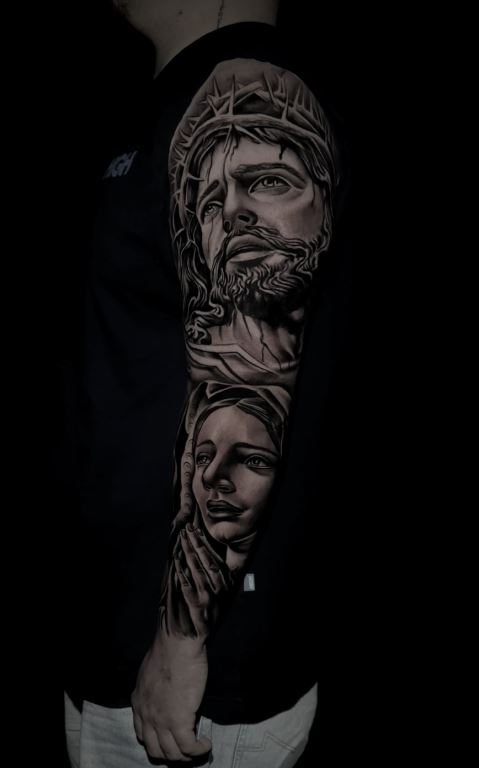
A: It was a natural evolution. I have always enjoyed observing
light, shadow, expression, and detail. Black and grey gave me a
great deal of freedom to explore those elements. Over time, I
learned that realism is not simply about adding more detail. It is
about knowing what needs to be visible, what needs to disappear, and
where contrast needs to exist. Today, I think much more about
readability than simply the amount of information. I want the tattoo
to work up close, but most importantly, I want it to continue
working from a distance.
Q: What were some of the most challenging technical
breakthroughs you experienced while mastering realistic shading,
contrast, and skin textures?
A: The hardest thing was understanding that skin is not paper. With
a drawing, you control everything. With tattooing, you have the
skin, the healing process, aging, and the movement of the body. You
have to learn how to work while respecting those limitations. It
took me a long time to understand that adding more black does not
necessarily create more depth. Sometimes the opposite is true.
Controlling grey tones, transitions, and skin breaks is just as
important as the black itself.
Q: Having taught and tattooed internationally, how do you
see the global perception and demand for black-and-grey realism
evolving today?
A: Black-and-grey realism has grown tremendously. Today there is an
audience all over the world looking for increasingly large,
detailed, and personalized work. I also see a huge evolution among
artists themselves. Access to information has increased
dramatically. Today, a Brazilian tattoo artist can follow an artist
from the United States, Europe, or Asia almost in real time. At the
same time, that has increased the competition. So it is no longer
enough just to know how to tattoo. You need identity, consistency,
and the ability to deliver a result that makes people remember you.
Q: In terms of client expectations and artist culture, what
differences or similarities stand out most when comparing the local
scene with the global tattoo industry?
A: There are cultural differences, but one thing is the same
everywhere: the client wants trust. When someone gives you a part of
their body, they need to believe that you know what you are doing.
In Brazil, there is often a very close relationship between the
tattoo artist and the client. In other places, the relationship can
be more professional and straightforward. But in the end, trust
remains the most important thing. One thing traveling has taught me
is that professionalism is a universal language.
Q: Working as an international artist requires constant
adaptation. How do you approach working artistically and
strategically across different cultures?
A: I try to arrive in every place with an open mind. I don’t believe
you need to change your identity to work in another country. On the
contrary, you need to understand the market, respect the culture,
and at the same time bring what makes you different. I have also
learned to observe people’s behavior very carefully. Every market
has a different way of buying, communicating, and perceiving value.
Traveling taught me that being an international artist is not simply
about putting a suitcase on a plane. It is about learning how to
adapt without losing your essence.
Q: What unique quality of black-and-grey realism allows for
such powerful storytelling and atmosphere compared with colorful or
traditional styles?
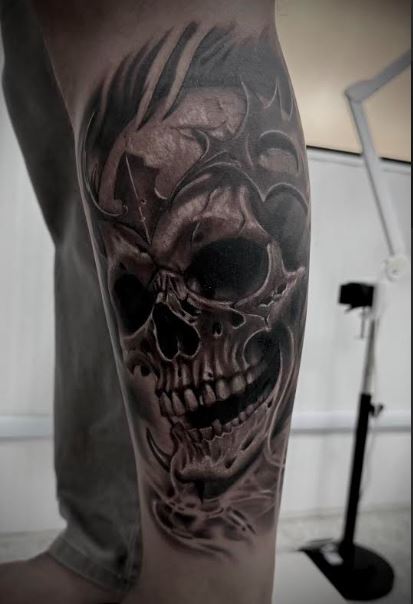
A: I think it is the ability to work directly with light and shadow.
Black and grey can create a very strong atmosphere without relying
on color. You can make an image feel heavy, delicate, dark,
dramatic, or even very clean simply by controlling contrast, light,
and texture. For me, there is something very cinematic about black
and grey. It is like telling a story using only light.
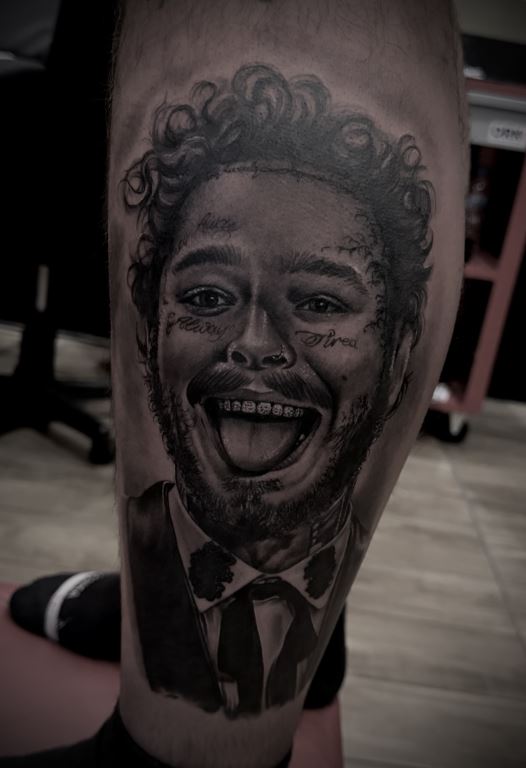
Q: Translating realistic subjects onto a dynamic canvas
requires immense planning. When approaching large-scale projects,
such as full backs or full limbs, how does your creative strategy
change?
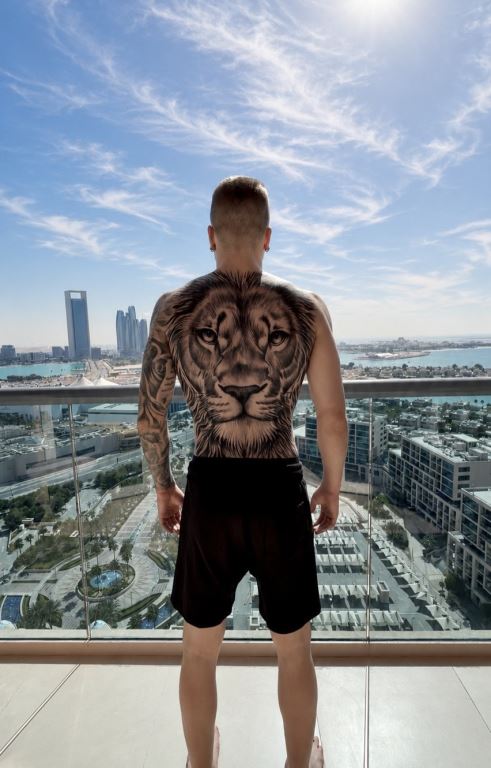
A: It changes completely. A small tattoo can work very well as an
isolated image. A large tattoo needs to communicate with the entire
body. Before thinking about detail, I think about composition. I
need to understand the shape of the area, the anatomy, the movement,
and how that tattoo will continue to make sense years from now.
Especially with full backs, sleeves, and full legs, I think first
about the story I want to tell. Then I begin building the images
within that story.
Q: Achieving rich depth relies heavily on high contrast and
smooth gradients. What is your fundamental approach to balancing
deep blacks with subtle grey tones?
A: I like to think that black needs to have a purpose. I don’t use
black simply because an area is dark. Black needs to help create
depth, separate planes, and guide the viewer’s eye. At the same
time, grey needs room to breathe. If you turn everything into grey,
you lose contrast. If you turn everything into black, you lose
information. So my goal is to create a hierarchy: knowing where the
strongest point is, where the second layer is, and where I need to
let the skin work together with the tattoo.
Q: How do you design large-scale compositions to ensure that
realistic elements flow naturally with the body’s muscular structure
and anatomy?
A: I start by thinking of the body as part of the composition. I
don’t like the idea of simply taking several beautiful images and
putting them together. A large tattoo needs to feel like it was
created specifically for that body. I look at curves, muscles,
joints, and movement. Some areas need more information, while others
need more breathing room. When the composition is well designed, you
can see the tattoo without feeling like an image has simply been
placed on top of the skin.
Q: Beyond technical mastery of equipment, how crucial is an
in-depth study of traditional fine-art concepts such as lighting and
anatomy to realism in tattooing?
A: It is fundamental. The machine is a tool. If you don’t understand
light, anatomy, perspective, composition, and contrast, you will
remain limited, even with the best equipment. I always say that you
can change a machine, a needle, or an ink. But you cannot replace
your eye. The more you understand about art, the better decisions
you can make within tattooing.
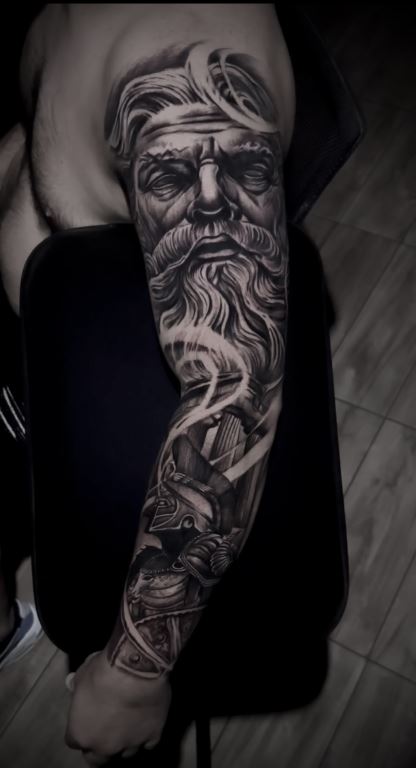
Q: Where do you believe the technical boundaries of realism
are heading in the future, whether through new equipment,
techniques, or application methods?
A: I think we are going to see tremendous advances in precision.
Machines, cartridges, inks, materials, and tools are evolving very
quickly. But I believe the biggest advancement will still come from
the artist’s knowledge. Today, we have access to references,
courses, and information that were extremely difficult to find in
the past. The tendency is for technique to become increasingly
precise. But there is one limit that no machine can solve: the
artist’s ability to see.
Q: Looking at the scale of what you have built so far, what
do you consider the most significant personal achievements of your
journey?
A: Without a doubt, my greatest achievement has been turning
tattooing into the life I always wanted to build. Tattooing has
allowed me to visit places I never imagined I would see, work with
incredible people, build a company, build a team, teach other
professionals, and reach clients and markets that once seemed very
far away. The awards and recognition are important, of course. Being
invited to judge conventions is also a huge honor. But for me, there
is something even bigger: looking back and remembering where I
started. I didn’t have the structure, the name, or any certainty
about where this would take me. Today, there is a story behind it.
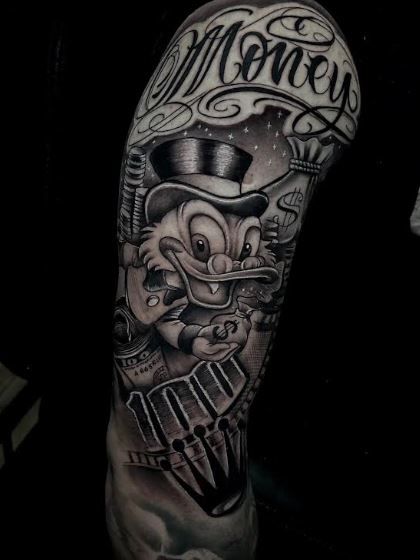
Q: Among the countless projects you have completed, which
specific piece or concept proved to be the most creatively
challenging, and why?
A: The projects that challenge me the most are the ones where there
is a major need for transformation. Especially complex cover-ups.
When you receive skin that already has a strong tattoo, often a dark
one that was poorly positioned, you are not starting with a blank
canvas. You have to find a solution within a limitation. It is
almost like solving an engineering problem, but artistically. You
need to understand what can be hidden, what can be used, where to
place contrast, and how to make the client look at that area and see
a completely new story.
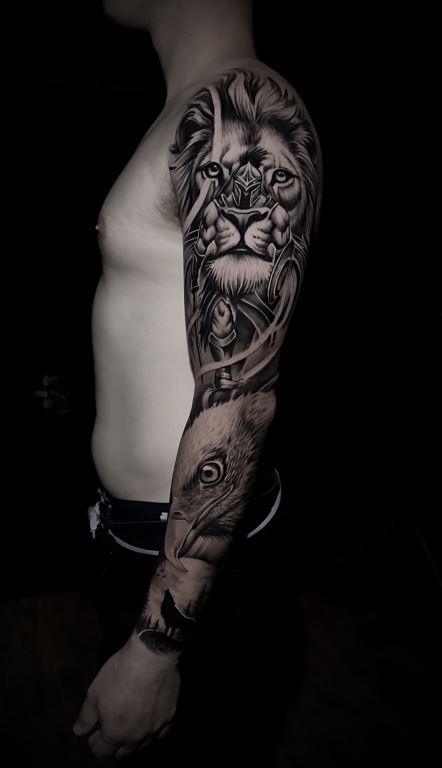
Q: You balance the roles of artist, entrepreneur, and
educator. How do you manage these responsibilities while maintaining
high creative productivity?
A: I learned that you cannot do everything at the same time. Today,
I try to work through systems and processes. I have a team,
organization, and clearly defined responsibilities. That allows me
to step away from some of the day-to-day operations and think more
strategically. I also realized that my job is not just tattooing.
For a long time, I thought I needed to be behind the tattoo machine
all day to be productive. Today, I see productivity differently. A
meeting, a class, a business strategy, or helping someone on my team
can also create a lot of value. Tattooing is still at the center,
but today I can see everything that exists around it.
Q: What is one specific artistic goal, new venture, or dream
project that you are still looking to accomplish?
A: I still feel like I am just getting started. I want to take my
work to more and more places and build a truly international career.
I want to continue evolving artistically, take on increasingly large
and complex projects, and work with artists from different parts of
the world. But there is also a bigger goal: building something that
continues to exist beyond my own schedule. I want to leave knowledge
behind, develop people, and create a structure that shows that a
tattoo artist can build much more than just a full appointment
calendar.
Q: Education is a fundamental pillar of your career. What
aspect of sharing your knowledge and mentoring other artists brings
you the greatest personal fulfillment?
A: Seeing the transformation. When you teach a technique and later
see someone applying it, starting to make money, improving their
work, and changing their life, that has enormous value. I like
showing people that tattooing doesn’t have to be only a manual
skill. You can learn to tattoo better, but you can also learn how to
sell better, communicate better with clients, build a brand, and run
a business. I had to figure out many things on my own. If I can
shorten that journey for someone else, then it is worth it.
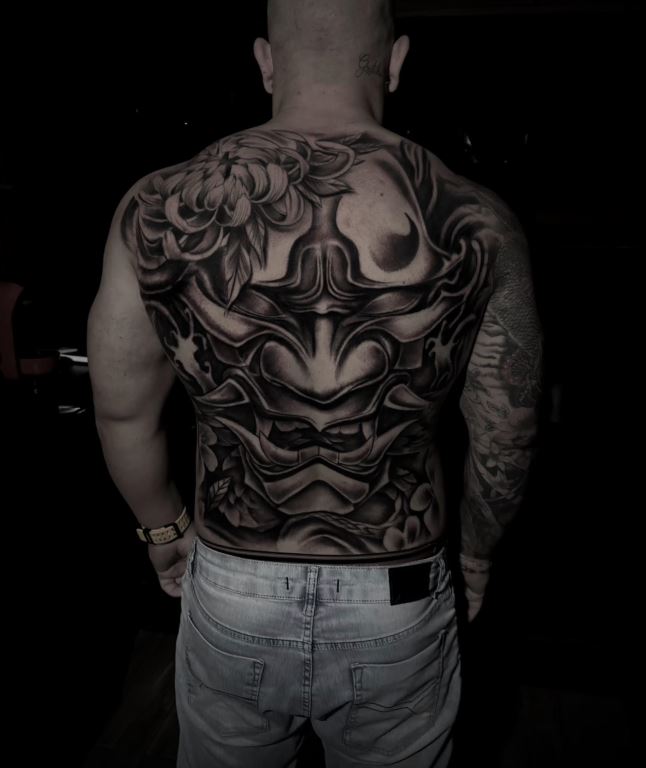
Q: What fundamental advice would you give to aspiring tattoo
artists who want to specialize in realism and build an international
reputation?
A: First: stop trying to be good at everything. Choose a direction
and become very good at it. Second: study drawing. Study light.
Study anatomy. Study composition. Don’t depend only on copying
references. Third: understand that being a good tattoo artist and
building a career are two different things. You need to learn how to
sell your work, work with clients, build relationships, and create a
brand. And, most importantly, be patient. Today, everyone wants fast
results. I took years to build what I have. The internet shows the
result, but it doesn’t show the thousands of hours that came before
it.
Q: Looking back at your entire journey, if you could give
one piece of advice to yourself when you were just starting, what
would it be?
A: I would tell myself to trust the process more. When you’re
starting out, it feels like everyone is ahead of you. You look at
better artists, people making more money, traveling more, and
receiving more recognition, and you think you’re behind. Today, I
understand that there is no single finish line for everyone. I would
also tell myself to study earlier, make mistakes faster, and not be
afraid to change. Tattooing completely changed my life, but it only
did that because I changed along with it. When I started, I just
wanted to learn how to tattoo. Then I wanted to become a better
tattoo artist. Then I wanted to build a business. Then I wanted to
teach. And today, I want to take all of that to the world. I think
that is the most important part of my story: I never stayed where I
was. And I probably won’t stop now.


