
Interview with Sercan Okten
Hello Sercan Okten! Thank you so much for
taking the time to do this interview. Please start by telling us
something about yourself and your background. What got you
interested in tattoo art? Hi Skinartists, thank you for giving me
the opportunity to do this interview. My name is Sercan Okten and I
started my tattooing journey in 2006 while I was studying tourism
and hotel management in college. Despite my non-related education,
I've always had a fascination for visual arts from a young age. I
started with photography and then drawing and graphic design, and
then I got interested in tattooing in high school after getting my
first tattoo. My friends and I at the time wanted to get many
tattoos; however, we couldn't afford them so I decided to build one
and try to do it myself. So, it kinda started as a DIY project and
became the most important aspect of my life. After tattooing for
many years in Turkey, I moved to the UK in 2015, and I'm currently
working in my studio called "One of None" in southwest London, which
is my biggest DIY project so far.
Q: Who helped you in the beginning, or are you a self-taught
artist? Was it hard to learn the basics?
A: I'm a self-taught artist, and yes, it was tough in the beginning.
My first and only introduction to how to tattoo was, "This is where
you put the needle, this is how much it should stick out, and this
is how the machine should sound." and that was it! I had to figure
out the rest so yes, it took me a long time to learn how to tattoo.
In the beginning, my biggest help was having good and brave friends
who were willing to get tattooed by me haha
- What type of tattoos you use to do as a beginner?
This is probably not something I would recommend to a beginner now,
but I used to do all kinds of tattoos, from large tribals to
football badges, dot-work mandalas to Jenny Clarke flashes and
more.. I wasn't giving too much thought to "How will I do this
tattoo?" and I wasn't afraid of failure. I was constantly trying new
things and trying to figure out what I was better at. I realised
that I was mostly enjoying black and grey realism and lettering, but
in the beginning, especially the first six or seven years, I didn't
have the urge to focus my work on a certain style so I was tattooing
whatever style the client wanted. Which gave me experience with
different styles and techniques and really helped me with the
fundamentals of tattooing.


Q: How long took you to figure out your creative direction?
A: I have been solely focusing on black and grey realism for the
past ten years. However, the creative direction is something that
constantly changes and evolves for me. I really enjoy the process of
creating something different every time, and that is what makes
tattooing fun for me. Currently I'm not worried about how the next
tattoo will look on my portfolio or about constraining my work into
a certain black and grey sub-category. I'm enjoying trying different
things with my work and seeing it evolve.
Q: Why tattoo realism, what do you like the most about this
style?
A: From a young age, I've always been impressed by ultra-realistic
Renaissance paintings, how the light works and creates depth and
looks almost like the figures are coming out of the canvas was
something that captivated me. Realism is also something everyone can
resonate with and understand, which is excellent for grabbing the
viewer's attention. Using something realistic as an anchor allows me
to interpret and create something interesting. Because to me,
there's nothing interesting about copying an almost exact replica of
an image onto the skin, which can be extremely impressive but
equally boring to look at.
- Will you stick to black and gray, or maybe you will try
experimenting with color tattooing?
I really enjoy having a basic black and grey setup. However, there
are limitations to classic black and grey. Especially when designing
large concepts with different elements, colours can really enhance
the overall design and help with definition and balance. Lately I'm
approaching my designs with basic design principles in mind. Every
element needs to work harmoniously and serve a purpose. If something
is not improving the design, I would get rid of it, and If something
is hard to read when monochrome, then I would add colour to it. So
to answer the question, I would like to use the colours to benefit
the design and final outcome. Otherwise, I'm happy with doing black
and grey all day for the time being.
Q: I absolutely love the portraits. They are very detailed
and the shading is just simply perfect. Creatively, I don't think
realism gives much space but still a lot can be done to achieve that
unique look we all want. I think this style is worth exploring.
There are some tattoos you did that have some interesting details as
a decorative elements. Your thoughts on this?
A: Thank you so much, and yes, you're right! Realism doesn't give
much space creatively, and I think it's essential to find the
balance in stylisation vs true to the reference look as well as
adding some decorative elements to help with the flow of the body if
needed. I think it all comes down to the character of someone's
work, how they think it will look better, and how different
decorative elements can improve the overall tattoo, as well as
giving them a specific, unique look whilst adding character to their
work. This can also be achieved by making simple technical decisions
such as using small liners vs magnums or different stroke machines
with various speeds to create textures purposely.
Q: One is the "Love is a loosing game" tattoo. Oh I love
that tattoo. Who was the main designer here, you or your client?
A: Thank you! My client asked for a "woman wearing sunglasses,
holding money, playing cards and writing 'Love is a losing game'
somewhere" on her leg and I made the design for her and tattooed it
without any changes, so it was a collaborative design, I would say,
and we were both happy with the outcome. Thanks Wiola!

Q: The big tattoos are always the ones that attract the most
attention, We are all like "Wow... What a masterpiece." I guess
every experienced artist wants/prefers to do big projects like full
legs, back pieces and sleeves. These types of tattoos require a lot
of time and patience but when it's all done it's worth it, right?
Any favorite project?
A: They're definitely fun to work on, I must say. It's a long
process and it requires commitment from both sides, and that's the
most crucial part for the best outcome, in my opinion. The longer
the project goes on, I mean the time between the sessions, the less
exciting it becomes for me. Our perspective and vision grow as we
evolve as artists. And a project I started six or seven years ago
may not align with my current approach to tattooing. It almost feels
like you're purposely going backwards just to finish something
you've started at a different time in your career. Not to mention
the having to match the tones of the tattoo. I would recommend that
whoever is looking to start a big project make sure to be ready and
committed to finishing it in the suggested timeframe by the artist,
as I have acquired quite a few "non-going" projects over the years.
If I had to pick a favourite, it would be the Asian-inspired Buddha
and Geisha piece on my long-term client, Ben.
Q: How long does it take to finish a full sleeve or a back
piece? The longest session and oh well, how the client handled the
pain?
A: They both usually take around six sessions or approximately 25-30
total hours on average, depending on the complexity, skin type and
size, of course. Every person is different and requires a tailored
approach, especially for large projects, and that is why I always
recommend having a consultation with my clients in the studio so we
can see the actual area before the designing process and also learn
about them a bit because I also think every tattoo should also suit
their collector.
Q: How important is to have a good energy during the
sessions, especially the long ones? I've heard, sometimes, people
open up about some personal stuff and what their tattoo means to
them etc. Any funny experiences with your clients?
A: I think it's extremely important to have good energy from both
sides, but most importantly, artists' attitudes and approaches are
what set the energy of the sessions. It's our responsibility to make
sure the clients are comfortable sitting long hours in our
environment and feeling relaxed, whilst enduring tattoo pain. The
setting, layout, light, and vibes really contribute to making the
whole process much more pleasant. And yes people do open up about
their personal stuff sometimes but I'm not going to break the
"Tattooer-Client Privilege" here or anywhere for that matter haha

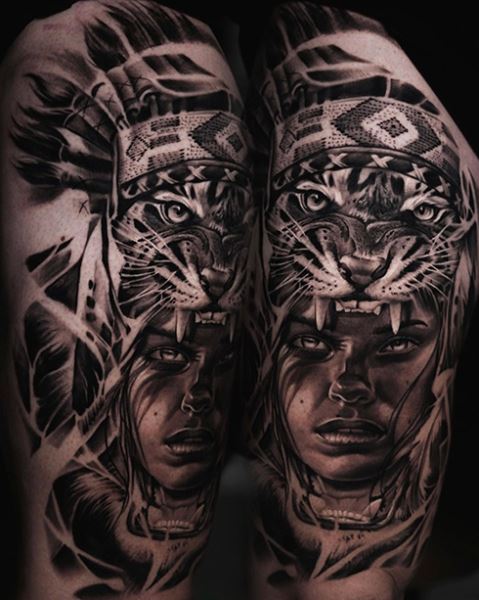

Q: How much their trust means to you? Let's not forget you
are "marking" them for life.
A: It really means a lot to me and I'm still surprised ever so often
when I think about it. I'm trying my best to make the "marking"
worth their trust. But I must say it puts a lot of pressure when you
overthink, or the client is trying to be overly involved in the
process, which shows a lack of trust if you think about it; then I
struggle to create something that pushes boundaries. I also think
artists need to trust their work first in order to gain client's
trust. If we're not sure about our work, we shouldn't expect our
clients to be sure about us.
Q: I love the digital art too. You are so creative. Do you
prepare a digital artwork of the tattoo before the session or it can
be done spontaneously with the client? I think it would be nice to
see like a catalog with all of your cool designs in one place. Just
an idea.
A: Thank you very much! Yes, I do prepare a digital concept before
the session; in fact, most clients don't know this but I prepare
multiple ones and show the best one on the day. I also make some
quick adjustments or changes spontaneously if I need to. I usually
put some of my pre-made designs on my Instagram highlights but never
thought of making a dedicated catalogue, but it could be a good
idea!
Q: You own "One of None Tattoo Studio" in London. When did
you open the studio? How many artists are currently working there?
Are you open for guest spot artists?
A: Yes, we fully started to operate in our studio in August 2022, so
it's pretty new. We currently have seven resident artists and
regular guest artists working together. Each artist specialises in
their own style and I really enjoy the variety as we all learn
different things from each other. It also helps the clients to have
the best-suited artist for their ideas, so it's been good so far.
Q: Is it a challenge to be a full time artist and owner of a
studio at the same time?
A: Oh well, it is definitely challenging to do both good at the same
time! I think being a studio owner gives you the opportunity to
create your ideal work environment, which, in my opinion, is one of
the most contributing factors to an artist's growth. I think in a
peaceful, well-lit, well-organised, artist-prioritised studio,
artists can be in a better mindset and, therefore, can create better
tattoos and grow as individuals. This was the case for me, so having
a studio was important for creating my ideal space. However, it also
comes with certain limitations and responsibilities, as many know.
I'm still learning how to make it all function better, and I believe
good time management and decision-making skills are essential when
you want both to run well.
Q: What are your plans regarding your work and the studio?
A: I plan on travelling, going for more guest spots, and expanding
my horizons a bit. I think tattooing is best for travelling and
working in different environments, leading to learning more about
various approaches to the craft to improve my work, myself and the
studio.

Q: Do you still have the same enthusiasm and enjoy your
work? What do you like the most about being a tattoo artist?
A: Well.. I still really enjoy tattooing and I can say that I have
more enthusiasm lately than I had in my mid-career, and I think the
mindset is the most important factor in the enjoyment you get from
work. When you start to change the way you think and how you
approach it, it all becomes more enjoyable. My favourite thing about
being a tattoo artist is that I get to meet and talk with people
with different backgrounds, different professions and different
mentalities. You can learn a lot from people who normally wouldn't
cross your path if you weren't tattooing them, as I could be
tattooing a musician on a Monday and a CEO on Tuesday, and I find
that really fascinating.
Q: A few words for those who want to try getting into
professional tattooing?
A: I think the most important thing is having patience. Take it slow
and absorb the whole process, from learning about the equipment to
different styles and approaches. Fundamentals are extremely
important. Really learn the craft before attempting to find your own
style. You must be a "Tattooer" before you're a "Tattoo Artist", and
the craft should always come before the art in whatever medium
you're working on. Times are different, I get it; we live in an era
where everything is widely accessible, and people can learn things
very quickly, or they think they've learnt it just by watching some
videos and attending a few seminars. Thanks to social media, where
everyone is eager to impress, doing many tattoos that have no
longevity, solid technique, or putting actual thought behind them.
Please avoid being one of those. Be ready for commitment: Put your
drawings together, prepare a portfolio and try to get an
apprenticeship in a sound studio with good artists and educate
yourself. Keep on trying to get a little better each time by staying
a bit out of your comfort zone and remember, if you can improve your
work by 1% for each tattoo you do, you'll be twice as good on every
100th tattoo!


