
Interview with Alex Trunov aka Sicko Black
Hello Alex Trunov, aka
Sicko_Black, thank you so much for taking the time todo this
interview. Please start by telling us something about yourself and
your background. Are you a self taught artist? What kind of
art do you like the most? Hello Skin Artists Tattoo Magazine, really
glad to talk to you So let's start with basics. I am currently 38
years old, not old but not young either. I started doing tattoos
professionally after I got my first degree. I was born in Moscow and
as pretty much every family here, my parents had very traditional
mentality. They thought it was a good idea for me to work in the oil
and gas industry, as it is well- known fact that Russia imports
resources all the time. But it so happened that engineering was not
particularly of my liking and I was looking for work not based
solely on the money. In my last years of education I got interested
in drawing and tattooing.
Q: What inspired you to try tattooing? Was it hard to learn
the basics?
A: I was inspired firstly by the originality of the tattoo
phenomenon itself, in the sense that you do the work not on a
canvas/wall/digital, etc., but on a living person, and is primarily
working with people. Tattooed people are a permanent exhibition, I
find that amazing and there is no other thing like this. I am also
delighted with the uncompromising nature of the process, you are
determined to wear that tattoo all your life. In addition to
choosing a theme, working with a composition and an idea, you have
to physically endure it; it is a kind of initiation, after which you
will never be the same, especially if we talk about large projects.
All this still inspires me. As for learning the basics, well... It
was terrible at that time, there was almost no information, the
tattoo culture was not up for par and the equipment was not as
advanced as it is now. To sum up, at that time interesting prospects
were opening up and I had to go through all the stages to learn the
technique of tattooing, design and communication with clients ...
etc.
Q: What type of tattoos you used to do as a beginner?
A: The first tattoos were simple and straightforward. I mostly used
pictures from the Internet and copied them. I did both black and
white and color tattoos. It was mostly called realism back then but
I quickly realized that constantly copying was a dead-end for me. It
would be great to create designs from a sketch, from my imagination
but I had no idea how to do it then, and I really had to learn how
to draw. Since our professional art community is quite secluded and
the only knowledge you can get is from an art institution, college
or academy, or in the institutions themselves, I myself knew very
little. It is quite problematic to get in as there is a serious
competition and exams, the education is not cheap, but only there
you can gradually learn and progress as you encounter good teachers,
the appropriate environment and learn the rules of the game. I spent
a lot of time and resources to enter and study at the Stroganov Art
Academy in the department of monumental-decorative art. After
graduation you work mainly painting walls in the interior, exterior,
make mosaics, etc. At the academy, I studied academic drawing,
painting, composition, art history, and related disciplines, but I
spent most of my time in drawing classes. The academy is a kind of
Hogwarts with its own specializations, where you can greatly expand
your understanding of fine art and its application - this was real a
magic for me. What is very important, you can get a certain model of
education from specialists of different art directions: graphics,
sculpture, design, etc. All students are in the same space, you can
interact with everyone. Probably, during my education, I began to
form the understanding of what kind of tattoos I would like to do
and, most importantly, how to achieve my goal.
Q: How do we call your style today?
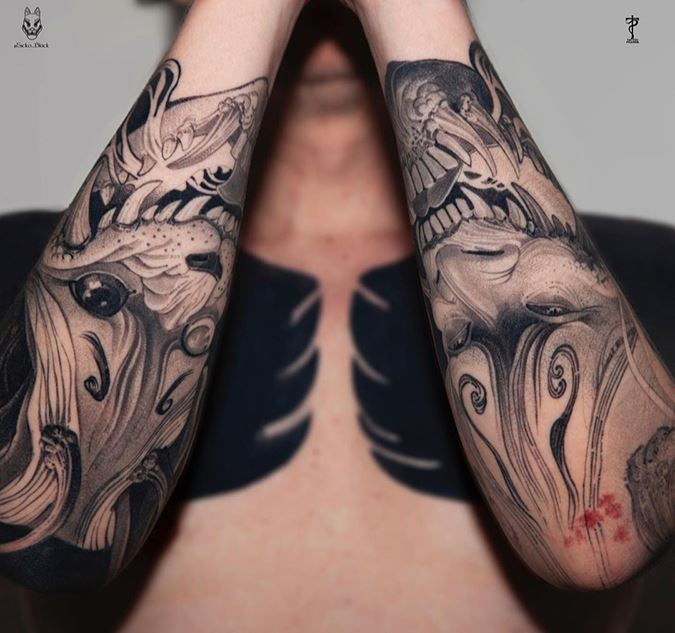
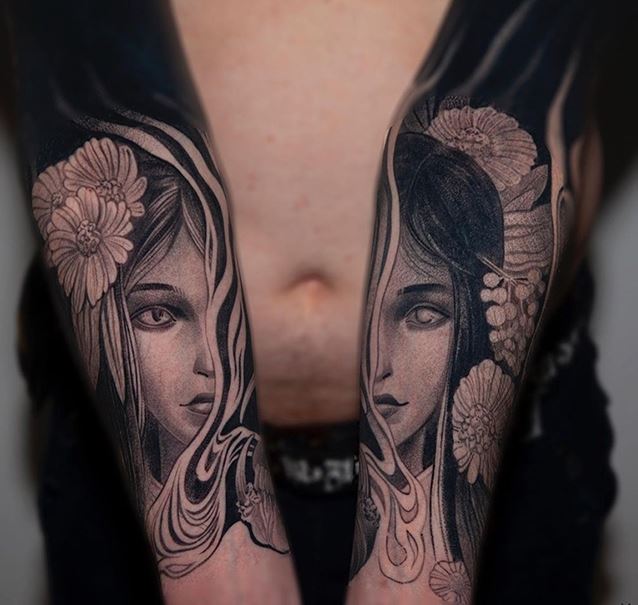
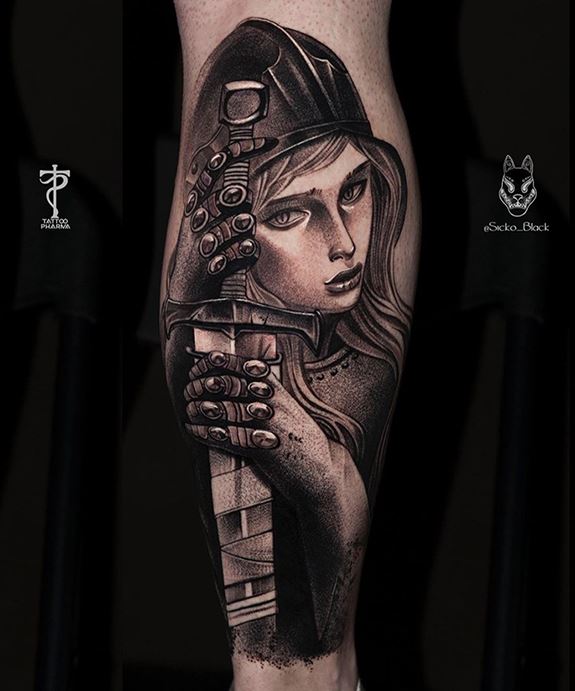
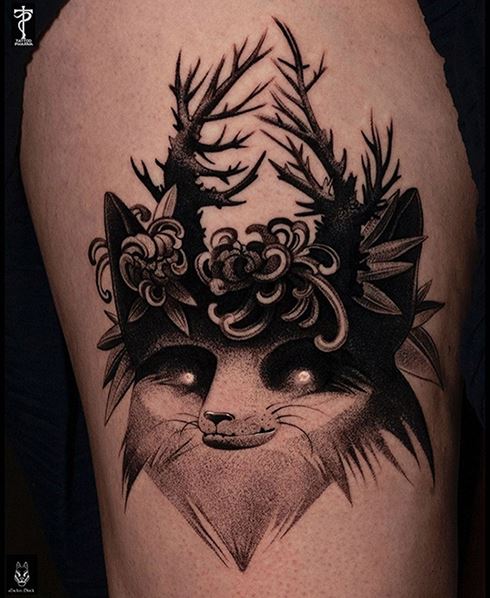
A: I have a somewhat original style, I would call it "Illustrative
Black". The foundation of this style is the harmony of black and
gray which is quite laconic combination. This style has no color,
only form and image. I think it is more than enough to make any
tattoo so that it will look good over time.
Q: Will you stick to this style or you might surprise us
with something completely different in the future?
A: I think that I have not exhausted the full potential of this
style, as it is flexible enough. I am constantly adding and
discovering new meanings and working with new compositional
combinations and plots. Anyway, the style should change over time -
this is inevitable if you work and experiment. And I like to
experiment, but I cannot predict what will happen, as I cannot force
it. This is the most exciting part, since it is impossible to be
sure where these experiments will lead me. Maybe the sky will fall
on my head and I will start working with color again - we'll see!


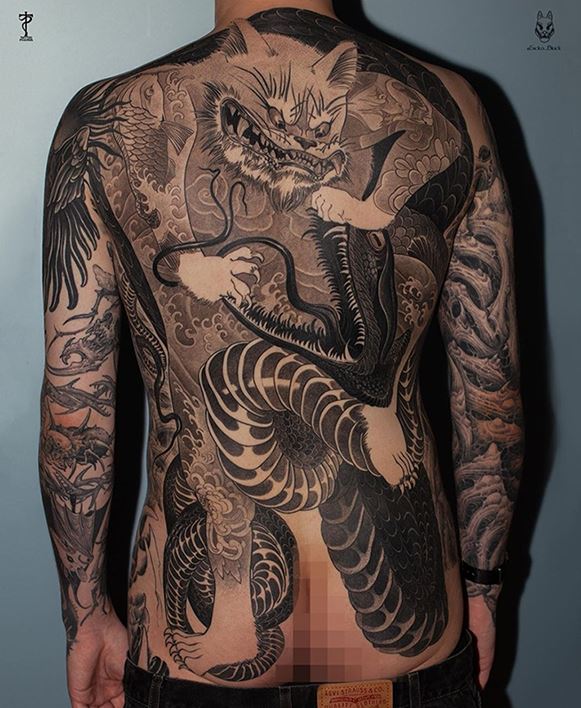
Q: I love every tattoo in your portfolio, but I have to say,
the back tattoos are truly something special. I love the designs...
the black color, perfect shading, I bet it takes a lot of time,
patience and effort to finish one back piece. What was the longest
session with a client? - Do you help them when choosing the design,
things like proper placement, backgrounds etc?
A: Thank you. Yes, large works require a special approach, both from
the artist and from the client. The last back pieces were done quite
quickly and in a general format, around 2-3 months for each one. I
don't really like it when such projects stretch out for years
because of once a month sessions. And if both the artist and the
client are eager, it's better to be done in the shortest possible
time. My sessions are quite long, 6-8 hours each, enough time to do
a certain stage of the work and not to torment the client, since
they also get tired and me myself really must maintain full
concentration during the work.
Q: Do you help clients with choosing design, tattoo
placement, background and etc?
A: Developing tattoo design is fully on me. Each tattoo sketch is
created individually for the client including their wishes and
preferences. Since I have more experience in this field I do help
with the placement, background and things like that but I'm always
eager to listen to comments and ideas from my clients. It is easy to
change any elements at the developing stage. I also have a lot of
sketches with tattoo designs that can be adapted to any placement
and size. Quite often I get requests like «do something in your
style», sometimes it’s something funny, dark or even something
powerful and this «moods» can be a good starting point.
Q: Tell me about the creative process. Do you use iPad or
you are old school pen and paper artist?
A: Lately I have been using digital tools. My permanent work tool is
the screen tablet Wacom CintiqPro. Large diagonal and the ability to
easily work and catalog designs on the computer are huge advantages
for me. I mostly use iPad as a sketchbook or while traveling. It is
also a great tool, but please make the diagonal bigger! Also
ProCreate has a great option for working with 3D models as you can
develop a tattoo design directly in dimention. I use this feature
for the initial lining up of the composition. It gives a great idea
of how the design will look in volume,from a distance, because this
is what distinguishes tattoos from all other directions - it is a
composition on the human body. Not long ago, I developed my own 3D
models, which are adapted for tattoo artists, they differ from the
existing ones in higher-quality scans and the ability to conjoin the
composition in a circle (arms, legs).
https://sickoblack.com/#procreate_stuff
Unfortunately paper and classic digital means can't attain this result. Nevertheless I happily use classic sketchbooks to develop some themes, images and then combine them digitally and finish them on my tablet. It requires sufficient time to develop a sketch, especially for larger tattoos. I do not do this just before the session, as I prepare the designs in advance in several stages. This part is crucial if you want to do something interesting and unique.
Q: Are some of those designs prints? Or ready-made designs
for clients who like the design for their own tattoo?
A: I have pre-made designs for tattoos from which you can choose and
also some of them are presented as prints, which can be used as the
interior décor. They are sold on my website and fit perfectly into
the design of both a tattoo studio and home.
https://sickoblack.shop/
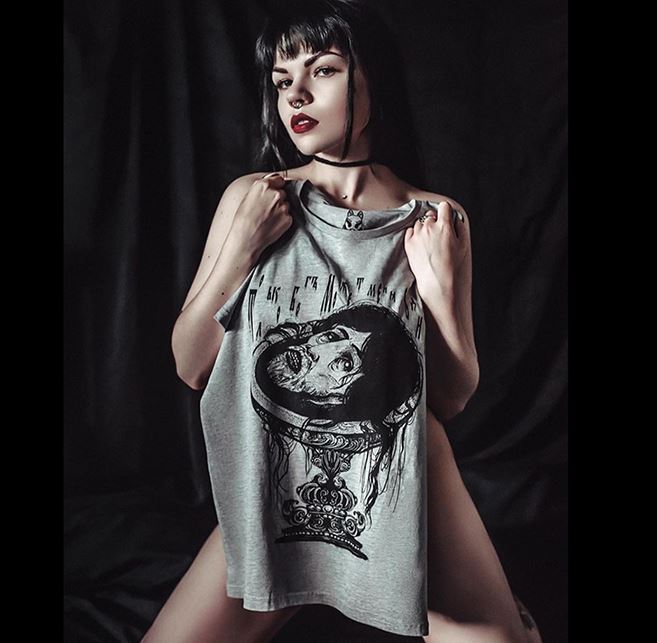
I also sometimes prepare designs for
T-shirts that I print myself or make collaborations with clothing
brands. For example, there was collaboration with a German clothing
brand StayColdApparel, and you can buy a digital version for
business. Another example is an English brewery «Anarchy Brew Co»
that purchased one of my designs for the labels of its Russian
imperial stout.
Q: You also have a YouTube channel where you share drawing
tutorials. How cool! I really like the channel. When did you start
YouTube and how do you like it? I assume you are very busy in the
studio tattooing all day, but I bet it's worth it to save some time
for your channel.
A: I started it not so long ago, and for the most part it is a new
thing for me, but I enjoy sharing my experience with my clients and
colleagues through video. In my blog I can reveal more details about
my fundamental idea of an individual approach to tattoos,
development of sketches, how to choose a tattoo artist and get good
results. I think that tattooing can be more creative, individual,
artistic and interesting than just a simple copy-paste of pictures
from the Internet. There is a lot of useful information on my
channel and it is constantly updated, if only there was more time to
do all this.
Q: Tell me about the tattoo seminars. How and when this
beautiful journey started?
A: In fact, these are not exactly seminars, but rather are
educational projects, which is called "Drawing for tattoo artists".
I started about four years ago. Tattoos have their own quite serious
nuances in composing and requirements for the skills that a tattoo
artist must have depending on the style in which he works. My
project is purely practical, there are no boring lectures with
theory (YouTube blog is just perfect for these lectures) we just
learn to draw with students. We mainly draw digitally, classes are
held online, I personally support each student, taking into account
their basic skills and aims for work. Therefore, the project is
suitable for both beginners (they have their own program) and
experienced artists. As for the style in which the artist works,
with the exception of perhaps ornamentation and lettering, the
artist needs to learn drawing as the better he draws and composes,
the higher the professional skills and demand as a tattoo artist.
Drawing has similar tasks, you need similar motor skills for it and
it is extremely short-sighted to ignore all these factors and not
taking them in attention. At this stage, the work is carried out in
the good old-fashioned way: the teacher shares the knowledge with
the students. The students do the task and I, in turn, make changes,
draw over the work, comment and show how to make improvements. It is
just like working in an art studio, only online. You can work at a
convenient time, you can work from anyplace in the world, combining
these lessons and work. Yes, it can be difficult, but it gives
results! It is shown by the positive reviews on the site from
masters with link. The most illustrative and my personal favorite is
the section called BEFORE/AFTER.
Q: Are you currently available for new students? How long
does it last? Will the artists get some kind of certificate after
successfully completing the program?
A: Currently, courses are aimed at the specific tasks. They are
divided into modules of knowledge and skills, each lasting 5 weeks.
It is an intense rhythm of work. Depending on the chosen course, our
program will help organize your practical and educational talents.
There is also a mentoring program in which the schedule is more
flexible and the program is more adaptive. You can find everything
on my website, and also on the YouTube channel with more details and
examples of students' work. If you are ready for serious work, you
will get a result proportional to your dedication. It will be a hard
work, but I, in turn, will help with this and be in touch during the
entire learning process. As for the certificates, I believe that it
is not necessary, as usually the main thing for artists should be
their portfolio and skills, not some certificates.
Q: You are also a sculptor... the masks are very interesting
and I already imagine them as part of some cool home interior design
or in a tattoo shop. Now let's talk about this... is this a hobby or
do you work on customs for sale?
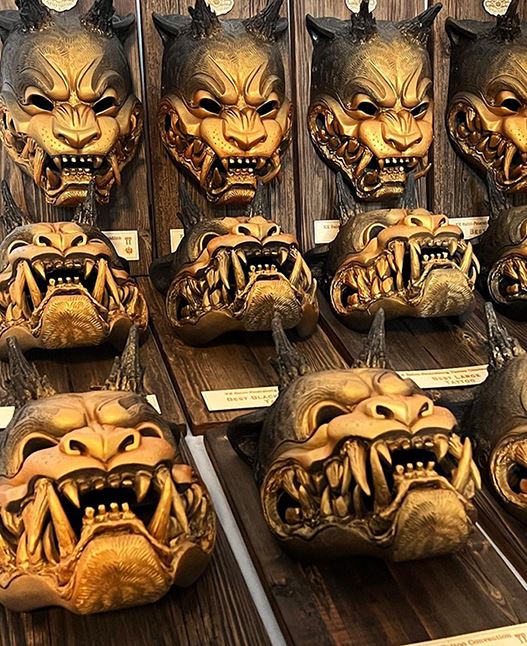
A: Sculpture for me is my creative outpost, a slightly different way
to visualize my thoughts, an attempt to move away from the flatness
into dimension. You usually use different ways of expression which
is very interesting to study, since these means make a certain
contribution to my work. It was also fascinating to master new
materials and to face the difficulties that my students face when
drawing. Mastering even the basics of a new craft requires a certain
amount of effort and time. I make my sculptures by hand and it is a
truly original work. Unlike popular approach now, when some take a
3D model of some mask and only slightly change the appearance, and
then print it, I create my work from sketch. I develop the
proportions, the image from my idea or from my sketch - and not from
a pre-made work. At first, this took quite a lot of time due to my
inexperience as one design took me from several weeks to several
months, but with time and experience I was able to do it faster.
Tattoo convention organizers noticed my works and last year I
developed a series of sculptures for two anniversary tattoo
festivals - one in Moscow and one St. Petersburg. It was an amazing
experience as they use my work as prizes for the winners and it was
the best award idea ever. At the moment, you can see several mask
designs on my website and they can be ordered in plastic or, as I
think even better, in bronze to decorate the interior of a home or
tattoo studio.
https://sickoblack.shop/sculpture
Q: No wonder your talent and hard work really paid off, you
are lucky to be sponsored by tattoo brands like Emalla and Tattoo
Pharma. How and when this beautiful collaboration happen?
A: I have been working with the Tattoo Pharma for many years. The
brand itself has started in 2014, I started working there probably
in 2017-2018 and I am glad to be part of this brand. They have good
tattoo cosmetics, aftercare products and they have an excellent and
strong pro team. We work together at tattoo festivals, and my
clients highly appreciate their products. I encountered the Emalla
brand a little over a year ago, after winning a tattoo festival.
They were just expanding their team. I think it's great when brands
attract tattoo artists and encourage their experiments with new
products and new needle configurations. If not for the feedback from
artists, it is quite problematic improving your products.
Q: Do you think is necessary for one artist to be supported
by big brands?
A: I think brand support is very important, but the artists
shouldn’t forget that the most important part of work is constant
practice and professional growth.
Q: Nowadays, we have so many new artists, tattoo styles,
conventions, seminars etc. Even YouTube video tutorials. I think it
is easier to get informed and get connected. Unlike back in the day,
when tattooing seem to be like an "underground" type of job. I like
it today. I think there's more good than bad. We night be "flooded"
with fake publicity and zero talent sometimes by some, but overall,
I think the global tattoo scene is growing and evolving. What's your
opinion?
A: It is definitely evolving, and it is great to watch how a certain
region develops, taking into account their personal styles depending
on the culture of the region. At our day and age, there is a huge
amount of information and those who really want to progress will be
able to overcome all barriers. I just believe that you must maintain
a balance between consuming information, assimilating it and
applying it. Thanks to the availability of basic information, the
average level of a tattoo artist has substantially grown, which
makes it possible to achieve more with your individual approach,
style and the ability to draw, as a huge number of artists can
already do basic things and the competition is very high. By the
way, this is just the sign of the times as a similar situation is
observed in related professions. You can undoubtedly say that in
tattooing the one thing remains unchanged – practice. This is what
will separate an experienced artist from another - the mastery of
the tool and knowledge of the craft. They are developed exclusively
with practice and no mere information will radically bring a
beginner closer to a pro.
Q: Your advice on finding a good, professional tattoo
artist? What people should look for?
A: Listen to your heart, of course)). Also check the portfolio and
finished works.
Q: Do you participate at local or international tattoo
conventions?
A: Let's start with international tattoo conventions; I visited the
main events of Europe as a participant. I’ve been in Milan,
Brussels, Berlin, and several smaller conventions in Sweden,
Germany, and Italy. I also happily visited several conventions in
England, traveling from north to south and ending with a trip to
Ireland. I was very interested in how the tattoo industry works
outside my area, what styles are popular there. It was a great
opportunity to communicate with colleagues, artists and studios. My
trips were mostly on business basis, although I was trying to stay
in different tattoo studios for some time. I constantly take part in
local tattoo conventions, both as a participant and as a jury
member. I also give lectures and seminars for tattoo artists so that
more colleagues learn about my project "Drawing for tattoo artists".
Twice I was also a tattoo convention’s partner. In the last few
years at each convention I won in the nominations in which I work
constantly - black & gray, big tattoo, miniature tattoo.
Q: As a talented artist, I think many opportunities are
constantly knocking on your door. If given chance, would you
consider trying your luck in the USA or somewhere abroad? I think
that will be a great career highlight.
A: I am always open to new opportunities and would be happy to try
my luck abroad, as it would be a great and new experience.
Q: After so many hours in the studio, so many clients... so
many projects, I bet it can get overwhelming sometimes. Do you feel
like you still have the same enthusiasm as when you started?
A: If my job was only tattooing and for seven days a week from
morning to evening I was doing only that, then yes, over time it
would be overwhelming. That is why I combine tattooing with teaching
students, my sculpture works and running a YouTube channel. This
allows me to have the same enthusiasm and sometimes enhance it as I
know and do a lot of exciting things. Taking into account all the
experience I have gained right now, it is always a great opportunity
to implement my plans and do my projects in the real life.
Q: What do you like the most about being a tattoo artist?
A: The best thing about being a tattoo artist is the initiation, as
I said above, and the personalization of my work. It is also the
combination of creativity and communication with people.
Q: Your advice for those who want to try getting into
professional tattooing?
A: You must be obsessed with your work. Only then everything will
work out and you will not abandon your goal.
Mr.Alex Trunov thank you so much for the interview,
we really appreciate it.
Kind Regards
Fredrik Lindström
Editor at Skin Artists Tattoo Magazine


