
interview with tattoo artist U-Gene
Hello
U-Gene! Thank you so much for taking the time to do this interview.
Please start by telling us something about yourself, how it all started? Was it hard to learn
tattooing? Did anyone help you?
Yes, it was hard to learn. My tattoo adventure started in Ukraine
ten years ago. There were not many tattoo artists there and it wasn’t easy to gather knowledge. The Internet provided few
videos on the equipment. I’ve been drawing since I was a child and
the artist who tattooed me suggested I should try.
Q: What type of art outside tattooing do you like? Do
you have any favorite artists?
A: I’m definitely most inspired by painting and graphic arts. I
admire Zdzislaw Beksinski, Alfons Mucha, Francisco de Goya and
Salvador Dali. I like works of various illustrators, such as
Grzegorz Domaradzki and Marcin Bondarowicz. I guess all the artists
I value, have had some influence on me and my art.
Q: You do almost all kinds of styles. Tell me about the
creative process.
A: I experiment only in the designing phase, never on the customer’s
skin. I rather do my designs based on the customer’s idea. I like
combining elements such as architecture, nature, humans. I prepare
projects in Photoshop, use photos and sometimes I draw.
Q: Having a talent is important, but so is hard work. How long took you to
gain confidence?
A: Being consistent and hard working is more important than being
talented. I’ve once heard that everyone can draw, but most people
don’t spend enough time on it. I’m very demanding when it comes to
myself, that’s why I’m still not satisfied with my work. I’m aware
of the fact that I’m already experienced and have the knowledge that
allows me to experiment with my works. There are more and more
tattoo artists who combine graphic arts with realism or make only
graphics, as far as the idea is concerned, there are many great
ideas. But to do it technically well and to inject the ink properly
so that it lasts for years, requires years of practice and learning
from the best. I’m in my experimental phase, I came back to colors
and mixing styles, I'm still facing some difficulties, but that’s
the best way to develop, isn’t it?
Q: Do
you have any creative hobbies?
A: I paint, currently I’m mostly using acryl and pencil. Lately I’ve
started to use oils. When painting, I definitely learn about colors,
shades and lines, which has a big influence on my tattoos getting
better. I don’t have as much time for it as I’d like to, but that’s
exactly what inspires me and makes me relax.


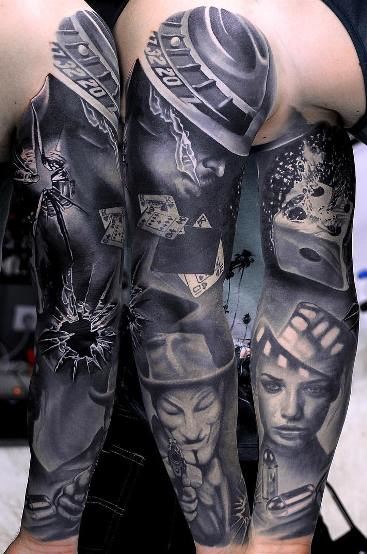
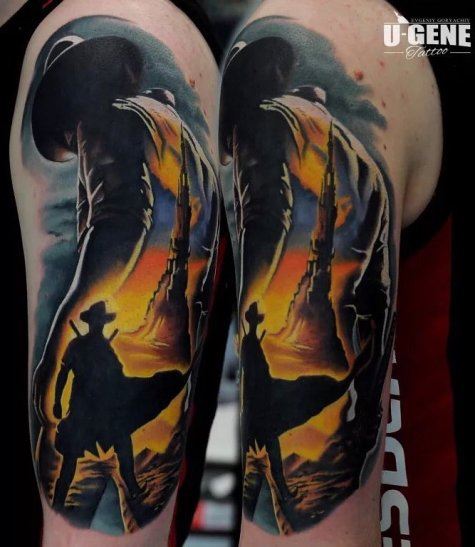
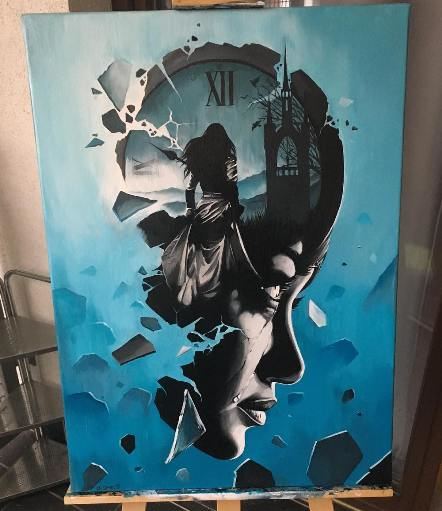
Q: Many, especially the young people believe that being a
tattoo artist is such a fun profession, me including, bit I know
that it takes a huge responsibility and constant development. But
from other hand, it could be a very interesting experience to deal with
so many people, some are even revealing their life story meanwhile
the session, so yes, a unique moment to be part of. What aspect of
your work you cherish the most?
A: As in each field, there are people for whom their development
isn’t important and they see their job as means of earning money
and/or social advancement. You see many photographers, movie makers
and hairdressers, but how many of them provide really good quality
of their service? I take every customer very seriously, which also
means I refuse to do a tattoo when I see that the customer’s idea
and/or expectations don’t comply with how I understand the quality
of work. My
sessions last very long (eight hours and more), which entails a lot
of talking – especially when a person comes in regularly (e.g.
having the sleeve done). It’s not unusual that such acquaintances
turn into friendships and/or close relations.
Q: How long your clients wait for their appointment?
Do you accept reference photos?
A: I don’t make appointments for more than three months in advance.
I don’t want to be booked for three years in
advance and have no freedom. Worst case is when I need to cancel or
reschedule an appointment because my plans have changed. The
customers send me their ideas and photos and I design the tattoo. I
show them the sketch on the day the tattoo is supposed
to be done and if they don't like something, we change it, but
in 99 per cent of the cases, the design is accepted.
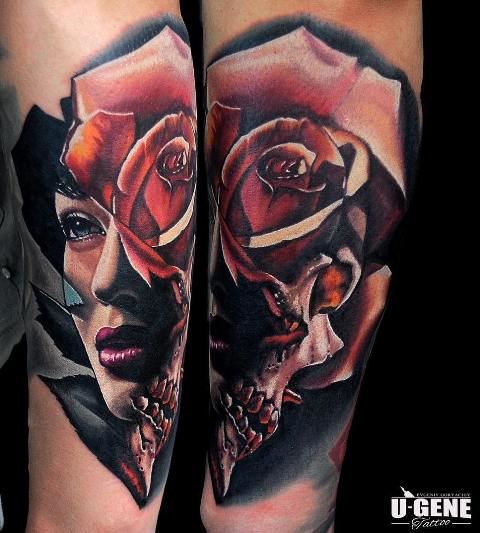
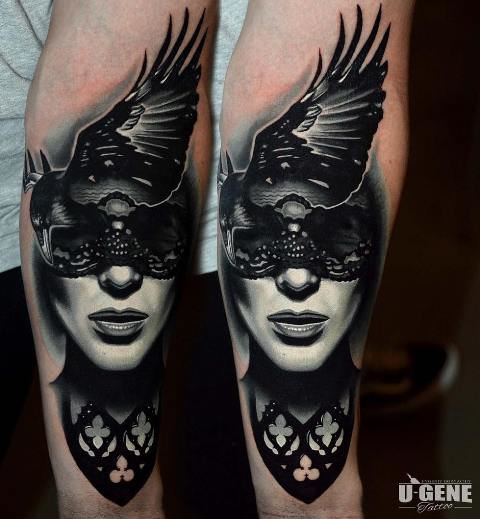
Q: Any advice for those who want to start tattooing?
A: First of all, assume it’s not going to be easy. One needs a lot
of patience and consistent course of actions. If you’re at the
beginning of your career, draw something every day, e.g. small
shapes or objects, something you can draw. When you feel confident
with small designs on a sheet of paper, invite your friends to
tattoo them. There’s no better way to
learn tattooing than to do it each and every day. All the rest will
come.


