
Interview with Valeriia Puhach
To mark nearly two decades of documenting
the global tattoo community, Skin Artists Tattoo Magazine is
spotlighting the elite creators who are redefining the relationship
between fine art and skin. Valeriia Puhach has been chosen for this
eighteen anniversary celebration as a premier talent whose work brings a
rare, painterly soul to the medium of realism.
Originally trained in architecture, Valeriia approaches the human
body with a sophisticated understanding of composition and flow. She
has gained significant international acclaim for her signature
"broken portrait" style, where flawless anatomical realism is
intersected by organic, botanical fragments. Her ability to treat
skin like a multidimensional canvas balancing delicate floral
transitions with structural precision has made her a leading figure
in the modern fine-art tattoo movement.
The following interview is dedicated to exploring the future of
tattooing. We delve into how classical art history informs
contemporary aesthetics, the technical challenge of maintaining
"lineless" transitions that stand the test of time, and Valeriia's
vision for the evolving boundaries of the craft as the magazine
looks toward its next chapter.
Q: Before we get into the technicalities of your craft, tell
us about the person behind the machine. What are your roots, and
what was that first 'spark' that made you realize art was your
calling?
A: I was born in Ukraine and originally studied architecture before
tattooing became my main path. Art was always present in my life -
drawing, painting, building forms. The real “spark” happened when I
realized tattooing combined everything I loved: composition, color,
psychology, and human connection. Skin became my living canvas.
Q: Your portfolio features incredibly delicate, painterly
transitions in flowers and birds. Is there a specific piece from
your early career where you realized skin could be treated exactly
like a canvas for fine-art realism?
A: Yes, early on I did a floral realism piece where I treated light
and shadow exactly as I would in painting. That moment made it
clear: skin isn’t just surface, it’s dimensional, emotional, and
responsive. From then on, I approached tattoos as fine-art
compositions.
Q: You’ve gained significant attention for your "broken
portrait" style, like the piece from the Golden State Tattoo Expo.
What is the technical challenge of blending realistic facial
features with fragmented botanical elements?
A: The challenge is balance and placement. Realistic faces require
anatomical precision, while botanical fragments need freedom and
flow. On top of that, composition must fit the body. Curves and skin
movement can easily distort a face if the size or placement isn’t
right. Technically, it’s about maintaining facial structure while
letting organic elements “break” it, without losing harmony.
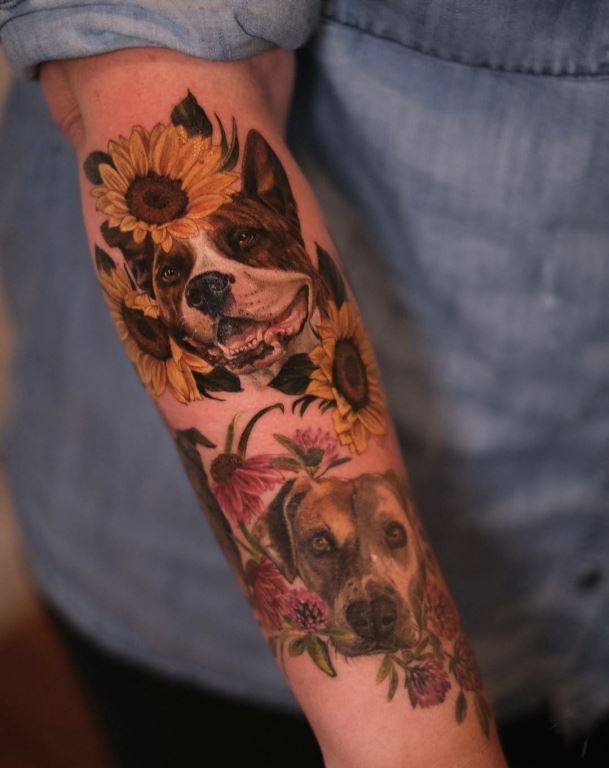
Q: From vibrant hibiscus to soft peonies, your use of
saturation is a hallmark of your work. How do you approach your
color palette to ensure these soft, "lineless" transitions stand the
test of time?
A: I work in soft layers, always thinking long-term. I choose
pigments based on undertone and healing behavior, build saturation
gradually, and rely on contrast rather than heavy outlines. Even my
“lineless” tattoos still have lines, they’re just extremely fine and
invisible to the eye, but they hold the structure of the tattoo.
High contrast is always key for brightness and longevity, along with
thoughtful color temperature and negative space.
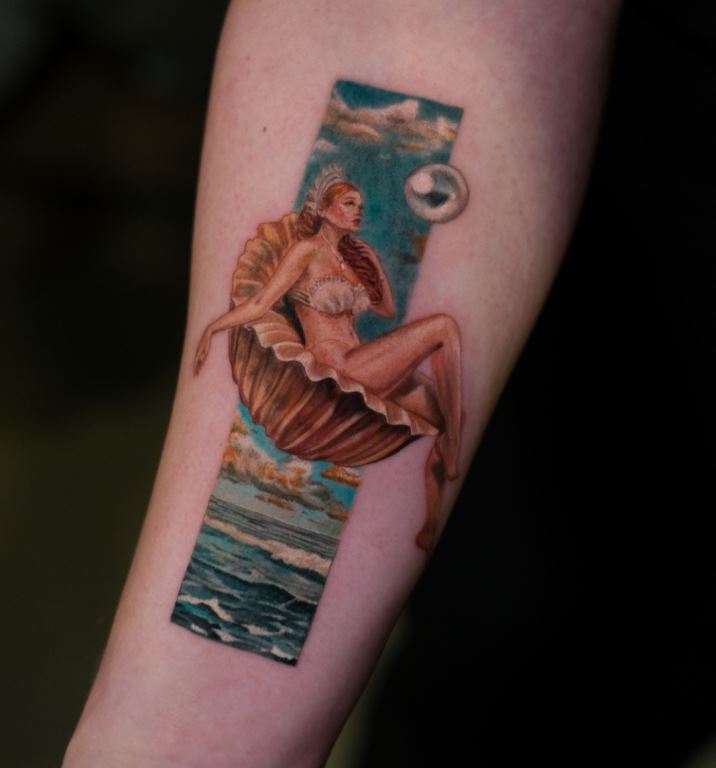
Q: We see nods to classical art, such as your "Birth of
Venus" adaptation. How do you balance staying true to classical art
history while pushing the boundaries of modern tattoo aesthetics?
A: Classical art gives me foundation, modern tattooing gives me
freedom. I draw inspiration from old masters in general, I deeply
love classical art but reinterpret it through contemporary
composition, color, and movement. In some of my painterly tattoo
pieces, like my “Birth of Venus” adaptation, she becomes almost a
burlesque diva not in a champagne glass, but in a shell, as a
tribute to the original. It’s modern composition with the soul of
classical painting.
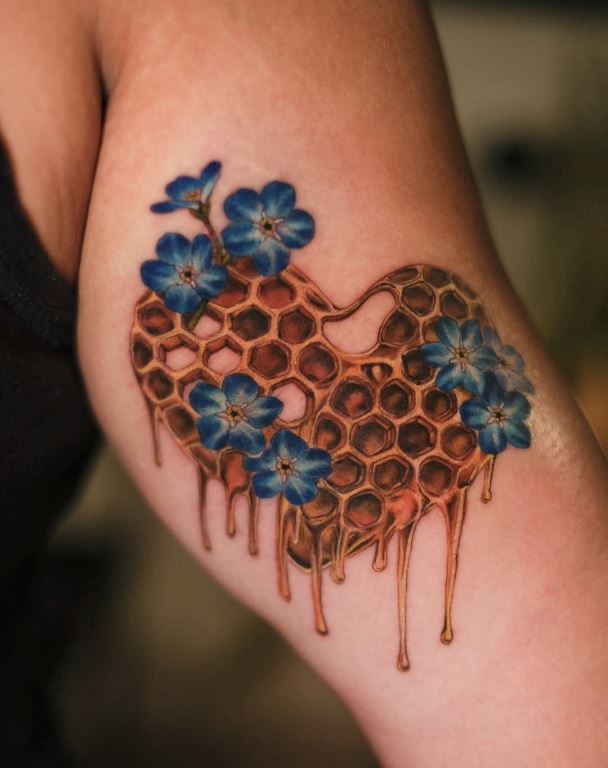
Q: You studied at the Architectural Academy in Ukraine. In
architecture, form follows function. How do you apply 'architectural
thinking' when mapping a tattoo onto the human body?
A: Architecture taught me to think in volume and movement. When
designing a tattoo, composition must follow the natural flow of the
body bones, muscles, and curves all matter. The design has to work
from multiple angles: front, side, and in motion. The human body
isn’t flat, and we don’t stand still, so a tattoo should feel
balanced and intentional no matter how the body moves.
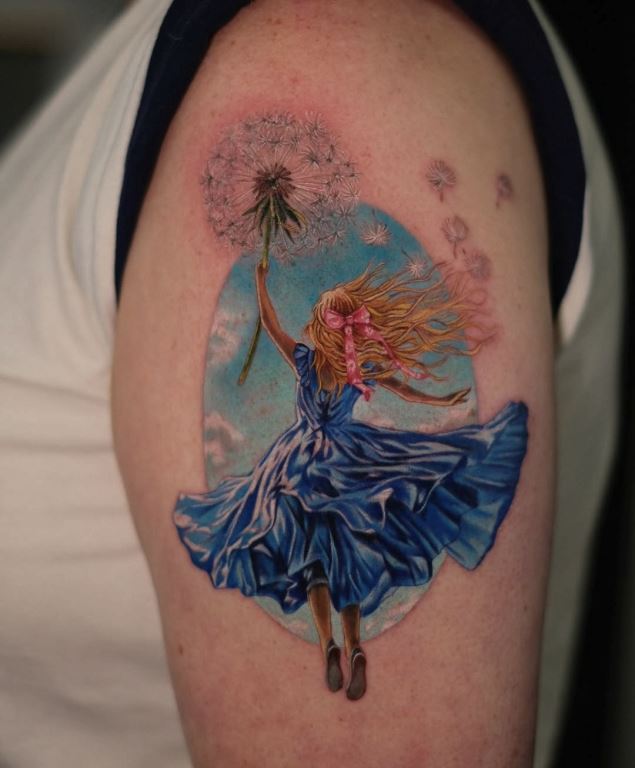
Q: Your 'broken portraits' often feature classical faces
fragmented by nature. What is the goal of this fragmentation? Are
you trying to deconstruct the traditional 'perfect' portrait to
reveal something deeper or more emotional?
A: Honestly, it started playfully, I just wanted to do something
different with a classical female portrait. Breaking the face felt
visually interesting. But over time it gained meaning for me.
Sometimes, to create something new, you have to break the old, like
a toy that needs to be taken apart before it can become something
else. For me, the fragmented face reveals what’s inside: inner
beauty, growth, imperfection. Nobody is perfect, what truly matters
is who you are beneath the surface.
Q: You often include very fine textures, the fuzz on a
peach, the veins in a leaf, or the reflection in an eye. At what
point in the tattooing process do you transition from the broad
'painterly' strokes to these hyper-fine details?
A: I start broad shapes, light, color flow. Fine details come last,
once the foundation breathes. Texture only works when the base
painting already feels alive.
Q: You founded the @tattootherapyproject, where you work
with scars and mastectomies. How does your artistic style shift when
the goal isn't just 'decoration' but 'reclamation'? Do you find that
certain colors or textures (like soft florals) are more effective
for covering scar tissue?
A: Every scar is different emotionally and physically and I can’t
ignore that. Each design I create to rebuild a scar into something
new and beautiful carries the soul of the person I’m working with.
It’s meant to become a forever part of them. Technically, I work
much softer, because scar tissue behaves differently and has its own
shape and memory. My goal is to completely move away from the
original scar form, while still respecting the body, creating
something that feels natural, balanced, and as if the scar was never
there.
Q: You’ve mentioned that tattooing is an 'intimate
exchange.' How do you balance your strong artistic 'Visionary'
identity with the intense emotional needs of a client who is coming
to you for healing?
A: For me, tattooing always begins with listening. Whether it’s a
scar cover-up, a memorial piece, or simply a meaningful tattoo, I
first take time to understand what the client wants and feels. Then
I share my ideas on how we can make it work together. Almost
anything can be created in many different ways, so if something
doesn’t feel right, we adjust it until it truly fits the person.
What matters most is that we’re on the same page. If someone comes
to me, it usually means our aesthetics already align, and together
we find the best way to bring their vision to life. I want every
client to feel seen and heard, and I genuinely do everything
possible to make their wishes come true.
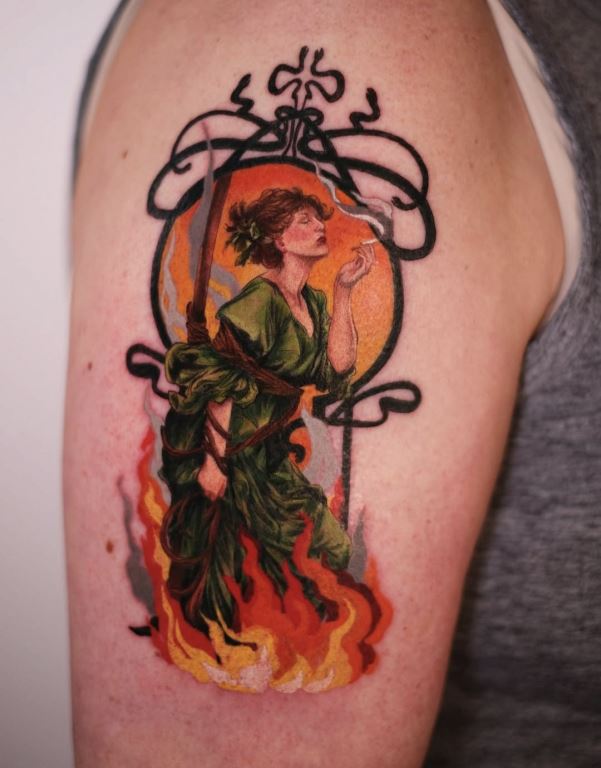
Q: Through your Tattoo Therapy Project, you help women move
from "shame" to "self-love." Can you share a moment where a cover-up
or a scar camouflage completely changed a client’s posture or
personality right there in the chair?
A: I’ve done many truly life-changing tattoos. Often during a
session, clients share their pain and past trauma, and knowing that
we’re physically transforming something connected to that story can
mean a lot. After hours of work, when they finally see their “new
you” reflection, I can feel the shift immediately. They stand
differently. They feel stronger. Something that once felt like
weakness becomes their power. I often see these clients again later,
and I notice how they dress differently, speak with more confidence,
and simply allow themselves to feel beautiful and welcome in their
own bodies.
Q: Having built a career in Ukraine and now dominating the
scene in Los Angeles, what do you see as the biggest difference in
'tattoo culture' today? Is the global scene becoming one giant
melting pot due to social media, or do regional styles still hold
their own?
A: I think every country and even every city carries its own tattoo
energy and preferences. In the U.S., I often see people choosing
memorial tattoos or pieces that honor family and loved ones. In
Ukraine, I created more self-empowering work, and especially now,
during the war, I feel a strong shift toward grounding tattoos,
designs that help people feel strong, beautiful, and connected to
their roots, honoring Ukrainian culture and identity. At the same
time, the global tattoo scene has become a melting pot. Through
social media, we all influence each other, learn from one another,
and feel connected across borders.
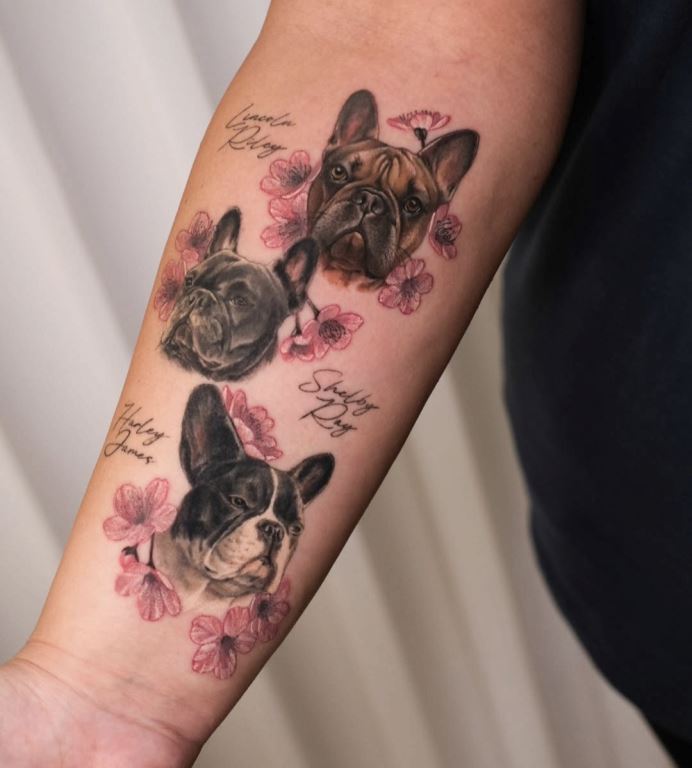
Q: We are seeing a massive shift toward hyper-realistic and
painterly styles that were once thought impossible on skin. In your
opinion, has the industry finally moved past the 'rebellion' phase
and fully entered its 'Fine Art' era?
A: I believe the tattoo industry is living through its own
renaissance era. We now have incredible equipment, high-quality
needles, and a huge variety of inks that have been tested over many
years and we’ve finally learned how to truly master them. Artists
are constantly challenging what once felt impossible and proving
that true fine art can live on skin.
Q: You’ve served as a judge at worldwide conventions and
lead seminars. With the explosion of self-taught artists via the
internet, do you think the traditional apprenticeship is dying, or
is it more important now than ever for maintaining the integrity of
the craft?
A: I’m self-taught myself. When I started, there were no seminars,
no YouTube, and almost no information online. Artists guarded their
knowledge, and in Ukraine there wasn’t and still isn’t a traditional
apprenticeship system. So I know firsthand that anything is possible
on your own. Still, I often wish I had a mentor back then. I truly
believe mentorship is a fast track to mastering the craft and can
save years of struggling with basics. At the same time, I have mixed
feelings about apprenticeships, because sometimes this system can be
abused. In my opinion, one of the healthiest ways to learn today is
through paid education and in-person seminars where knowledge is
exchanged with respect on both sides.
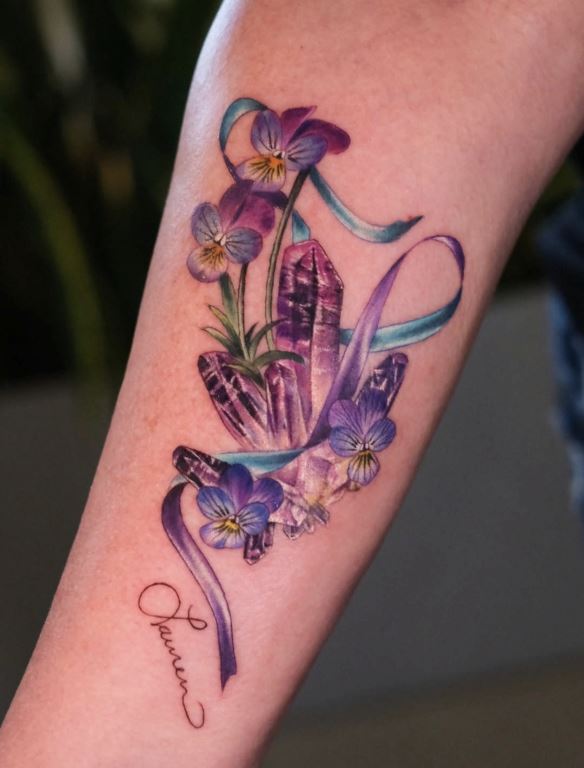
Q: As we move further into 2026, AI-generated art is
becoming a standard tool for many. Do you view AI as a threat to the
artist’s 'soul,' or do you see it as just another 'digital brush'
that can help visionaries like yourself explore complex compositions
faster?
A: I see AI as a coin with two sides, but ultimately it’s just a
tool, another digital brush. The artist is still the one who carries
the vision and brings it to life.
Q: In a saturated market where everyone is trying to go
viral, how does an artist protect their 'Signature Style'? How do
you ensure that a 'Valeriia Puhach' piece remains instantly
recognizable in a sea of digital clones?
A: Signature style comes from honesty. I believe you should simply
do what excites you, create what you truly love and enjoy seeing on
skin. Everything else is noise. I protect my style by staying rooted
in emotion, composition, and my personal language of color and
softness. Trends fade, but authenticity stays.
Q: The biggest myth in tattooing today?
A: One of the biggest myths is that you can’t do color tattoos on
melanated skin, or that color tattoos always fade faster. Both are
simply not true. With the right color choices, contrast, technique,
and placement, color can look beautiful and last on any skin tone.
Q: One word to describe the future of ink?
A: Limitless.
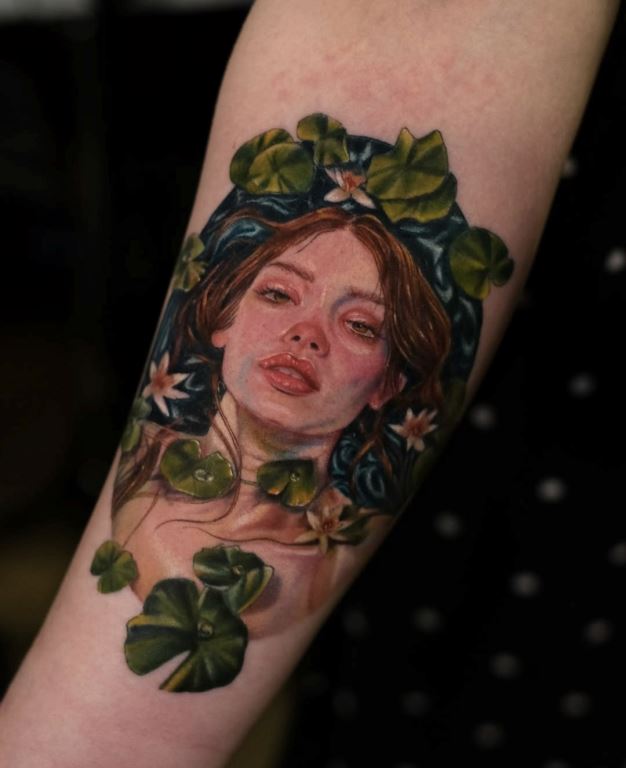
Q: We live in an era where social media 'clout' can
sometimes outpace technical skill in terms of driving demand. How do
you distinguish between market popularity and intrinsic artistic
value when setting your own standards? In your view, has the
industry reached a point where 'followers' are being priced higher
than 'fundamentals'?
A: Popularity and artistic value don’t always move together. Social
media can amplify visibility, but it doesn’t replace fundamentals.
For me, real value comes from technical growth, healed work,
consistency, and the impact you have on people, not numbers on a
screen. I try to set my own standards based on craft, integrity, and
long-term quality. Followers can open doors, but skills keep them
open.
Q: Your message to the artist who will pick up a machine for
the first time in 2026?
A: Start with art. Take local drawing or painting classes, train
your eye, and learn fundamentals. Sooner or later, what you create
on paper will translate to skin. Find a good art teacher, and if
possible, a tattoo mentor who respects the craft. Be patient with
yourself, stay curious, and remember, every great artist once held a
machine for the very first time.
Interview: Magnus Karlsson
Date: 11/02/2026


