
Interview with Yana Sulina
Hello Yana Sulina! Thank you so much for taking the time to do this interview. To begin, could you share a bit about yourself and your artistic journey? We're particularly interested to know if you're a self-taught artist and when you first recognized your passion or talent for the arts. I’ve always loved drawing, but I didn’t see it as something serious growing up. I’m originally from Ukraine, and at the time, artistic professions weren’t considered viable careers. Toward the end of high school, I enrolled in prep courses with the intention of studying economics at university. But as those classes came to an end, I realized it wasn’t for me, I didn’t enjoy it at all. At the very last moment, after a conversation with my mother, we decided to change direction. I had always been drawn to design l loved creating compositions and inventing things even as a child, so we took a leap of faith. Within a week, I applied to a design program at university, passed the entrance exams, and was accepted. That marked the beginning of my artistic journey. The university I attended had a strong academic foundation in painting and drawing. For four years, we were deeply immersed in academic art training, alongside design and composition courses. It was challenging at first, especially since I had no prior formal art education. But after the first year, I started to grasp the fundamentals and felt for the first time that I was exactly where I belonged. Those years gave me a solid base, thanks to some truly inspiring teachers who nurtured our creativity and skills. Toward the end of my studies, I became interested in tattooing, although at the time I wasn’t sure it could be a real profession or something that would suit me long-term. After graduation, my department head offered me a job at a design firm, where I worked for a year. That experience helped me realize that I didn’t want to pursue a career in design, I was craving more creative freedom and hands-on artistry. Then, by chance, I met a tattoo artist who had seen my sketches. The very next day, he invited me to tattoo him. I was so excited, I said yes immediately. That was nearly ten years ago. After that, I started tattooing friends for free and what began as a spontaneous decision slowly turned into my career.

Q: When did tattooing become a part of
your artistic path? What was it about the art of tattooing that
specifically drew you in?
A: As I mentioned earlier, I became interested in tattooing while I
was still studying design at university. There was a student a few
years ahead of me who started tattooing after graduation. He did a
few tattoos for people we knew, even some of our professors, and I
had the chance to see both his process and the results. That’s when
I first realized how captivating and powerful this form of art could
be. What drew me in was the idea that tattooing is just as complex
and expressive as drawing or painting on paper but it’s done on
living skin. It felt much more personal and meaningful, because the
artwork becomes part of someone’s body and story. Unlike art in
galleries, this is something people carry with them every day. That
intimacy really inspired me. I also became fascinated by the
diversity within tattooing - how many different styles and emotional
expressions it could hold. Each piece is unique and tailored to the
individual. Around that time, I found myself constantly doodling on
my sister or friends’ skin with a pen almost as if I was already
projecting this desire to eventually create real tattoos.
Q: What did your early tattoo journey look like in terms of
the styles you were learning, and how did your distinct artistic
style gradually take shape?
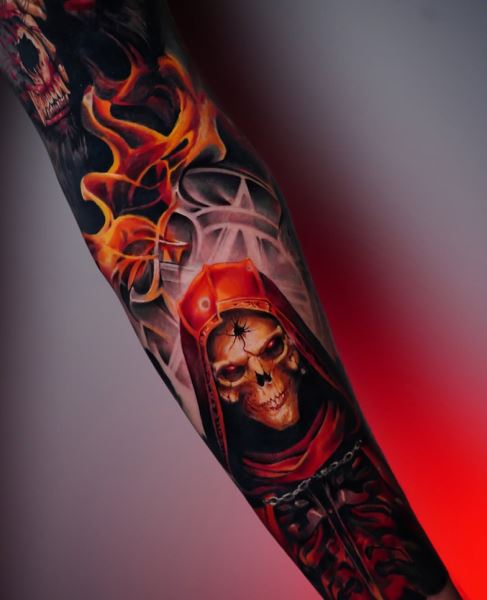
A: Interestingly, my earliest tattoos were quite complex. I started
with black and gray portraits and plaster sculptures, likely because
during my academic art training, I spent a lot of time drawing
plaster casts. That background naturally influenced my early tattoo
work, which I mostly did for friends. In the beginning, I primarily
focused on black and gray pieces. Later on, I began doing a wider
range of designs based on client requests. Many tattooers I knew at
the time advised me to take on lettering projects, saying it was
important for refining technique. But in hindsight, I feel that may
have slowed down my development, because I had a natural inclination
toward watercolor and color transitions. Technically, my early color
work lacked saturation and polish, but I think if I had focused on
that style from the start instead of trying to do everything, my
growth would’ve been faster. During those early years, I worked
across many styles - I did a bit of everything. In some ways, that
variety became a strength. It taught me how to blend styles
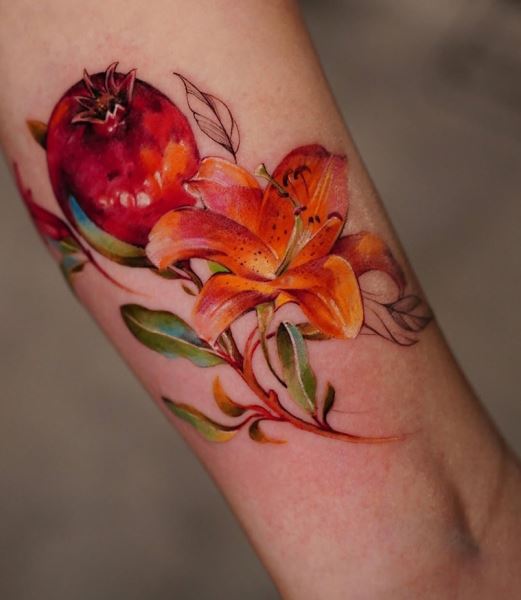
creatively. Today, I enjoy combining elements like realistic flowers
with watercolor accents or graphic linework in the leaves, which
gives the tattoo an unexpected and artistic look. Now, I’m much more
selective. I no longer take on projects that don’t resonate with me.
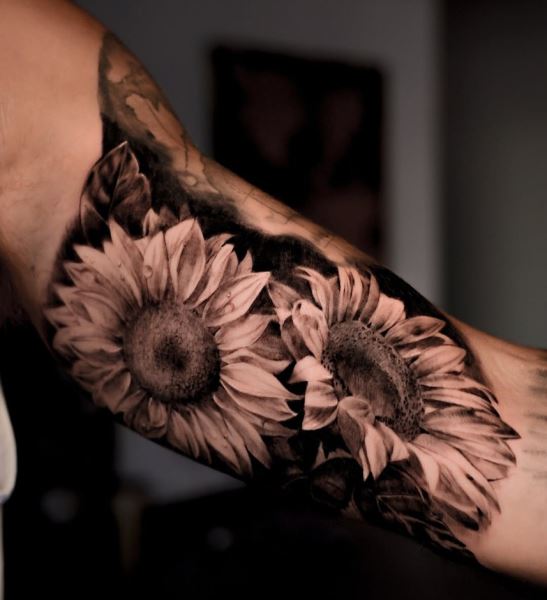
My current focus is on colorful, detailed tattoos-especially floral
and botanical themes, which are quite popular in Philadelphia. I’m
also evolving my style to incorporate more narrative elements, like
portraits, poetic touches, or characters within the compositions.
Lately, my goal has been to enrich my portfolio conceptually, not
just visually.
Q: How did the growth of your
self-assurance in your abilities influence your capacity to build a
steady stream of clients?
A: To be honest, self-confidence didn’t come right away. In the
beginning, I often doubted my work, didn’t know how much to charge
for a tattoo, and was afraid that clients would walk away. Because
of that, I sometimes accepted projects I didn’t enjoy or priced my
work too low. Over time, I started to see that people genuinely
appreciated my art, they were willing to wait for an appointment or
even travel from other cities to work with me. That gave me a real
sense that I was in the right place, doing what I was meant to do.
As my confidence grew, I began approaching my work more
intentionally. I became more selective with the projects I took on,
felt comfortable setting fair prices, and presented myself more
openly and proudly on social media. When you believe in yourself,
clients can feel it, they trust you more, and many of them come back
again.
Q: Where do you typically draw your creative energy and
initial ideas when starting a new design project?
A: Most of my projects are inspired by my clients’ ideas or the
emotions they want to express through their tattoo. Usually, a
person shares their concept or a feeling they’d like the piece to
reflect, and I start thinking about how to translate that into a
visual design. I often begin by searching for references with the
right lighting and mood, which I use to build a sketch. For floral
tattoos, I usually work from my own photo archive. I have a personal
hobby of photographing flowers and interesting textures, this
collection often comes in handy when I’m creating designs. If the
piece is based on a game character or fan art, then of course I
stick closely to the original, but I still adjust lighting and
contrast to make the image work better as a tattoo. When it comes to
more personal or artistic pieces, like paintings or custom designs,
I usually start from an emotion. That emotional impulse becomes the
foundation, and I develop it through elements like light,
composition, the expression of a character, or the contrast in the
scene.
Q: Your proficiency in both color and
black and gray tattooing is evident. Are there particular nuances or
complexities within either style that you find more demanding or
intriguing?
A: I genuinely enjoy working in both color and black and gray, and
each style has its own set of challenges. Technically, I’d say color
tattoos are more complex, but they also feel more natural to me. I
love creating smooth color transitions, working with contrast, and
building vibrant compositions, especially when it comes to floral
designs. That’s why I tend to gravitate more toward color work. One
of the challenges with color tattoos is that they’re not always in
high demand, depending on the client or region. Interestingly, I’ve
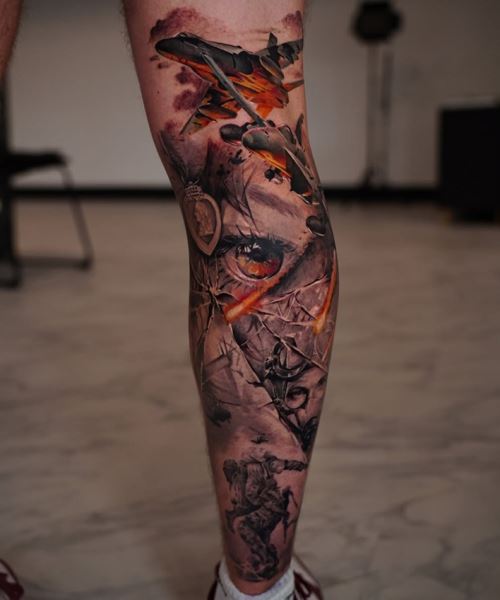
noticed that most male clients request black and gray pieces, while
smaller floral projects are usually done in color, so my approach
often depends on the nature of the design and the client’s vision.
Q: What tattoo pushed you the most, either
creatively or technically, and what did you learn from the
experience?
A: From a technical standpoint, some of the most challenging tattoos
I’ve done were early projects on difficult areas like the ribs or
neck. These zones are highly sensitive, textured, and constantly
moving, which makes the tattooing process much more complex. When I
first started, I didn’t yet have the experience to manage these
areas efficiently, so the sessions were long, slow, and often
stressful for both me and the client. Because of that, I often had
to split projects into multiple sessions, which made the process
more painful and exhausting. After working on a few of these pieces,
I decided to stop accepting tattoos in those areas for a while. I
chose instead to focus on arms and legs, where the skin is more
stable, easier to work with, and generally more comfortable for both
the artist and the client. However, as my experience grew, I
gradually returned to more complex areas. Now I feel much more
confident working on them. I’ve learned how to design specifically
for curved or stretching areas of the body, how to reduce pain and
stress during the process, and how to place the tattoo in a way that
flows naturally with movement. That said, I’m still very selective
about neck tattoos, they require not just technical skill but the
right concept. I only take them on when I’m confident the design and
placement will truly work for that part of the body.
Q: The artistry in your floral tattoos is
remarkable. I'd love to know more about their origin. Do you
typically conceive these designs independently, or is there often a
collaborative element with your clients?
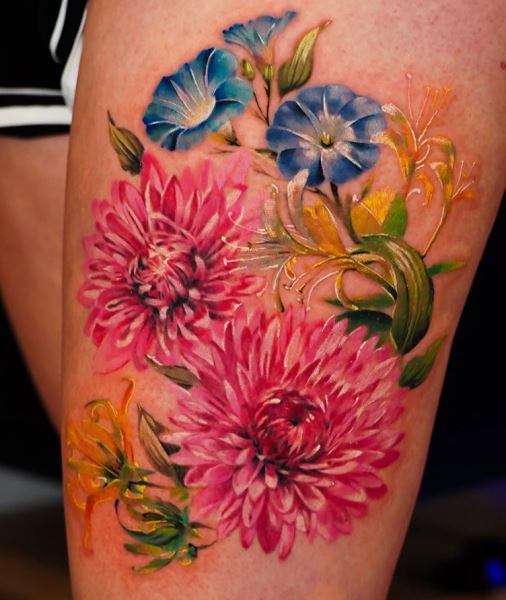
A: Thank you! Most of my floral tattoo designs begin with the
client’s personal story or intention. While some clients choose
flowers for their aesthetic beauty, many assign deeper meaning to
them, often in memory of loved ones. For example, I’ve noticed a
tradition where each birth month is associated with a particular
flower, so I often create compositions that represent family members
or significant people through their birth flowers. The process is
usually collaborative. Clients tell me which flowers they’d like to
include, or what colors and placement they prefer. From there, I
shape the composition, taking into account the flow of the body. I
always ask for reference photos or schedule a consultation, because
I believe a tattoo should not only reflect meaning but also
harmonize with the natural lines of the body. I design each
composition specifically for the area it will be placed, ensuring
both beauty and anatomical fit. I typically use my own flower
photographs as references, I have a personal habit of photographing
flowers I see, and over time I’ve built a large gallery. Sometimes
clients bring meaningful photos, like flowers from a grandparent’s
garden or a special bouquet. If the image is good quality, I
incorporate it directly. In rare cases, I’ll source additional
references online to match the idea we’re working on.
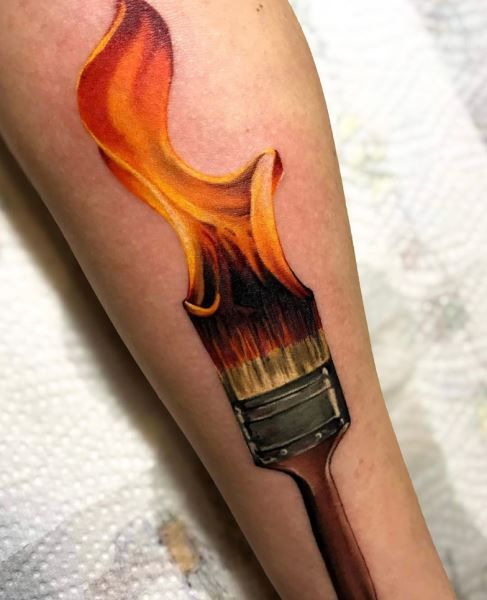
Q: Cover-up tattoos present a unique
challenge. How do you navigate the delicate balance between
understanding and managing a client's expectations while still
allowing your creative vision to flourish in these often complex
situations?
A: Before starting any cover-up project, I always begin with either
an online or in-person consultation. The first and most important
step is evaluating the existing tattoo: how old it is, where it’s
located on the body, and how much it has faded or changed over time.
This gives me a clear understanding of the technical limitations and
possibilities. Once I assess the tattoo, the client usually shares
their ideas or what they envision for the new piece. That’s when I
determine what’s realistically possible and present options for how
we can approach the cover-up. If the old tattoo is very dark or has
heavy linework, I may advise against covering it immediately and
instead recommend laser removal to lighten the area first. In cases
where the old tattoo is smaller or not too saturated, I can usually
integrate it into a larger design by placing darker elements, like
shadows or background textures, strategically over the existing
work. I always aim to design something visually strong, not just to
hide the old tattoo, but to create a new piece that looks
intentional and cohesive. Color choice is critical. Cooler
tones-like deep blues, purples, or desaturated green, tend to work
better for cover-ups. Sometimes I use warmer colors, such as deep
reds or burgundy, but only when paired with the right contrast. I
pay close attention to how the values and color blocks are
distributed so the cover-up blends naturally and doesn’t look like
one part is unnaturally dark while the rest is overly light, a
common mistake that makes the piece look unbalanced or obviously
like a cover-up. Ultimately, I only accept cover-up projects when
the client trusts my process and is open to working within the
limits of what’s possible. If the client has unrealistic
expectations or insists on something that won’t work technically or
artistically, I prefer to be honest and recommend laser removal
first. For me, the goal is not just to mask the old tattoo, but to
create something beautiful and satisfying that both the client and I
can be proud of.
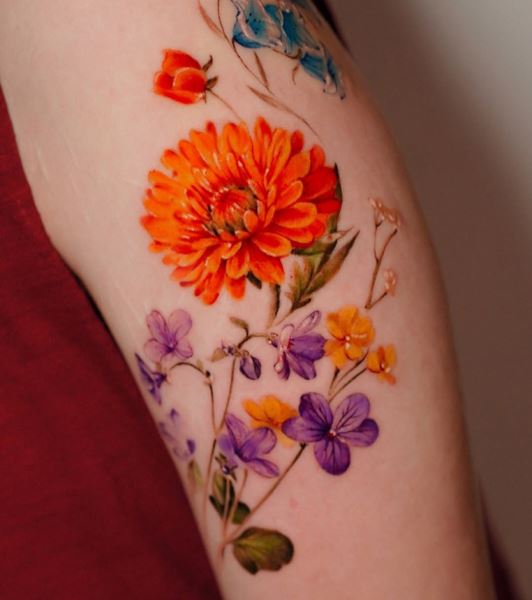
Q: As artists often evolve, have you ever
considered exploring or incorporating elements from other tattoo
styles into your work?
A: Honestly, when I first started tattooing, I spent a lot of time
exploring different styles. I tried a variety of approaches and
designs, which helped me understand what truly resonated with me and
what didn’t. Now, I mainly work in the styles I genuinely enjoy, but
I still occasionally incorporate elements from other genres. For
example, as I mentioned earlier, I often mix realism with graphic or
ornamental details, like creating realistic flowers paired with
linework leaves, or adding subtle ornamental patterns to enhance the
overall composition. I use these stylistic blends when I feel they
help express the client’s idea more clearly or bring more depth to
the piece. At this stage in my career, I feel quite close to the
direction that reflects my vision. That said, I’m still exploring
certain things, like refining my color palette and possibly focusing
more consistently on specific tones or moods in my work. So yes,
evolution is always ongoing, just in a more intentional and nuanced
way now.
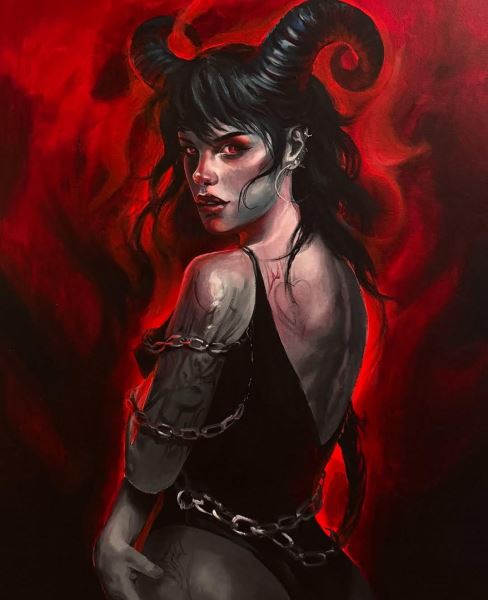
Q: I'm so drawn to your paintings. They have such a unique
quality. Are they available for purchase, perhaps for someone
looking for a special piece for their home or workspace?
A: Thank you so much that means a lot. At this stage, my original
paintings aren’t available for sale. Right now, painting for me is
not about making money, but more about exploring emotions,
techniques, and personal growth as an artist. Until recently, I
mostly worked with acrylics and sometimes created pen sketches,
which I really enjoyed. Lately, I’ve shifted toward oil painting,
and I’m currently exploring this medium. Oil allows for much more
depth, texture, and color complexity, and I feel it gives me greater
freedom to express subtle emotions and inner states. At this point,
I’m focused on experimentation, playing with color transitions,
light, and mood. In the past, when I lived in Ukraine, I
occasionally sold paintings, not as a business, but more as a way of
sharing something meaningful when someone connected with the work.
Today, I feel more inclined to keep many of my pieces, possibly for
a future exhibition or as part of a personal archive. That said, I’m
planning to make prints and posters of some of my paintings in the
near future. I’d love to make the artwork more accessible for people
who connect with it, whether it’s for their home, studio, or
workspace.
Q: Building and maintaining client trust
is paramount in the tattoo industry, requiring both artistic
excellence and ethical practice. In your experience, what core
principles are most essential for cultivating and preserving a
strong reputation?
A: Building and maintaining trust with clients is one of the most
important aspects of being a tattoo artist, and I take it very
seriously. Artistic skill is only part of the equation. Just as
essential are consistency, honesty, empathy, and treating people and
their stories, with genuine respect. For me, trust is built not only
through the quality of the tattoo itself, but also through how I
communicate, how I listen, and how I guide the client through every
stage from consultation to the final healing process. Many clients
come to me with deeply personal ideas, sometimes tied to emotional
or painful experiences, and I see it as my responsibility to create
a safe, respectful space for that. What means a lot to me is that
clients often travel from other cities just to get tattooed by me.
Many of them come based on recommendations or because they’ve seen
the work I’ve done for friends or family. That emotional connection
and word-of-mouth trust mean everything to me and I do my best to
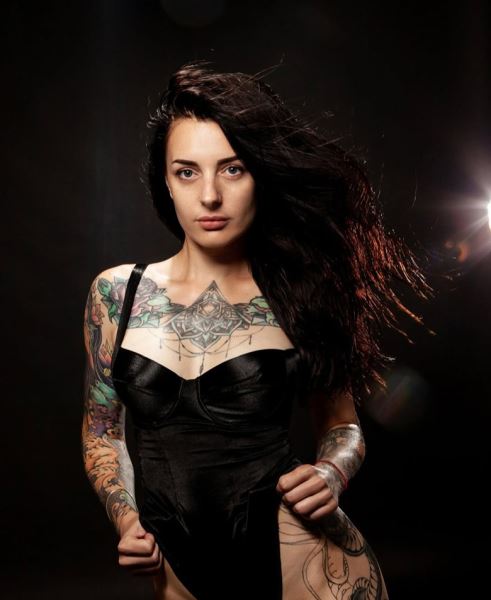
honor it fully. I’m currently based in Philadelphia, USA. You can
find my work and get in touch through my website and social media,
which I’ve linked below. I usually book appointments a couple of
months in advance, and at the moment I’m accepting bookings for
July.
Website: sulina13.com
Instagram: sulina13
TikTok: sulina13
Q: What projects or opportunities are you
most excited about pursuing, and how do you envision them
contributing to your continued artistic growth?
A: Right now, I’m focusing on taking on larger-scale projects. In
the past, most of my work has been smaller or medium-sized pieces,
but I’m currently looking to create more full sleeves, full-leg
tattoos, and back pieces. I’m especially excited about doing these
in color with rich transitions, atmospheric backgrounds, and
possibly some watercolor-inspired elements while keeping a strong
focus on realism. These types of projects allow me to fully explore
composition, movement, and storytelling on a larger canvas. I see
them as an opportunity to push my technique further, challenge
myself artistically, and create work that feels immersive and
expressive not just in detail, but in overall impact.
Q: Moving from Ukraine to the USA is a significant life
transition. Could you share some reflections on your experience
living in Philadelphia?
A: Before moving to Philadelphia, I had already spent several years
living in France and had the opportunity to travel extensively
throughout Europe. That experience gave me a broader perspective on
different cultures and ways of life, and I’ve always appreciated the
diversity and creativity that come with discovering new places.
Philadelphia felt surprisingly familiar to me from the start. It’s a
very artistic city with so many spaces, communities, and events that
support creative growth. I love how it brings together so many
cultures, viewpoints, and lifestyles in one place. It’s a city with
strong character and a deep appreciation for art, and that resonates
with me. I truly enjoy living here, and I see Philadelphia as a
place where I could grow both personally and professionally
long-term. It feels like a city where I can both create and belong.
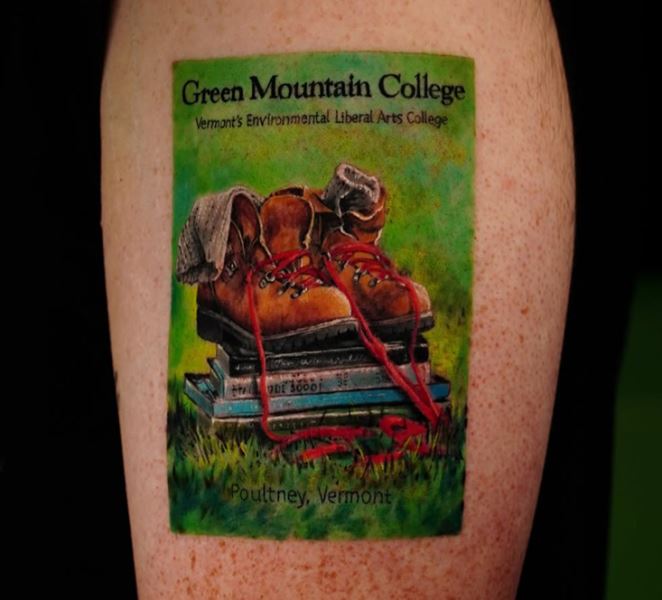
Q: Having experienced the tattoo scene in
both Ukraine and now the United States, what are some of the most
striking contrasts or unique characteristics you've observed in the
American tattoo landscape?
A: I can probably best compare the tattoo scenes based on the cities
where I’ve worked both in Ukraine and now in the U.S., specifically
in Philadelphia. One noticeable difference is the stylistic
preferences. In my hometown in Ukraine, there was a stronger focus
on realism, color work, and larger-scale projects. In Philadelphia,
while realism is certainly present, I’ve noticed a larger number of
artists working in traditional, neo-traditional, and old-school
styles. That said, the connection I’ve experienced with clients
feels very similar in both countries. The way people express their
ideas, the emotional significance behind their tattoos, and the
communication during the process have all felt familiar. In both
places, I’ve found that when the connection between artist and
client is strong, the creative process flows naturally, regardless
of where you are. There are several American tattoo artists whose
work truly resonates with me. One of them is Angela Wood. I really
admire her technical precision, especially the way she works with
color, transitions, and overall smoothness. Her tattoos are both
playful and detailed; she often creates surreal scenes featuring
frogs, mushrooms, or whimsical characters. Her approach inspires me
from a technical and stylistic standpoint. I’m also very drawn to
the work of an artist named Diana James . She primarily works in a
painterly style, and her tattoos often resemble fine art
compositions. I’ve seen many of her pieces in real life, and I’m
always impressed by how balanced and thoughtfully constructed they
are. Her projects are typically large-scale and expressive, which I
find truly inspiring. They remind me of the emotional impact a
tattoo can have when it becomes more than just a design when it
turns into a genuine artistic statement.
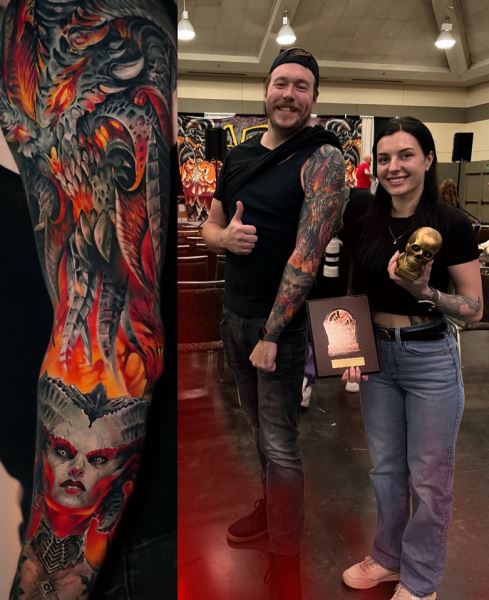
Q: Favorite career highlight?
A: One of the most meaningful highlights in my career was early on,
when I was still working in Ukraine. There was a very popular tattoo
community that regularly featured exceptional and complex work. I
remember the first time they published one of my tattoos it felt
like such a big moment for me. I had only been tattooing for about a
year or two at the time, and that recognition gave me a huge boost
of confidence and motivation. It felt like the first real
acknowledgment that what I was doing mattered. More recently, over
the past year, I’ve started actively traveling and participating in
tattoo conventions, which has also been a major step in my artistic
journey. One of the most meaningful experiences was winning first
place for Best Sleeve at the Baltimore Tattoo Convention. It was my
first award in the U.S., and it meant a lot to me, not just as
recognition, but as a confirmation that the direction I’m growing in
is the right one.
Q: What's next?
A: At the moment, I’m focused on a few long-term and short-term
goals. Looking ahead, one of my biggest dreams is to open my own
studio more than just a tattoo space, but a creative environment
where I can teach, collaborate, and invite other artists to share
their work. I’d love to build a place that feels like a true art
community. In the nearer future, I plan to continue attending tattoo
conventions and begin collaborating with artists whose work I
admire. I also want to dedicate more time to personal artistic
growth, drawing more, painting, and developing creative ideas
outside of tattooing. These are the steps I see as part of my
evolution not only as a tattoo artist, but as a multidisciplinary
creator.
Q: If you could go back and give your
younger self advice about pursuing tattooing, what would it be?
A: I could go back and give my younger self some advice, I’d say:
choose your direction earlier. Find a theme or style that truly
resonates with you and build your artistic identity around it. In
the beginning, I experimented with many styles, which helped me
grow, but I believe I would’ve progressed faster if I had focused
earlier on what felt authentic to me and avoided styles that didn’t
suit me, like certain graphic approaches. I’d also tell myself to be
more confident. To connect with other artists, ask questions, trust
my instincts, and not be afraid to claim my space as a professional.
And most importantly value your art more. When I started tattooing,
I didn’t fully realize that this could be my profession. For a long
time, it felt more like a hobby. It took time to understand that
something you love can also be your work and that it’s okay to build
your life around it. In the beginning, I gave away a lot of my work
almost like charity, either for free or at very low prices. So
another piece of advice I’d give myself is: don’t undervalue your
creativity. Respect your work, and let others learn to respect it
too.


