
Interview with Eva Ronnova
Hello Eva Ronnova! Thank you so
much for taking the time to do this interview. We really appreciate
it. You describe fine-line tattooing as an "extension of drawing and
illustration." Can you take us back to your early days in Russia?
What was the moment you realized that skin was the canvas you were
meant to work on? I’ve been drawing since childhood, and
for the five years before I started tattooing I was teaching
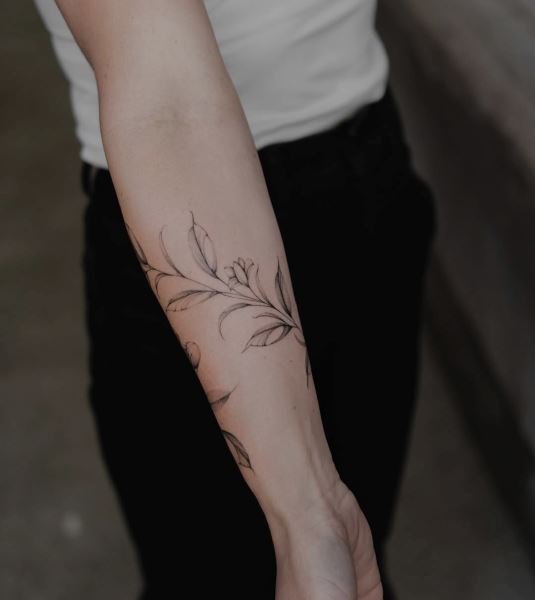
sketching and working in graphic design. When Covid began, I
happened to get my second tattoo, a fine-line leaf bracelet done
freehand. The entire process felt light and effortless, almost like
regular drawing. That was the moment I realized a tattoo machine can
feel like a pencil, and skin can truly be a canvas. Something
clicked inside me right then.
Q: Your work is incredibly delicate and refined. In the
beginning, were you always drawn to this "aesthetic" minimalism, or
did you experiment with bolder, more traditional styles before
finding your voice in fine-line?
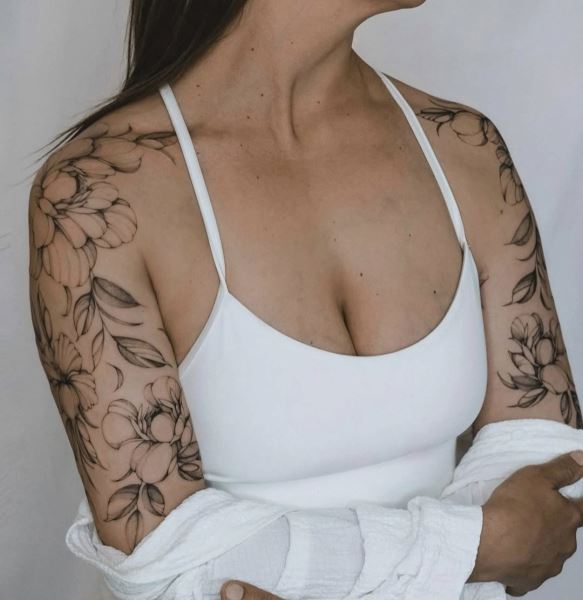
A: From the very beginning, I knew I wanted to create what I
personally felt was missing as a client: an artist who understands
the female body and creates work that enhances femininity and
delicacy rather than overpowering it. At the time, I felt that niche
wasn’t fully occupied. Many artists were working across multiple
styles, but I made a conscious decision to focus exclusively on fine
line, with flowers and botanical elements. I didn’t search for my
style, I chose it and committed to learning it from day one.
Q: Why flowers? Beyond their beauty, what
is it about botanical composition and symbolism that keeps you
inspired after five years in the industry?
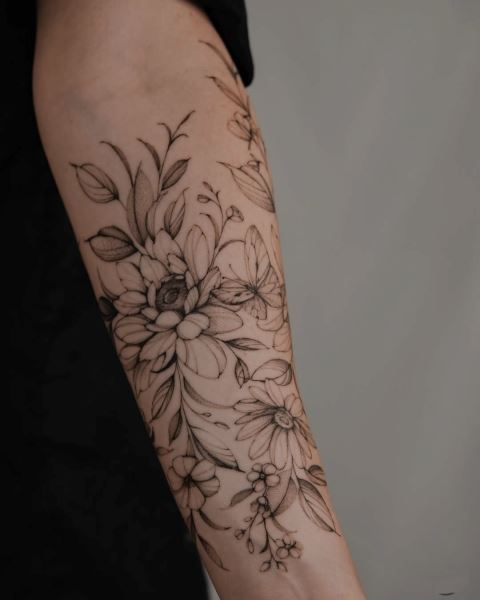
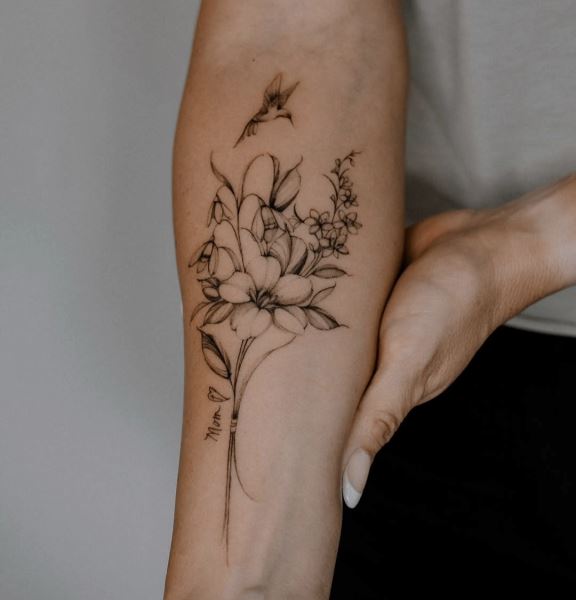
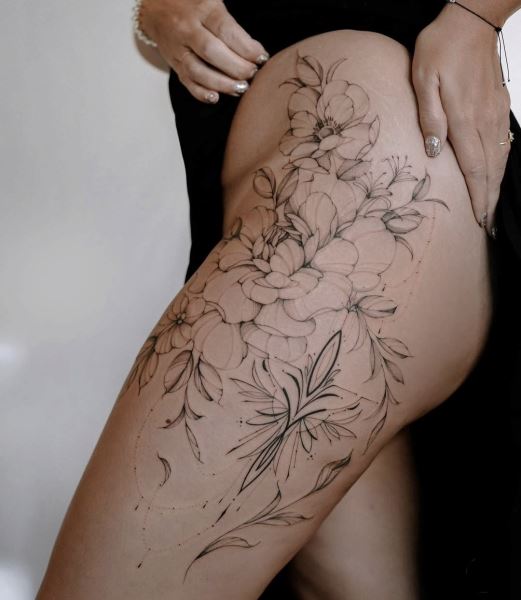
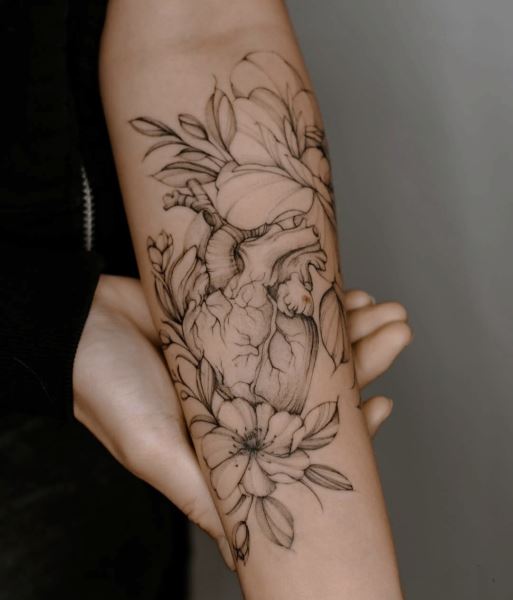
A: For me, flowers are about meaning and association. When
femininity is viewed through nature, flowers appear almost
instinctively. They are ideal for people who want something organic,
detailed, yet still light. Botanicals are endlessly diverse, which
means I never get tired of them. Even after five years in the
industry, I continue to discover new plants and forms I haven’t
worked with before, and that ongoing discovery keeps me inspired.
Q: Every artist faces a "learning wall." What was the most
significant challenge you faced while developing your technique in
Russia, and how did that shape the artist you are today?
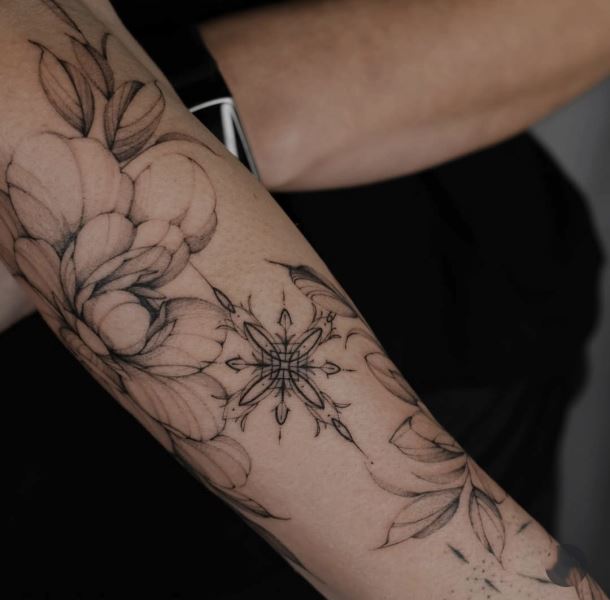
A: The most significant challenge was finding the right education. I
reached out to artists whose work I admired, but none of them
offered training. The programs that did exist were usually very
broad, realism, portraits, color work, everything at once, but not
what I was looking for. I’m very direct by nature: if I know what I
want, I’ll find a way without forcing myself into someone else’s
direction. My early education focused more on tattoo fundamentals
than fine line specifically, but my mentor respected my vision and
didn’t impose anything unnecessary. After that, I continued learning
through advanced online courses with artists who specialize in
fine-line florals and botanical work.
Q: Moving a career from Russia to the USA
is a massive leap. What were the biggest differences you noticed in
the "tattoo culture" immediately upon arriving in California?
A: In Russia, my career was developing well. Even after the war
began and Instagram became inaccessible, my schedule remained full.
At that time, I was mostly creating smaller pieces, and large
projects like sleeves were still quite rare.
When I moved to Los Angeles, I had no connections and couldn’t find
a studio where I felt supported. I had to rely entirely on myself. I
rented and set up my own private studio, launched Instagram ads, and
within a week bookings started coming in. Clients here were
genuinely drawn to my style and quality, and the level of respect
for my work feels higher. At that time in Russia, many people didn’t
yet fully understand the value of fine line and freehand tattooing.
Q: You mention that you create each piece directly on the
body rather than using pre-made designs. How does this "live
creative process" change the energy of a session for both you and
the client?
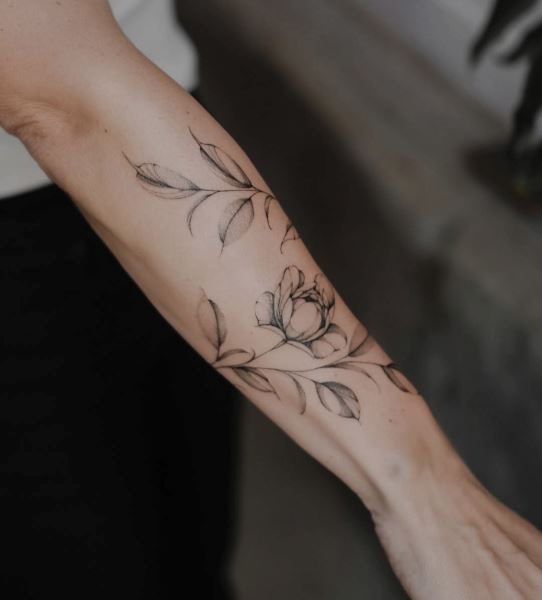
A: Because I work within one style, mainly flowers and leaves,
transitioning to freehand was essential for me. Botanical elements
naturally repeat, and I didn’t want clients wearing similar tattoos.
Stencils also often don’t fit the body correctly, which meant
reworking and reprinting anyway. Freehand allows for true
uniqueness. When I see the body in front of me, I immediately
understand the right composition and scale. We can explore different
options directly on the skin before refining details. For clients,
this creates more freedom and collaboration than working from a
fixed, pre-made design.
Q: In the US market, clients often seek
"intentional and personal body art." How do you manage the balance
between your artistic vision and the high expectations of a client
who is trusting you to freehand a permanent piece of art?
A: I always respect the client’s wishes and never push someone into
something they don’t like. At the same time, I carefully select the
projects I take on as an artist. The choice happens from both sides,
and in most cases it becomes an ideal match between two very
conscious people who want the same thing, meaningful art on the
body.
Q: Having worked as a guest artist in multiple states, how
would you describe the "American Aesthetic" compared to the European
or Russian scenes? Is there a specific trend in the US that excites
or perhaps bores you?
A: The American tattoo market is very active and constantly
evolving, which I really enjoy. There are so many styles, studios,
and formats here that it’s difficult to describe one single
“American aesthetic.” When I travel and work in different studios, I
enjoy being around artists who work in other styles. There’s a
strong sense of mutual respect, we admire each other’s work and
support one another.
Q: You mentor and train other artists
through educational programs. What has teaching taught you about
tattooing? Does explaining your technique to a student ever make you
rethink or refine your own process?
A: Teaching has helped me look much more deeply at what I do. Every
student is different and requires an individual approach, so I often
explain the same technique in different ways until it truly makes
sense to them. This process has refined not only how I teach, but
also how I understand and apply my own technique.
Q: Is everyone welcome there from the get go or the
candidates need prior formal training or experience?
A: I work only with artists who already have experience. At the
moment, I offer individual trainings (one or two days), group
workshops focused on live demonstration, and I’m currently
developing an online course scheduled to launch in March 2026. In
individual training, I share everything I know and focus on the
student’s specific challenges rather than following a standard
program. Before the training, I send a detailed questionnaire and
prepare based on their answers. I approach education openly and
deeply, and I truly believe tattoo artists are colleagues, not
competitors.
Q: Fine-line is currently experiencing a massive surge in
demand. Do you see this as a permanent shift in how we view body
art, or do you think the industry will eventually swing back toward
more traditional, heavy-saturated styles?
A: I don’t think fine line is a trend, it’s a foundation. It has
already become an inseparable part of the tattoo industry and will
continue to evolve and expand. Styles may change, but fine line as a
language and approach is here to stay.
Q: Are you going to experiment with other
tattoo styles?
A: At this stage, I’m not interested in experimenting with other
tattoo styles. I prefer to go deeper rather than wider, to refine
and develop fine line and botanical work instead of spreading my
focus across multiple directions.
Q: Every person's skin holds ink differently. When you are
working with such thin lines, how do you adjust your technique on
the fly when you encounter skin that is particularly thin, elastic,
or sun-damaged?
A: I always analyze the skin before I begin working. There are
several parameters I adjust depending on the skin - depth, pressure,
needle size, and sometimes even pigment choice. If the skin is
sun-damaged, it’s often not suitable for tattooing at all, because
the upper layers may shed and take the tattoo with them. That’s why
it’s also important to educate clients in advance on how to prepare
their skin properly so the final result is high quality and
long-lasting.
Q: There is a common misconception that
fine-line tattoos 'disappear' after a few years. Looking at your
work from five years ago, what have you learned about how fine lines
age, and how has that changed the way you design your pieces today?
A: It’s essential to understand how skin works, its layers and the
correct depth for tattooing. Fine-line tattoos usually “disappear”
only when they are done too shallow. Early in my career, during the
first year or year and a half, I had to retouch around 50% of my
work. Today, almost none of my tattoos require correction, except
for fingers. Once you truly understand how to work with skin,
healing becomes predictable, and the tattoos age beautifully,
staying dark and clear over time.
Q: Without heavy black shading or bold outlines, how do you
create 'depth' in a flower so it doesn't look flat as it heals and
settles into the skin over time?
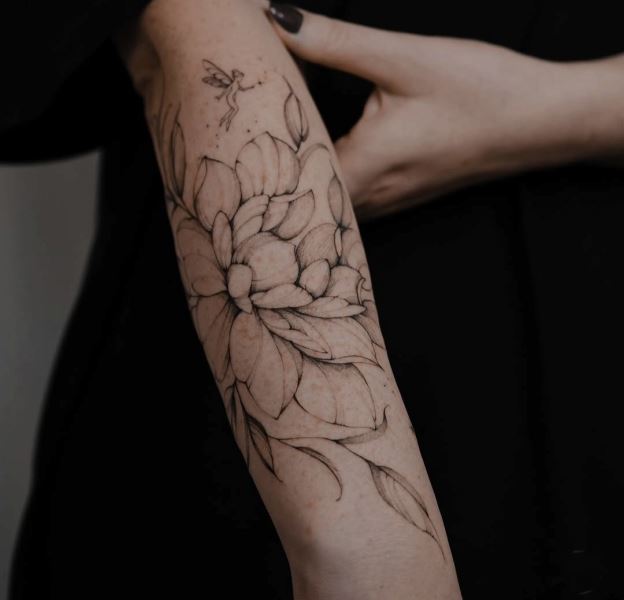
A: Contrast doesn’t come only from bold, heavy black lines. There
are many techniques that allow you to create depth while using a lot
of skin and negative space. Layering, variation in line weight,
different saturation levels, and different needle groupings all play
a role. When working with flowers and plants, it’s crucial to
understand what you’re doing and why each line exists. Just like in
portrait work, you need to understand anatomy - in this case, the
anatomy and proportions of a flower, to create a balanced and
beautiful composition.
Q: Sometimes clients want an impossible
amount of detail in a very small space (the 'Micro' trend). How do
you handle the conversation when you have to tell a client that a
design won't hold up technically in the style they want?
A: I always explain clearly how much detail can realistically fit
into the size a client wants. I walk them through why something may
or may not work technically and visually, and then I offer
alternatives, adjusting scale or simplifying elements while still
respecting their original own idea. Most clients trust that
explanation. If they don’t, I simply don’t take the project.
Q: Because fine-line work is so delicate, do you find you
have to be more 'strict' with your clients regarding aftercare
compared to traditional artists? What is the one thing they usually
get wrong?
A: Healing is an important part of any tattoo. I provide very
detailed information on what clients should do before and after
their session to preserve the quality of the work. I always explain
aftercare instructions clearly and why each step matters. Because of
that, there are usually no issues, clients feel informed and
confident in how to take care of their tattoo.
Q: What your "dream" piece would look like? Are you open to
do a collaborative tattoo with another artist?
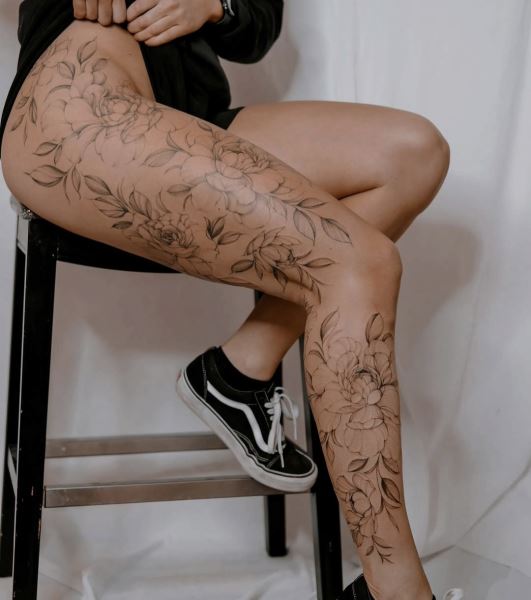
A: My dream project would be a very large-scale piece, something
that connects the leg, back, and arm, or possibly a symmetrical
composition across the torso, chest, sides, and hips. I would love
to work on something that covers a significant portion of the body,
using florals on a much larger scale than I typically do. I’ve
created many sleeves and thigh pieces, but working on a large back
that flows into the legs or across the body would be both
challenging and incredibly beautiful.
Q: Now that you’ve established yourself in
the US, what is one thing you love about the US tattoo industry, and
conversely, is there anything you miss about the way things are done
back in Europe or Russia?
A: In my case, the US has given me an enormous opportunity for
growth. It’s a highly competitive market, and I enjoy that
challenge, especially being surrounded by top-level artists. It
pushes me to grow faster and develop further than I would in a
comfort zone. The industry here is constantly evolving, with new
artists emerging all the time, which keeps you learning and moving
forward. For me, the US has become a platform for continuous
development, and my main focus is building my future here.
Q: US tattoo culture is often heavily influenced by social
media. Have you noticed any specific American trends in botanical or
fine-line art that you find yourself adapting to, or do you prefer
to stick strictly to your original European-influenced aesthetic?
A: I think social media works more or less the same way in Europe
and the US. The algorithms are similar everywhere, and people often
do the same things. I try to focus on showing work that truly
reflects what I do, my process, especially freehand, the fact that I
can work outside the studio, and create visual content in nature.
These kinds of trends exist in fine-line floral work both in Europe
and the US, and they feel organic rather than forced. If I see a
beautiful concept that aligns with my aesthetic, I may adapt it, but
I do this selectively and not very often.
Q: You’ve participated in major
international events like the Berlin Tattoo Convention and planned
visits to others like the Empire State Expo. How do these
high-energy US conventions compare to the European ones you’ve
attended?
A: I’ve only participated in one convention in the US, the All Stars
Tattoo Convention in Miami and it was my first experience.
Unfortunately, it was also quite disappointing. The industry still
seems heavily focused on traditional tattooing, with much less
attention given to aesthetics and styles like fine line. Fine line
is rarely presented as a separate category, which makes it difficult
for me to find conventions I genuinely want to participate in or
even attend as a visitor. At the moment, that kind of representation
is still very limited in the US convention scene.
Q: Beyond just tattooing at conventions, you are active in
the guest-artist circuit. What is the most valuable thing you’ve
learned from a peer during your time working as a guest artist?
A: Working as a guest artist showed me that I can find my audience
anywhere, regardless of the state or studio. It opened up much more
freedom for work, travel, and even choosing where to live. Not many
professions allow you to move and work at the same time. It also
gave me valuable connections within the industry. For a long time, I
worked alone without close contact with other artists. Through guest
spots, I met many strong tattoo artists, and some of those
relationships turned into real friendships where we exchange
experience, advice, and support. I truly value that, and it became
possible only through guest work.
Q: Please write down your studio location and website/social
media links. Also let us know if you are available.
A: I work from a private studio in Joshua Tree, California. My
Instagram is @tyler_eva, and my booking website is
https://tylereva.taplink.ws.
I am currently available for bookings.
Q: As a teacher and mentor, how do you
advise your students to handle the high expectations of the modern
US client, who often comes in with very specific ideas they found
online?
A: I always advise my students to focus on developing their own
individual style. There’s nothing wrong with clients coming in with
specific ideas they found online, that’s the most natural way for
them to search for inspiration. A client may bring a reference from
Pinterest or another artist’s Instagram, but they come to you for a
reason. Your job is not to copy, but to interpret their idea through
your own experience, technique, and style. That’s the core of the
artist - client relationship. When you have a strong portfolio and a
clear personal style, clients will trust you. If that trust isn’t
there yet, the focus should be on strengthening your portfolio.
Q: What impact do you aspire to have on the tattoo
community?
A: I would like to continue sharing the idea that we are not
competitors, but colleagues, and that there are enough clients for
everyone. There’s no need to fight over clients, the focus should be
on improving quality and developing individuality, and the right
clients will find you naturally. I hope the industry becomes less
toxic and more supportive, with artists being open to communication
and exchange rather than conflict. Personally, if I see an artist
whose work I genuinely admire, I support them openly. I believe that
kind of openness and mutual respect matters.
Q: If you could go back and give your younger self advice
about pursuing tattooing, what would it be?
A: I would tell my younger self not to be afraid, to stay true to
the original idea I had, to trust myself, and to keep working and
growing without giving up.
Interview: Ivana Kancheska
Date: 04 February 2026
Read our second interview with Eva Ronnova.


